In 1845, two Royal Navy ships sailed into the Arctic with 129 men aboard, searching for the elusive Northwest Passage. The HMS Erebus and HMS Terror never returned, disappearing into one of the most unforgiving environments on Earth. For more than 160 years, their fate remained a mystery pieced together from scattered clues and Inuit testimony. Then, in 2014 and 2016, the wrecks were finally found, giving researchers an extraordinary opportunity to revisit one of history’s greatest exploration mysteries.
The Two Ships That Vanished Into the Arctic
How can two fully equipped ships—and 129 men—simply disappear?
In 1845, two Royal Navy ships left Britain on a mission that was supposed to make history. The HMS Erebus and HMS Terror, carrying 129 officers and crew members, were heading into the Arctic in search of the elusive Northwest Passage—a sea route connecting the Atlantic and Pacific through the Canadian Arctic.
The expedition was led by Sir John Franklin and represented one of Britain’s most ambitious attempts to conquer one of the world’s great geographical mysteries. The ships were well equipped, experienced sailors were on board and the mission had the backing of the Royal Navy.
Then, they vanished.
Neither ship returned. Not a single member of the expedition survived to tell the full story. As months turned into years, search parties were sent into the Arctic, following fragments of information and reports from Indigenous communities. They discovered traces of the expedition, but the ships themselves remained hidden beneath or within the vast Arctic landscape.
The disappearance became one of the great mysteries of 19th-century exploration. How could two large, fully equipped ships disappear along with an entire expedition in an area that was being actively searched?
For decades, the fate of Franklin and his crew remained a puzzle assembled from scattered clues—written notes, abandoned equipment, human remains and oral accounts. Some theories were later supported by evidence; others became part of the mythology surrounding the expedition.
But the strangest part of the story was still to come.
More than 160 years after the ships disappeared, modern technology would finally locate the wrecks of both vessels.
And when they were found, they offered historians something they had been missing for generations: physical evidence of what happened in the Arctic.

The Expedition That Was Supposed to Make History
A Mission Into the Unknown
When Sir John Franklin set out in 1845, the expedition was intended to accomplish what generations of explorers had failed to do: complete the remaining unknown section of the Northwest Passage.
The two ships, HMS Erebus and HMS Terror, had been specially prepared for the Arctic. They were experienced vessels, equipped for a long voyage through some of the most challenging waters on Earth. The expedition left Britain in May 1845, carrying 129 officers and crew members under the command of Franklin.
This was not an improvised adventure by inexperienced explorers. It was a major Royal Navy expedition, backed by one of the world’s most powerful naval forces. The ships were carefully provisioned, and expectations were high. That made what happened next even more extraordinary.
What really happened to the Franklin Expedition? Watch this video to uncover the mystery behind the vanished explorers—and the shocking discoveries that finally revealed their fate.
Then the Arctic Closed Around Them
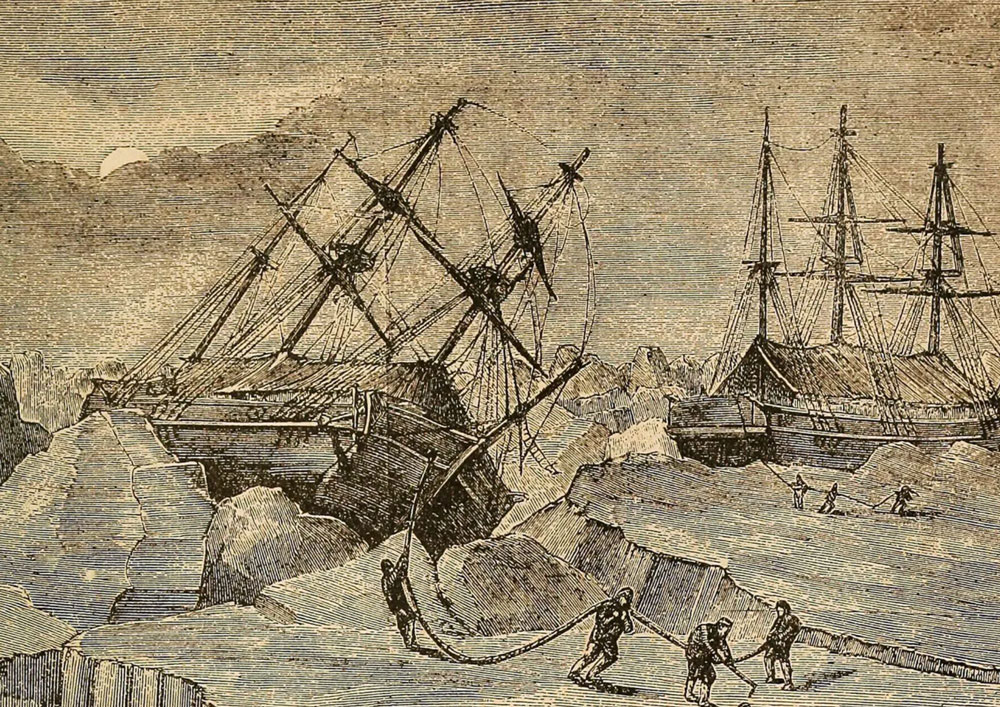
The expedition entered the Canadian Arctic, but the environment proved far less forgiving than the planners had hoped. The ships became trapped in sea ice and spent the winter of 1846–1847 frozen in place.
Franklin died in June 1847. By the following year, the situation had become desperate. The ships remained trapped, and in April 1848, the surviving members of the expedition abandoned them and began attempting to travel south on foot.
A note left behind recorded that 105 men remained when the ships were abandoned. They carried limited supplies into an enormous and unforgiving landscape, attempting to reach safety across hundreds of miles of Arctic terrain.
None of them survived.
The expedition that had set out with the ambition of making exploration history had instead become one of its greatest mysteries.
And that left investigators with an extraordinary question: If the ships were abandoned, where did they go—and why did nobody find them?

The Clues Were There—But They Were Hard to Understand
A Note, Scattered Remains and Inuit Testimony
The first search parties did not return empty-handed. Over the decades, they discovered fragments of the Franklin expedition scattered across the Arctic: written notes, abandoned equipment, human remains and traces suggesting that survivors had attempted to travel south after leaving the ships.
One of the most important discoveries was a note left behind in a stone cairn. It recorded that the Erebus and Terror had remained trapped in the ice and were eventually abandoned in April 1848. By then, Franklin himself had already died, and the surviving members of the expedition were facing an increasingly desperate journey south.
But some of the most valuable clues came from a source that European searchers initially struggled to fully appreciate: Inuit knowledge.
Inuit hunters and communities had observed the expedition’s movements and later provided accounts of ships, camps and abandoned equipment in the region. Their knowledge of the Arctic landscape, sea ice and travel routes proved crucial to later searches for the wrecks.
The Mystery Became Bigger Than the Evidence
As the years passed, the missing expedition generated theories about what had happened. Starvation, disease, extreme cold, lead exposure and even cannibalism all became part of the story.
Some of these possibilities were supported by evidence, while others were exaggerated or sensationalized as the mystery grew. The reality was almost certainly more complicated than a single dramatic explanation.
The expedition faced multiple problems at once: worsening weather, dwindling supplies, prolonged exposure to extreme conditions and the enormous difficulty of traveling across the Arctic on foot.
For generations, investigators had pieces of the puzzle but lacked the technology—and sometimes the context—to connect them.
The Arctic had preserved the clues—but for generations, nobody knew how to put them together.
More Than 160 Years Later, the Ships Finally Reappeared
Erebus Was Found First
For more than a century and a half, the locations of the two abandoned ships remained one of the great unanswered questions of Arctic exploration. Then, in 2014, a Canadian search expedition finally found the wreck of the HMS Erebus beneath the waters of the Canadian Arctic.
The discovery was the result of modern technology combined with years of historical research and knowledge of the region. Sonar helped search the seafloor, while marine archaeologists examined the wreck’s structure and features. Its location and physical characteristics were then compared with historical information about the ship.
After 166 years, a vessel that had disappeared into the Arctic had finally been seen again.
A ship lost in 1848 had finally been found.
The discovery was extraordinary not only because of the wreck itself, but because it provided something previous generations of investigators had never had: a physical site that could be studied directly.
Then Terror Was Found
The story became even more remarkable two years later.
In 2016, researchers located the wreck of the HMS Terror, completing the discovery of both ships from Franklin’s lost expedition. The wreck was found roughly 40 miles from Erebus, remarkably well preserved beneath the Arctic waters.
After more than 160 years, the two vessels that had vanished with 129 men were no longer simply names in historical records. They were tangible archaeological sites.
But finding the ships did not suddenly explain everything.
Instead, the wrecks created new questions. Why did the ships end up where they were found? What happened after the expedition abandoned them? How did the vessels move through the ice? And what might their remarkably preserved interiors reveal about the final days of the expedition? Finding the ships answered one question—but opened many more.

What the Wrecks Changed About the Franklin Mystery
The Ships Became Time Capsules
Finding the Erebus and Terror changed the Franklin story because researchers could finally study the expedition’s physical remains rather than reconstructing everything from scattered clues on land. The wrecks became archaeological time capsules, preserving evidence about the ships’ condition, equipment and final circumstances.
Objects left aboard can reveal details that written records cannot. The position of the vessels can also help researchers understand what happened after the expedition became trapped in the Arctic, while the condition of the wrecks offers clues about how they survived—and eventually sank.
For more than a century, the Franklin expedition had existed somewhere between documented history and legend. The discovery of the ships helped move the story firmly toward archaeology.
The Mystery Is No Longer Just About Franklin
At first, the central question seemed simple: What happened to the Franklin expedition?
After the wrecks were found, the question became much more interesting: What can archaeology, science and Indigenous knowledge tell us about what really happened?
Modern technology made it possible to locate and examine the wrecks. Historical records provide the context for interpreting what researchers find. Inuit knowledge contributed crucial information about the Arctic landscape and the expedition’s movements. Meanwhile, forensic research, including DNA analysis, has helped researchers identify some of the expedition’s members and investigate what happened to them.
No single source can explain the entire mystery. The written records are incomplete, the Arctic preserved some evidence while destroying other clues, and later accounts sometimes mixed fact with speculation.
That is what makes the Franklin expedition so fascinating. The Arctic mystery survived for centuries because no single source could explain it. Solving it required many kinds of knowledge to come together.
The Ships Were Found. The Story Is Still Unfinished.
In 1845, the HMS Erebus and HMS Terror sailed from Britain carrying 129 men into the Arctic. None of them returned. For more than 160 years, the two ships existed only through fragments of historical records, rumors, Inuit testimony, scattered artifacts and the efforts of countless search parties.
Then, remarkably, the wrecks began to reappear. Erebus was found in 2014, followed by Terror in 2016. What had once seemed like an unsolvable mystery suddenly had physical evidence waiting beneath the Arctic waters.
But the greatest achievement was not simply finding two lost ships. It was discovering how many different kinds of knowledge could work together to reconstruct a story that had been incomplete for generations.
- History provided the records.
Inuit knowledge provided crucial understanding of the Arctic landscape.
Archaeology revealed what remained aboard the ships.
Sonar and modern technology helped locate what had been hidden for centuries.
DNA and forensic research continue to reveal details about the people who disappeared.
The Franklin expedition therefore remains more than a story about a failed journey. It is also a reminder that history does not always survive in one complete record. Sometimes, it has to be rebuilt piece by piece.
The Arctic kept the ships hidden for more than a century and a half. But it never completely erased their story.
The discovery of HMS Erebus and HMS Terror finally answered one of the biggest questions surrounding the Franklin expedition, but it did not end the mystery. Instead, the wrecks opened a new chapter in which archaeology, Inuit knowledge, historical records and modern technology could work together to reconstruct what happened. More than a century and a half after 129 men vanished into the Arctic, their story continues to emerge piece by piece. The ships were lost—but the evidence they left behind was never completely gone.