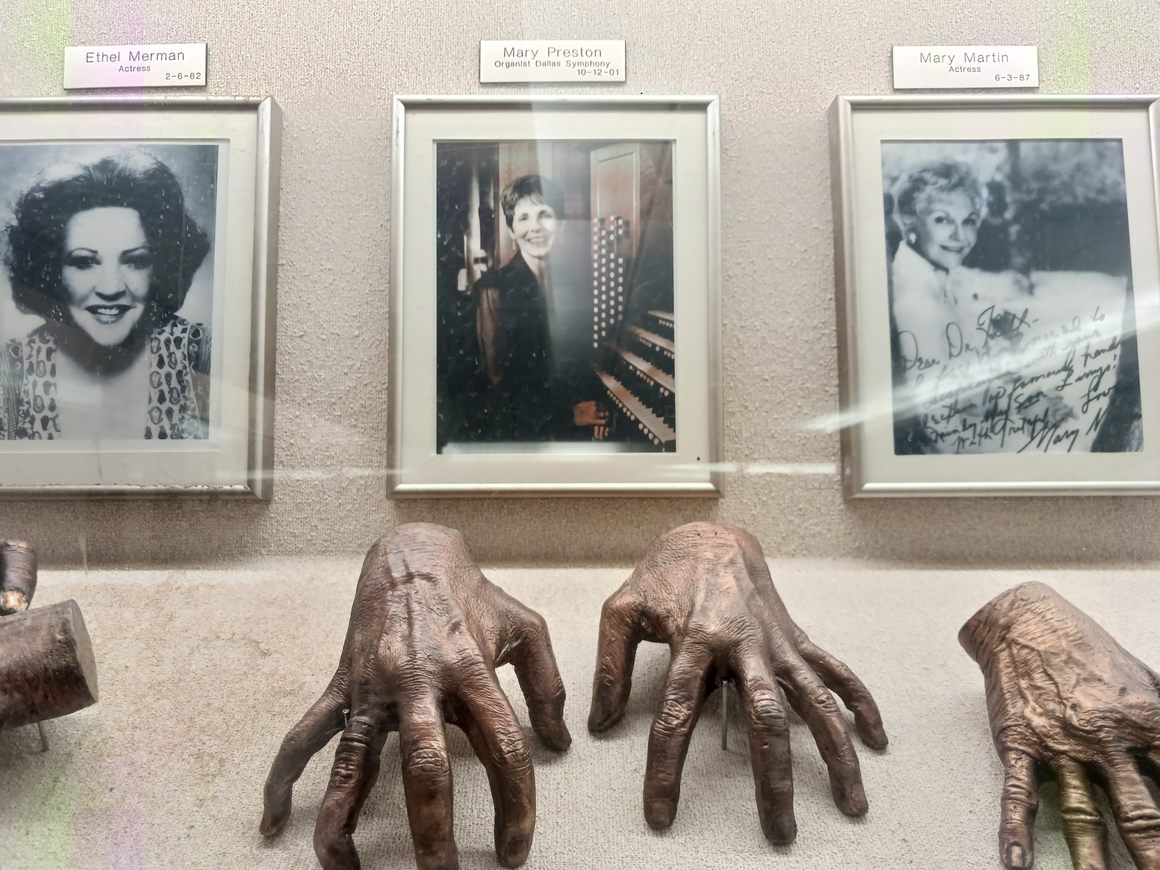
Walk into a hospital in Dallas and you might expect to see medical equipment, patients, or portraits of distinguished physicians. Instead, near the entrance of Baylor University Medical Center, visitors can encounter something far stranger: glass cases filled with bronze casts of human hands belonging to presidents, astronauts, athletes, musicians, surgeons, and entertainers. The collection began as a medical tool in the hands of Dr. Adrian E. Flatt and eventually became one of Dallas’s most unusual historical exhibits.
It Started With Medicine, Not Celebrity
Adrian E. Flatt was born in England in 1921 and became an influential orthopedic and hand surgeon after studying medicine at Cambridge and training in surgery and orthopedics. His interest in casting hands began for a practical reason: he used molds of patients’ hands, particularly children with congenital abnormalities, to help visualize their anatomy and plan surgical procedures. What began as a clinical technique gradually became a lifelong fascination with the extraordinary variety of the human hand.
During the 1950s, Flatt began making casts of fellow surgeons as well. He eventually assembled casts of 24 surgeons, using them to challenge the idea that there was a recognizable thing called a typical “surgeon’s hand.” In a later interview, Flatt explained that the surgeons’ hands differed dramatically in size and shape, reinforcing his view that the skill of surgery came from the mind and training rather than from some special physical hand.
That realization changed the collection forever. If every surgeon had a different pair of hands, perhaps hands could tell stories about people without actually revealing their professions. Flatt began wondering what the hands of famous scientists, musicians, athletes, political figures, and entertainers would look like—and the medical collection slowly became something much more unusual.
Discover the unique Adrian E. Flatt, M.D. Hand Collection! This Dallas gem features hand casts from presidents, astronauts, and sports legends. Curious how a surgeon turned a medical tool into an artistic masterpiece? Watch the video to explore this fascinating and truly one-of-a-kind exhibit!
Then the Famous Names Started Appearing
Beginning in the 1960s, Flatt expanded beyond the medical community and began casting the hands of well-known public figures. The collection eventually grew to more than 120 individuals and included former presidents, actors, athletes, scientists, musicians, astronauts, and other prominent personalities. Early celebrity casts included presidents Dwight D. Eisenhower and Harry S. Truman, while later additions included figures such as Walt Disney, Mickey Mantle, Dr. Seuss, and many others.
What makes the collection so strange is that the hands often do not look particularly extraordinary. A photograph tells you what a famous person looked like, while a hand cast captures something much more intimate and physical. David Copperfield’s hands, for example, look relatively ordinary despite the extraordinary things he has done with them; André the Giant’s are impossible to miss simply because of their scale.
The collection also created unexpected visual contrasts. Wilt Chamberlain’s large hands could be displayed near the much smaller hands of jockey Willie Shoemaker, while musicians’ hands offered a completely different range of proportions and shapes. The result was less like a conventional celebrity museum and more like a three-dimensional catalogue of human anatomy attached to remarkable lives.
How Do You Preserve a Famous Person’s Hand?
The process was surprisingly practical. Flatt used a molding material similar to the resin dentists use when making impressions, placing the hand into a container and allowing the material to capture its shape. Once the mold was removed, it could be used to create a detailed cast, which was then finished and, in many cases, bronzed for long-term display.
The technique allowed Flatt to preserve tiny details that made individual hands recognizable. CBS Texas reported that the collection’s casts could reproduce details as fine as the Claddagh ring worn by Walt Disney, demonstrating how precise the impressions could be. For André the Giant, however, an ordinary shoe box was obviously insufficient; a much larger container was required simply to accommodate his enormous hand.
The process also explains why the collection feels so strangely personal. A bronze hand is neither a portrait nor a conventional statue. It is a physical record of someone’s actual proportions, joints, fingers, and gestures, preserved at roughly the scale in which that person lived.
Presidents, Athletes, Artists—and One Remarkable Hospital Lobby
The collection became particularly unusual because of the range of people represented. Public figures connected to American politics sit alongside athletes, entertainers, astronauts, musicians, surgeons, and international leaders. Among the collection’s documented subjects are seven former U.S. presidents, while another medically significant example is former Philippine president Corazon Aquino, whose hands were cast during her 1989 visit to Dallas.
The Aquino story reveals how seriously Flatt approached the project. During Aquino’s state visit to the United States, a physician who knew her helped arrange the casting, and Flatt brought his equipment to her hotel suite in Dallas. Her bronzed hands are now displayed alongside those of former British prime minister Margaret Thatcher, turning a moment from an international political visit into a permanent medical and historical artifact.
By the time the collection was established at Baylor University Medical Center, it had become something far beyond a doctor’s private hobby. The hospital has displayed the collection since 1982, and medical publications have described it as one of the most visible legacies of Flatt’s career. What began as anatomy for surgical planning had become a public exhibition of hands connected to some of the twentieth century’s most recognizable figures.
Why Are Hands So Fascinating?
The collection becomes more interesting when the novelty wears off. Hands are among the most ordinary parts of the human body, yet they are also the instruments through which people perform much of what makes them memorable. They write, operate, build, play instruments, climb mountains, shake hands, hold trophies, perform surgery, and create objects that did not exist before.
That is why Flatt was fascinated by them. In a recorded interview, he rejected the idea that there was such a thing as a special physical “surgeon’s hand” and instead emphasized how different hands could be from one another. He also compared the hands of musicians, noting how dramatically their shapes could vary even though all were capable of producing remarkable results.
There is also a deeper cultural reason. Hands have long carried symbolic meanings across societies, from gestures of blessing and greeting to protective symbols such as the hamsa and the Brazilian figa. Atlas Obscura’s recent account of the collection points to this wider symbolism and asks why humans attach such significance to an ordinary body part that is also the physical agent through which thoughts become actions.

The Collection Turns Fame Into Something Physical
Celebrity usually exists at a distance. We see famous people on television, in photographs, on screens, or from across a stage, but rarely encounter anything physically connected to them. Flatt’s collection reverses that relationship: instead of showing another photograph of a famous person, it preserves a small piece of their physical individuality.
That is particularly powerful because the hands often look surprisingly normal. The cast does not show the audience that someone was a champion, a president, a world-famous entertainer, or a groundbreaking surgeon. Without the photograph beside it, a bronze hand may be almost impossible to identify. The meaning comes from the life attached to it, which turns a simple anatomical object into a historical artifact.
The collection therefore sits somewhere between medicine, art, biography, and curiosity. It can feel eerie at first because dozens of bronze hands appear to have been detached from their owners, but the longer you look, the more the exhibition becomes a reminder that extraordinary lives are carried out through remarkably ordinary bodies.
The Doctor’s Strange Legacy
Dr. Adrian E. Flatt died in 2017 at the age of 96, leaving behind an important legacy in hand surgery as well as the unusual collection that bears his name. More than 120 casts preserve the hands of people whose achievements range from medicine and politics to sports, music, exploration, and entertainment. The collection remains at Baylor University Medical Center in Dallas, where its unusual combination of medical science and human history continues to attract attention.
What makes Flatt’s legacy memorable is precisely the strange path it took. A surgeon began making casts because they helped him understand difficult hands; then he became curious about the hands of other surgeons; eventually he began preserving the hands of remarkable people from around the world. A practical medical technique had quietly transformed into a museum unlike almost any other.
Perhaps that is the real reason the collection survives in people’s memories. It does not preserve fame in the usual way. It preserves the physical tools through which famous people did the things that made them famous. In a hospital filled with modern medicine, that may be the strangest tribute of all.
Dr. Adrian E. Flatt’s hand collection began with medicine but evolved into something far more memorable. By preserving the hands of presidents, athletes, artists, surgeons, and entertainers, he created a physical record of people whose achievements are usually remembered through photographs and stories. The collection remains fascinating because the hands themselves look ordinary, yet each one is connected to an extraordinary life. In the end, Flatt preserved more than anatomy—he preserved a small piece of history.
This article was developed from Atlas Obscura’s account of the Adrian E. Flatt Hand Collection, biographical and historical records published by Baylor University Medical Center, and reporting from CBS Texas and D Magazine on the collection and its unusual casting process. Source: https://www.atlasobscura.com/articles/posts/the-doctors-got-a-bit-of-a-hand-fetish