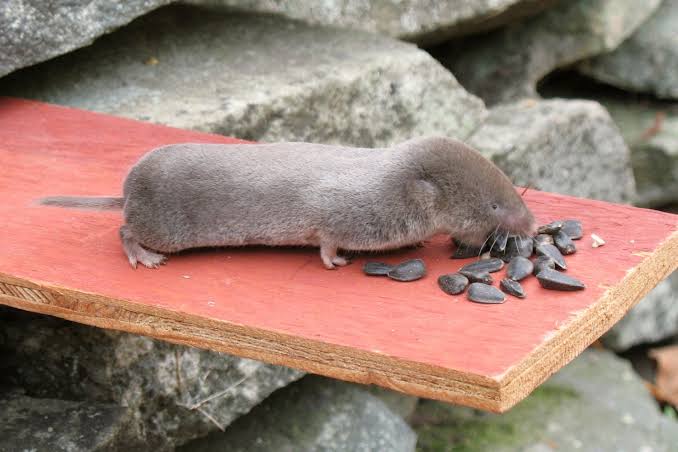
Imagine surviving winter by making your brain smaller while making your nose bigger. That is what researchers found in the long-clawed shrew, a tiny mammal from Hokkaido, Japan, whose skull changes with the seasons. The reason is not fully settled, but the leading explanation is that the enlarged snout may help the animal deal with freezing air while its braincase is at its smallest.
This Animal Already Had a Very Strange Winter Strategy
Scientists have known about Dehnel’s phenomenon since Polish biologist August Dehnel described it in 1949. In several small mammals, including shrews, the skull, brain and other body structures can shrink during winter and then regrow when conditions improve, apparently reducing the energy required to survive when food is scarce.
The long-clawed shrew, Sorex unguiculatus, lives in Hokkaido, where winters can be severe. Researchers had reason to expect the species to show the familiar seasonal reduction, but they had far less information about how shrews in northeastern Asia change because those populations have been relatively understudied.
So Yugo Ikeda of Toyo University and his colleagues turned to an unusual archive: 136 shrew skulls collected in Hokkaido between 1948 and 1988 and preserved at the Botanic Garden of Hokkaido University. Because repeatedly measuring live wild shrews would be extremely difficult, the specimens allowed the researchers to compare animals collected throughout the year.
Its brain actually shrinks during winter—then grows back when spring arrives. Watch the video below to see this bizarre seasonal transformation in the long-clawed shrew
The Nose Was Doing the Opposite
The researchers examined 16 skull traits and confirmed that the animals showed the expected winter reduction and spring regrowth of the braincase. But one feature was moving in the opposite direction, and that was the part that caught them off guard.
The snouts of winter specimens were about 7% taller and 6% wider than those of spring specimens. They measured roughly 2.43 millimeters tall and 2.19 millimeters wide in winter before becoming smaller again in spring.
The researchers described this as the first known example in shrews of a “reverse Dehnel’s phenomenon.” The important point is that the skull was not simply shrinking uniformly; different regions were changing in different ways, suggesting a more complicated seasonal remodeling process.

So Why Would a Shrew Need a Bigger Nose?
Researchers have proposed several explanations, and none has been definitively proven. One possibility is that a larger snout could increase bite force and allow the shrew to tackle tougher food when winter resources become harder to find, although the lack of a similar change in jaw shape provides little direct support for that idea.
Another possibility is improved smell. A larger nasal structure could potentially help the animal detect prey beneath deep snow, giving it an advantage during a season when finding food becomes more difficult. Researchers still need to determine whether the scent-detecting tissues inside the nose actually enlarge along with the skull.
The leading hypothesis is about temperature control. A larger nasal cavity could provide more room for a dense network of blood vessels, allowing incoming freezing air to be warmed before it reaches the animal’s delicate, winter-shrunken brain.

The Strange Part Is That the Changes Reverse
This is not a permanent anatomical change. The shrew’s snout becomes larger during winter and returns toward its smaller spring condition, while the braincase follows the opposite pattern. That reversibility is what makes the phenomenon so unusual from an evolutionary and physiological perspective.
The research therefore adds another layer to Dehnel’s phenomenon. Instead of thinking about winter adaptation as an animal simply shrinking to save energy, scientists are beginning to see it as a reorganization of the body, with different structures changing according to different demands.
There is still plenty to discover. Researchers want to know whether long-clawed shrews living in milder climates develop the same enlarged snout and what actually happens to the tissues inside it as temperatures fall. Those answers could reveal whether the unusual nose is mainly about heat exchange, smell, feeding or some combination of all three.

The long-clawed shrew appears to have found an extraordinary way to survive winter: shrink the braincase, but enlarge the snout. Researchers found the seasonal pattern by studying 136 skulls from Hokkaido and discovered that winter snouts were about 7% taller and 6% wider than those seen in spring. The reason remains a hypothesis, but the enlarged nasal cavity may help warm freezing air before it reaches the brain. What looks like a bizarre physical change may actually be a highly specialized seasonal survival strategy.