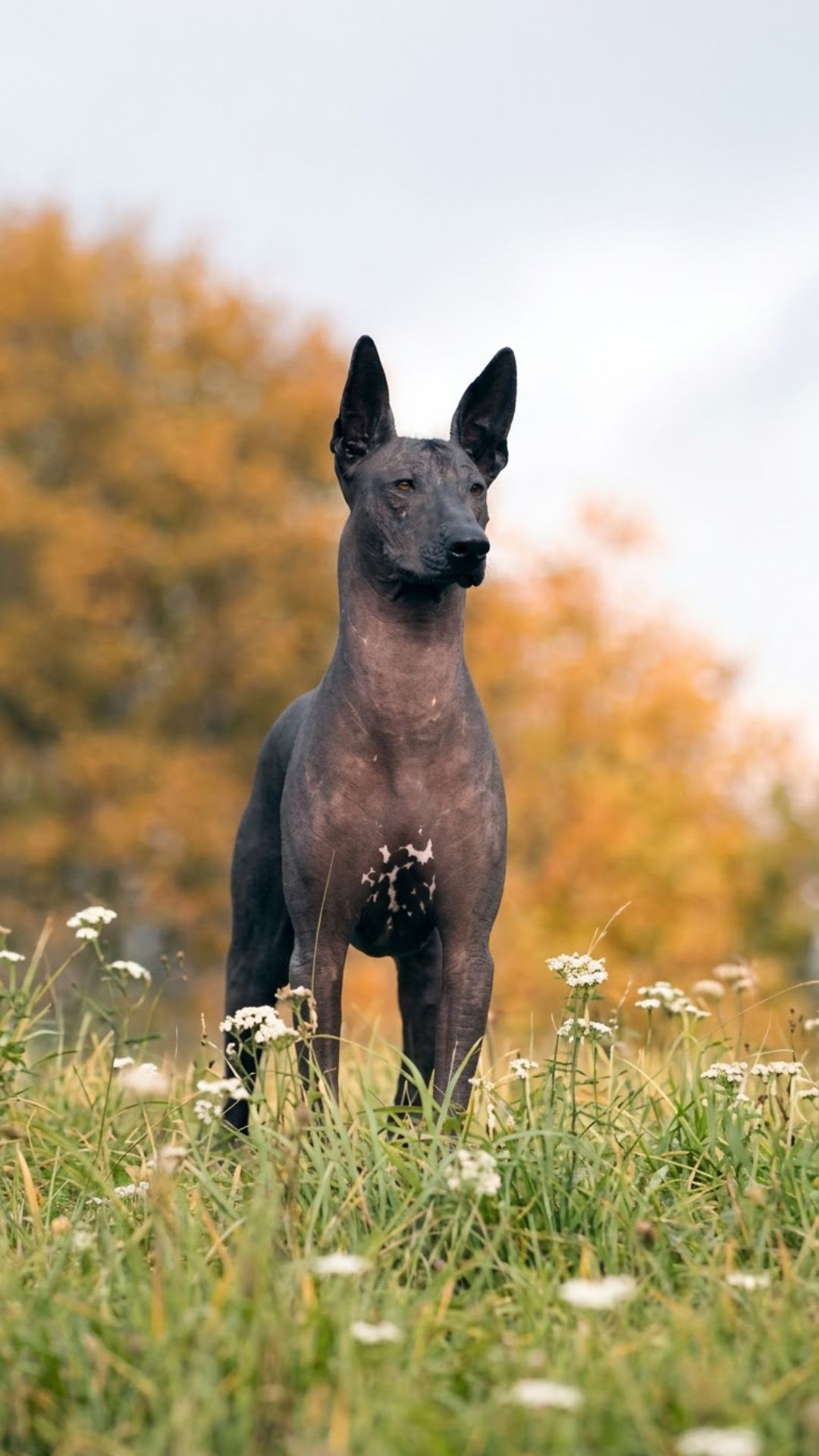
At first glance, the Xoloitzcuintli looks like almost no other dog. With its hairless skin, large ears and unusual appearance, the Mexican breed might seem like a modern curiosity. In reality, its story stretches back more than 3,500 years. Ancient peoples in Mexico regarded the Xolo as much more than a companion: it was associated with healing, religious beliefs and the journey into the afterlife. The breed later came dangerously close to disappearing, only to make a remarkable comeback.
Why Does This Dog Look So Different From Almost Every Other Breed?
Known as the Xoloitzcuintli, or simply Xolo, this ancient Mexican breed comes in three sizes and exists in both hairless and coated varieties. The hairless version is the one most people recognize, with exposed skin, large ears and an unusual, almost prehistoric appearance.
Its lack of hair isn’t simply a cosmetic feature.
Hairlessness is linked to a genetic mutation that also affects the dog’s teeth. Hairless Xolos commonly lack some premolars, giving archaeologists an unusual clue when identifying ancient remains believed to belong to the breed.
The genetic relationship between hairlessness and missing teeth also explains why the coated variety remains important. Dogs carrying two copies of the hairless mutation do not survive in the womb, so coated Xolos are part of the genetic story that allows the hairless variety to continue.
But the most fascinating thing about the Xolo isn’t its appearance.
It’s what ancient people believed the dog could do.

The Aztecs Didn’t See This Dog As Just A Pet
To the ancient Aztecs, the Xoloitzcuintli had a role that went far beyond ordinary companionship.
The name itself is connected to Xolotl, an Aztec deity associated with lightning and death, and itzcuintli, meaning dog. According to Aztec beliefs, Xolotl created the dog to guard the living and guide the souls of the dead through Mictlán, the underworld.
The journey to the afterlife was not imagined as a simple passage.
According to Aztec tradition, the dead faced a series of challenges before reaching their final destination. A Xolo could therefore serve as a guide and companion during that journey.
This helps explain why dogs appear so frequently in pre-Columbian Mexican art.
One of the most recognizable examples is the group of ceramic figures known as Colima Dogs, found primarily in western Mexico. Archaeologists have discovered large numbers of these objects in ancient burial contexts, and some researchers interpret them as symbolic companions for the dead.
The Xolo also had a reputation among the living.
Because its hairless body radiates heat directly, people associated the dogs with warmth and healing. Historical accounts describe them being kept close to sick people or the elderly, almost like a living hot-water bottle.
So the same animal could be understood as a companion in life and a guide after death.
That is a remarkable role for any dog.

Discover the fascinating story of the Mexican Hairless Dog, or Xoloitzcuintli—an ancient breed with a history stretching back thousands of years. Watch the video to learn why this unusual-looking dog became one of Mexico’s most iconic animal symbols.
More Than 3,500 Years Ago, These Dogs Were Already Part Of Mexican Life
The Xolo’s history reaches far beyond the Aztec Empire.
Researchers believe its ancestors accompanied some of the earliest human migrations into the Americas and that dogs resembling the modern breed had developed by at least 3,500 years ago.
That means the Xolo existed long before the Aztecs became a dominant power in central Mexico.
Archaeological evidence provides an extraordinary record of this relationship between humans and dogs.
Ancient Mesoamerican artwork depicts dogs with pointed ears and hairless-looking bodies. Ceramic dog figures have been found in large numbers, particularly in areas associated with ancient burial practices.
The Xolo was also not restricted to one narrow purpose.
Ancient sources and archaeological evidence suggest dogs could occupy several roles in Mesoamerican societies, including companionship, ritual and, in some contexts, food.
The Xolo’s importance therefore wasn’t simply that it was an unusual breed.
It was woven into the culture of the people who lived alongside it.
For thousands of years, generations of humans and dogs shared the same landscape.
Then that relationship was threatened by a dramatic change in Mexican history.

Then Europeans Arrived — And The Ancient Breed Nearly Disappeared
The arrival of Spanish conquistadors had devastating consequences for many Indigenous traditions, and the Xolo was no exception.
European dogs were introduced into the Americas, creating new competition and genetic mixing with Indigenous dog populations. At the same time, Spanish chroniclers described the consumption of dogs, and the Xolo’s population declined dramatically.
By the early 19th century, the once more widespread Xolo had become extremely rare and was largely confined to remote mountain communities.
This is one of the most remarkable turns in the breed’s history.
For thousands of years, the Xolo had survived alongside successive generations of people.
But within a few centuries after European contact, it was approaching extinction.
Its survival became increasingly dependent on isolated populations.
The ancient dog that had once occupied an important place in Indigenous culture was in danger of becoming nothing more than a memory preserved in pottery, paintings and archaeological remains.
Yet the story didn’t end there.

Only A Handful Of Dogs Were Left — Then Mexico Brought The Breed Back
Interest in Indigenous Mexican culture grew during the 20th century, and the Xolo gradually became part of that cultural revival.
Mexican artists Frida Kahlo and Diego Rivera famously kept Xolos and featured them in their art and photographs, helping bring attention to a breed that had nearly disappeared.
In the mid-1950s, Mexican and international dog experts organized efforts to find surviving Xolos in remote parts of the country.
Eventually, about ten identifiable Xolo-like dogs were located and used as the foundation for efforts to rebuild the breed.
The recovery took time.
But it worked.
Mexico officially recognized the breed in 1956, and decades later the American Kennel Club formally recognized the Xoloitzcuintli again in 2011.
The Xolo eventually went from being a breed on the edge of extinction to becoming an important symbol of Mexican identity.
Its revival also introduced the ancient dog to a much larger modern audience.
In 2017, the Pixar film Coco featured a Xolo named Dante, helping millions of people around the world become familiar with the breed.

The Dog Once Associated With Death Became A Symbol Of Mexico
There is something almost poetic about the Xolo’s survival.
For ancient Mexican peoples, the dog was associated with the boundary between life and death. It could be a companion to the living and, according to traditional belief, a guide for the dead.
Centuries later, the breed itself seemed to face its own kind of disappearance.
Yet it survived.
Today, the Xoloitzcuintli is recognized as a national symbol of Mexico and remains deeply connected to Indigenous Mexican history and traditions. The Smithsonian’s National Museum of the American Indian describes the breed as deeply embedded in the cultures and cosmologies of Mexico’s Indigenous peoples.
Its appearance may be the first thing people notice.
But the hairless skin is only the beginning of the story.
Behind that unusual face is a breed that has witnessed thousands of years of human history — from ancient Mesoamerican societies and their beliefs about the afterlife to the arrival of Europeans, near-extinction, cultural revival and modern popular culture.
The Xolo survived because people eventually recognized that they weren’t simply preserving an unusual-looking dog.
They were preserving a living connection to a much older Mexico.

The Xoloitzcuintli is far more than a hairless dog with an unusual appearance. For more than 3,500 years, it has shared Mexico’s history, appearing in ancient art and carrying deep spiritual meaning for Indigenous cultures. After coming dangerously close to extinction, the breed was rescued and brought back. Today, every Xolo carries something remarkable with it: a living connection to a world that existed thousands of years before modern Mexico.