It was only 84 centimeters tall—so low that getting inside required lifting the windshield. Yet this wasn’t a model built simply to sit under an auto-show spotlight. The 1970 Lancia Stratos Zero could actually move. Marcello Gandini and Bertone had somehow packed a mid-mounted V4, five-speed gearbox and a working chassis into one of the lowest cars ever built. But the strangest part came next: this bizarre experiment would help inspire one of rally racing’s most legendary machines.
At 84 Centimeters Tall, How Do You Even Get Inside?
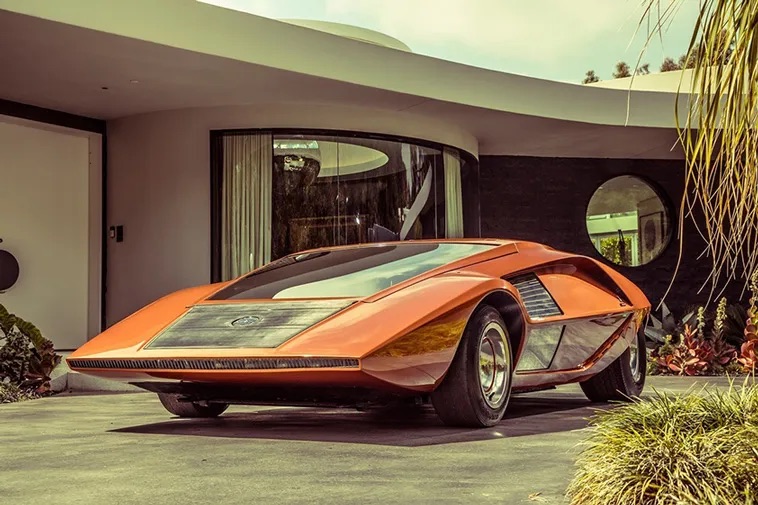
The first thing that makes the Stratos Zero seem impossible is its height. At just 84 centimeters, the car was dramatically lower than an ordinary sports car, forcing Gandini to rethink something as basic as getting the driver into the cockpit.
Instead of conventional side doors, the entire front windshield section hinged upward to create an opening. The steering wheel could also retract to make entering the cockpit easier, while the seats were built directly into the extremely low body.
The unusual entry system was not simply a styling gimmick. The entire car had been designed around the idea that almost every mechanical component should sit as low as possible, allowing Gandini to create the dramatic wedge profile without sacrificing the ability to drive the machine.

Why Make It So Low?
Get ready to see the legendary 1970 Lancia Stratos HF Zero in action! From its wild spaceship shape to the raw sound of its V4 engine, this video is a must-watch for all car lovers. Hit play today!
The answer begins with design freedom. Gandini was trying to create something that looked radically different from conventional sports cars of the period, drawing inspiration from the futuristic, space-age design language that was popular in the late 1960s and early 1970s. The result was an extreme wedge with almost no visual excess.
But making the body incredibly low created a genuine engineering challenge. The chassis, engine and suspension components had to be packaged beneath or behind the driver while leaving enough room for the car to function as a real vehicle rather than a stationary showpiece.
That is why the Stratos Zero is more interesting than a beautiful concept car. Bertone did not simply sculpt a futuristic shell. The company built a fully drivable one-off, using a real Lancia Fulvia drivetrain and mechanical components beneath the body.

So Where Did the Engine Go?
The answer is another major part of the trick. The Stratos Zero used a 1.6-liter Lancia Fulvia HF V4, positioned in the mid-rear of the car. It produced about 115 horsepower and was paired with a five-speed manual transmission.
Bertone built the prototype around the mechanical hardware of a Fulvia HF, including its engine and other running gear. By placing the engine centrally toward the rear, the designers could keep the nose extremely low while maintaining a compact overall package.
The result was a car only about 3.58 meters long yet equipped with a genuine performance-oriented drivetrain. Its proportions were dramatically different from most sports cars of the era: very short, very low and heavily focused around the center of the vehicle.

It Wasn’t Just a Show Car. It Could Actually Move.
This may be the most important detail about the Stratos Zero. It was not a hollow display model designed to sit under bright lights at an auto show. It was built to run.
When Nuccio Bertone wanted to show the car to Lancia executives, he famously drove it to the company’s racing headquarters. The car was so low that Bertone could reportedly drive under the factory entrance barrier, creating exactly the kind of dramatic entrance a futuristic concept could hope for.
That encounter mattered far beyond the spectacle. Lancia’s competition manager Cesare Fiorio was impressed by the concept and saw potential in its compact, mid-engine architecture. Shortly afterward, Lancia and Bertone began working toward a much more practical car that could actually compete in rallying.

One Concept Helped Lead to a Rally Legend
The production Lancia Stratos was not simply the Stratos Zero with doors added. A new rally prototype appeared in 1971 with a more conventional body, but it retained the central engineering idea: a compact, mid-engine performance car built around agility rather than the architecture of a traditional front-engine vehicle.
The powertrain also changed dramatically. The Fulvia’s V4 was eventually replaced by a much more powerful Ferrari Dino V6, giving the Stratos the performance needed for international rally competition.
That combination proved devastatingly effective. The Lancia Stratos went on to dominate the World Rally Championship, winning the manufacturers’ title in 1974, 1975 and 1976.
The irony is that the rally legend began with a car that looked almost too impractical to exist. The Stratos Zero was created to make people stare; the later Stratos used many of the ideas behind that radical shape to make people lose races.

The Stratos Zero Was Built to Make People Ask Questions
The Lancia Stratos Zero was never mass-produced. Only one was built, and its purpose was to demonstrate how far automotive design could be pushed. Its futuristic wedge shape, windshield entry and extreme proportions made it almost impossible to confuse with anything else on the road.
But its real importance came from what happened after people saw it. Lancia’s racing department recognized that the mid-engine concept could become something more than a styling experiment, while Bertone had demonstrated that an extreme design could still be engineered into a functioning vehicle.
The strange little wedge therefore became a kind of technical statement: lower the car, centralize the mass and design around the machine rather than around convention. A year later, those ideas were already being transformed into the car that would become the Lancia Stratos HF.

Stratos Zero is one of those cars that photographs can never fully capture. Its extreme proportions, impossibly low stance and futuristic details become much easier to appreciate when you see the car from different angles. Take a look at some more photos of this extraordinary one-off and see just how radical it really was.


The 1970 Lancia Stratos Zero was only 84 centimeters tall, yet it was a fully drivable one-off with a mid-mounted 1.6-liter Fulvia V4, five-speed manual gearbox and an unusual windshield that lifted to let the driver climb inside. Its extreme low-slung design impressed Lancia’s racing team and helped inspire the development of the Stratos HF, which later dominated the World Rally Championship. What began as a futuristic design experiment became the starting point for one of rally racing’s most legendary machines.