In April 2012, a man walking along a remote beach in British Columbia found something that seemed impossible: a rusted Harley-Davidson motorcycle sitting inside a battered storage container. The bike still carried Japanese license plates, even though it had washed ashore more than 4,000 miles from Japan. It had been swept out to sea more than a year earlier, carried across the Pacific by a combination of ocean currents and floating debris. What happened next revealed not only where the motorcycle came from, but how an ordinary object could become an extraordinary record of a journey across the world’s largest ocean.
The Harley Was Swept Out To Sea In Japan
The motorcycle was a 2004 Harley-Davidson Night Train owned by Ikuo Yokoyama, a resident of Miyagi Prefecture in northeastern Japan. On March 11, 2011, the region was struck by the massive tsunami generated by the Tōhoku earthquake, sending enormous quantities of debris from coastal communities into the Pacific Ocean. The motorcycle disappeared along with the owner’s possessions.
More than a year later, its journey would become visible again on the opposite side of the ocean. By then, Japanese debris was appearing along the western coast of North America, creating a scattered trail between the two continents. The Harley, however, had traveled in an unusually useful container.
Discover the incredible story of a Harley-Davidson motorcycle that traveled 6,000 kilometers across the Pacific after the 2011 tsunami. Witness how this lost treasure became a heartfelt memorial in the Harley-Davidson Museum. Watch this emotional journey of recovery and tribute to those affected by the tragedy. Don’t miss it!
A Shipping Container Carried It Across The Pacific
When Peter Mark discovered the motorcycle on Graham Island in British Columbia in April 2012, it was still inside a large storage container. The container had survived long enough to keep the motorcycle afloat, effectively turning a piece of ordinary cargo equipment into a temporary vessel.
The journey was more than 4,000 miles long and lasted for over a year. The container did not simply drift randomly across the ocean. According to the Smithsonian’s account, it was carried first by the Kuroshio Current, then influenced by the Oyashio Current and West Wind Drift before the Alaska Current helped carry it toward the Canadian coast.
That combination of currents created an extraordinary natural transportation system. The motorcycle had no engine, no navigation system and no destination. It simply remained inside a floating container while the Pacific Ocean slowly carried it west to east.
More Than 4,000 Miles Later, Someone Found It In Canada
Peter Mark was walking along the isolated coastline of Graham Island when he came across the container. Inside was the rusted motorcycle, still recognizable despite the damage caused by more than a year at sea.
Mark initially left the bike where he found it and returned roughly three weeks later intending to retrieve it. But the ocean had already changed the scene. The storage container had disappeared, leaving the motorcycle itself partially buried in sand and exposed to the repeated movement of the tide.
The discovery was remarkable for another reason. The motorcycle still carried enough identifying information for investigators to determine where it had originated. Its Japanese license plate provided the first major clue, while the vehicle identification number, or VIN, ultimately allowed Harley-Davidson to trace the motorcycle back to its original owner. A journey that had begun thousands of miles away suddenly had a name attached to it.

The Motorcycle’s VIN Revealed Where It Came From
Harley-Davidson staff were able to use the intact VIN to identify the owner as Ikuo Yokoyama. The company initially considered restoring the motorcycle, but the damage was far beyond an ordinary restoration project.
According to the Smithsonian, Harley-Davidson determined that approximately 99.9 percent of the motorcycle would need to be replaced. Rather than rebuild a machine that had been heavily damaged by salt water and exposure, the company offered Yokoyama a brand-new motorcycle. But Yokoyama declined.
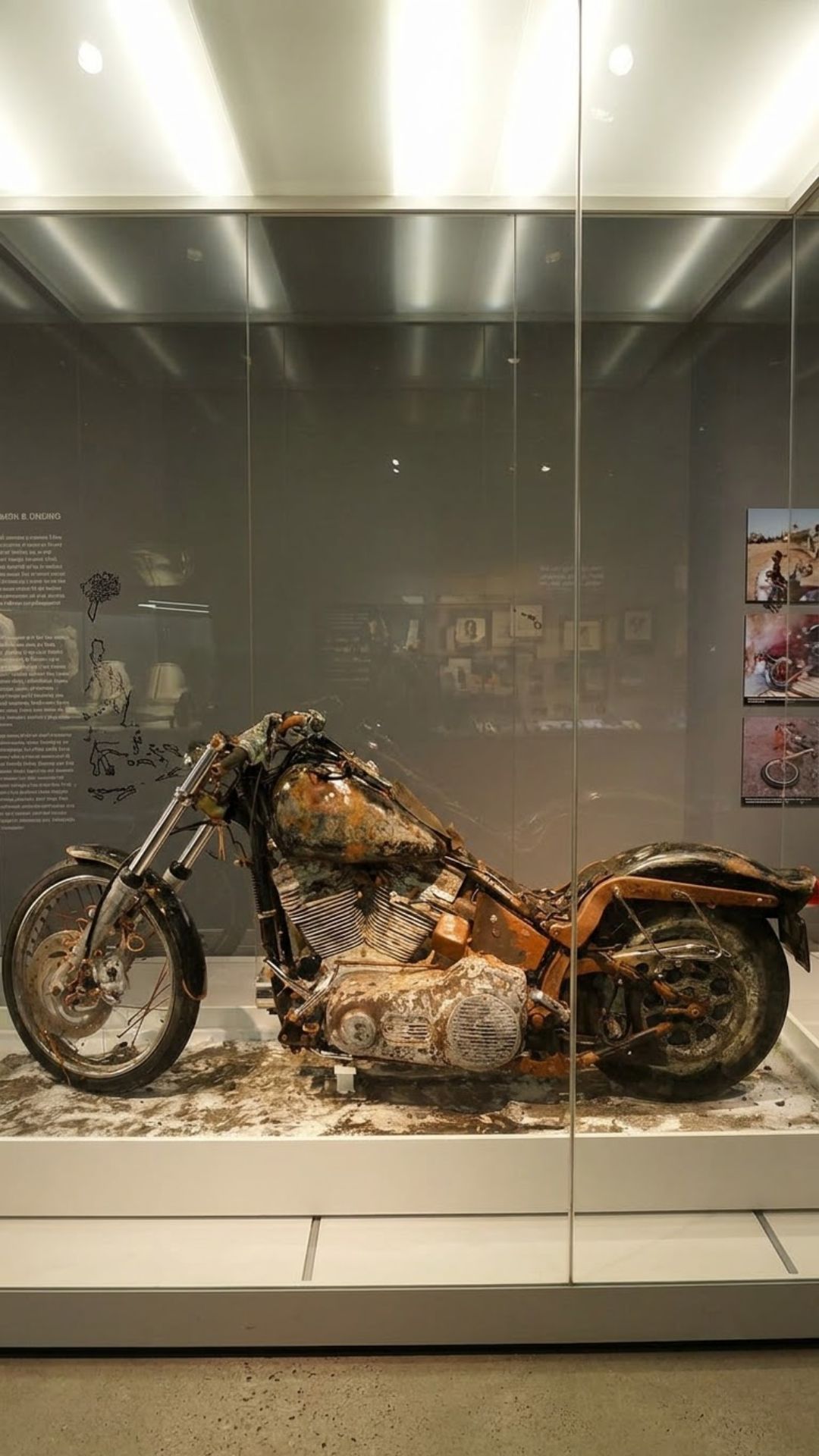
His response changed what happened to the battered Harley next. Rather than treating it as a damaged motorcycle that needed to be replaced, he wanted it to become a reminder of what had happened. He asked for the original machine to be displayed at the Harley-Davidson Museum in Milwaukee. The rust, corrosion and missing components would remain part of the story.
A journey across the ocean, a story of survival, and a tribute to the resilient. Discover the incredible story of the tsunami motorcycle. Watch now to learn how this bike ended up in a museum.
Its Owner Refused A Brand-New Harley
Yokoyama’s decision was striking because the motorcycle could easily have been treated as a lost possession replaced by a new one. Instead, he saw something different in the damaged machine.
The motorcycle represented far more than its original value. It had disappeared in Japan, crossed the Pacific inside a drifting container and eventually appeared on a Canadian beach. Its condition recorded the journey in a way that a restored motorcycle never could.
The Harley-Davidson Museum ultimately placed the motorcycle on permanent display. Rather than repairing every trace of its journey, the museum preserved the damage as evidence of what the machine had experienced. In that sense, the rust became part of the artifact.
The Rusty Motorcycle Became A Piece Of History
The Harley-Davidson Night Train now occupies an unusual place in automotive history. It is not famous because it was a rare racing machine or an expensive collector’s motorcycle. Its importance comes from what happened to it after it left its owner’s hands.
A motorcycle built to travel on roads ended up crossing the Pacific without ever being ridden. A shipping container became its vessel. Ocean currents became its route. And a remote Canadian beach became the place where its journey was discovered.
The motorcycle’s final destination is now a museum rather than another coastline. There, its damaged frame provides a physical record of an extraordinary journey—one that began in Japan, crossed more than 4,000 miles of ocean and ended with a motorcycle that somehow made its way into a permanent collection thousands of miles from home.

The journey of this Harley-Davidson is remarkable because the motorcycle became a record of an event far beyond its original purpose. Swept from Japan and carried more than 4,000 miles across the Pacific inside a floating container, it eventually reached a remote Canadian beach more than a year later. Its owner chose not to replace it with a new motorcycle, allowing the damaged machine to be preserved instead. Today, the rusted Harley stands as an unusual reminder of how an ordinary object can carry an extraordinary story across an ocean.
The Smithsonian documented the remarkable journey of this Harley-Davidson from its discovery on a remote Canadian beach to the identification of its original owner in Japan. The photographs below offer a closer look at the motorcycle, the storage container and the condition in which the bike was found. Source: https://www.smithsonianmag.com/travel/motorcycle-rode-tsunami-180960327/