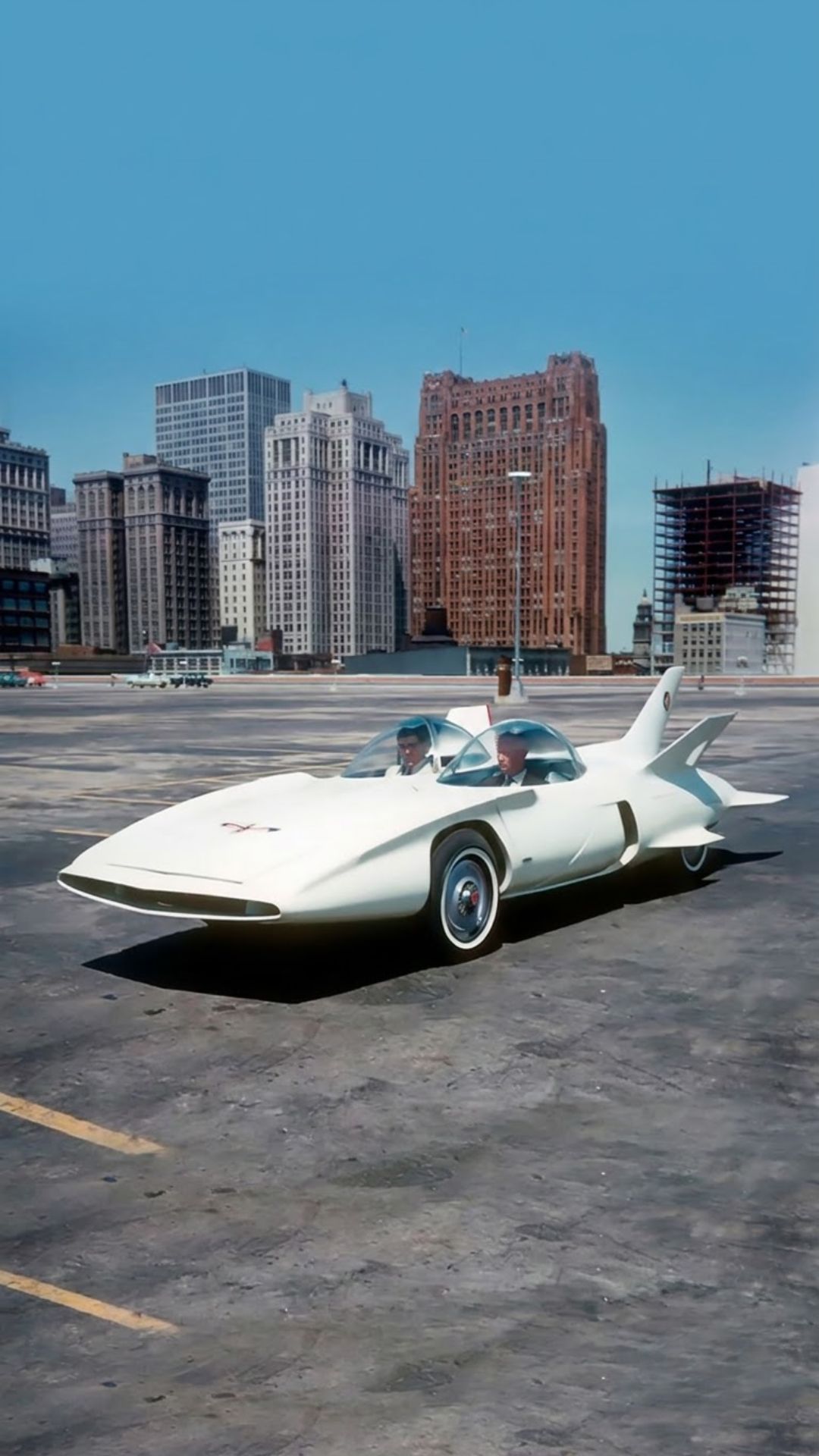
In 1958, General Motors built a car that looked less like a family automobile and more like something from a science-fiction movie. The Firebird III had a 225-horsepower gas turbine engine, seven fins, a double-bubble canopy and a single joystick instead of a conventional steering wheel and pedals. It even featured cruise control, anti-lock braking, air-conditioning and an automated guidance system. GM was not preparing to sell it at a dealership. It was trying to show Americans what the automobile of the future might look like.
America Was Designing Cars For The Space Age
The Firebird III emerged at a moment when American popular culture was fascinated by rockets, jet aircraft and the possibility of futuristic travel. General Motors’ designers were thinking beyond ordinary automobiles, and the Firebird series became a way to demonstrate what that future might look like.
The third Firebird was created in 1958 and presented publicly as part of GM’s 1959 Motorama. Its styling deliberately borrowed from the aerospace world, with a low body, seven rear-mounted wings and fins, and two separate bubble-like cockpit covers for the driver and passenger.
But the styling was only the beginning.
GM wanted the Firebird III to demonstrate that a gas turbine could power a practical automobile. The result was a two-seat experimental car built around a Whirlfire GT-305 gas turbine producing 225 horsepower, supplemented by a small 10-horsepower gasoline engine to operate the car’s accessories. It was an automobile designed according to the logic of the Jet Age.
Step back into 1958 and witness the future as it was imagined! Discover the General Motors Firebird III, a stunning concept car featuring jet-inspired design, a futuristic joystick controller, and early self-driving technology. Don’t miss this fascinating glimpse into automotive history—watch the original promo film and be amazed today!
There Was No Steering Wheel
The strangest feature was waiting inside.
Instead of a steering wheel, accelerator pedal, brake pedal and conventional transmission controls, the Firebird III used a device called Unicontrol. It was a short joystick mounted between the two seats, and it was intended to control steering, speed and braking from a single point.
For drivers accustomed to three pedals and a steering wheel, the system must have looked completely alien.
But GM was not simply trying to make driving unusual. It was imagining that future cars could become easier to control by replacing multiple mechanical controls with a single electronic interface.
That idea was accompanied by another futuristic feature: Autoguide, an automated guidance system designed to steer the car along specially equipped future roads using an electrical signal transmitted through a cable in the road.
In 1958, automated highway guidance was not a normal transportation technology. GM was imagining the infrastructure first, then designing a car to use it.

The Car Had Technology That Sounds Surprisingly Modern
The Firebird III was packed with features that seem far less strange today.
It had automatic cruise control, allowing the car to maintain a selected speed. It had a braking system designed to prevent wheel lock, along with special air-drag brakes that extended from the rear of the car to help slow it at high speeds.
The car also featured automatic headlights controlled by a photoelectric cell, electronic temperature and air-conditioning controls, and a system that could alert the driver to mechanical problems.
Even the doors were supposed to feel futuristic. The Firebird III used an ultrasonic key concept to trigger the door-opening mechanism. It was another example of GM trying to replace familiar mechanical interactions with systems that seemed more like aircraft or laboratory equipment. In other words, GM did not simply build a strange-looking car. It built a rolling demonstration of future technology.

The Turbine Was The Heart Of The Experiment
The engine was perhaps the most important experiment of all.
Gas turbines had obvious appeal in the 1950s. Jet aircraft had demonstrated their extraordinary power, and engineers wondered whether the same basic principle could eventually transform automobiles. The Firebird III was one of GM’s most ambitious attempts to find out.
Its GT-305 turbine produced 225 horsepower and incorporated a regenerative system intended to improve fuel efficiency. The separate 10-horsepower gasoline engine handled accessories, allowing the turbine to concentrate on propulsion.
The problem was not that a turbine could not move a car. It could. The harder question was whether a turbine made sense in an everyday automobile.
The challenges included cost, efficiency and practicality. Gas turbines were simply not well suited to the stop-and-go demands of ordinary passenger-car use, helping keep the technology in the realm of experiments rather than production vehicles.
The Firebird III therefore became a glimpse of a future that never quite arrived.

GM Even Imagined Roads That Would Drive Themselves
Some of the Firebird III’s ideas were surprisingly ambitious because they extended beyond the car itself.
The Autoguide system was designed for a future in which roads would contain electrical guidance equipment. In that imagined world, the automobile would not necessarily need the driver to control every movement. The road and the car could work together.
That vision now sounds oddly familiar.
Modern driver-assistance systems, lane guidance and automated driving all depend on the idea that a vehicle can sense its environment and take over some driving functions. The Firebird III was not doing those things with modern sensors and computers, but the basic ambition—to reduce the driver’s role through technology—was already being explored more than six decades ago.
The important difference is that GM was working with the technology of 1958. It was imagining a computerized future before the tools to build that future actually existed.

Most Of The Future Never Arrived
The Firebird III was an experimental car, not a production model. GM never expected customers to walk into dealerships and order one.
Its purpose was to demonstrate possibilities, attract attention and give engineers a platform for testing technologies that might influence future vehicles. Of the many futuristic concepts built into the car, some proved impractical and others eventually appeared in very different forms.
The gas turbine never became the standard power source for passenger cars.
The futuristic automated highway system never became the everyday road network GM imagined.
And almost nobody today would want to steer a normal car with a tiny joystick. Yet that does not mean the experiment failed.

The Firebird III Left A Mark On Real Cars
GM itself points to one important legacy: the Firebird III was the only member of the Firebird trio to have a direct influence on production GM vehicles. The 1959 Cadillac incorporated elements of its surface development and distinctive lower-body treatment, while the 1961 Cadillac adopted rear “skegs” inspired by the Firebird.
That may be the most interesting way to judge a concept car. Not by asking whether every prediction came true, but by asking whether the experiment changed what eventually went into ordinary cars.
The Firebird III certainly did that. Its name also lived on. GM’s Firebird concept series ultimately gave its name to the Pontiac Firebird, introduced as a production car in 1967. The strange turbine car from the Jet Age never became the future on four wheels. But parts of its future did survive.

The 1958 GM Firebird III was an extravagant experiment built at the height of America’s fascination with jets and the Space Age. It combined a 225-horsepower gas turbine with a joystick instead of traditional driving controls, automated guidance, cruise control, anti-lock braking, air-conditioning and aircraft-style drag brakes. Most of its futuristic ideas never became standard automotive technology, but the car was never really meant to. Its job was to explore possibilities—and some of those ideas influenced production cars that followed. The Firebird III remains fascinating because it captures a moment when Detroit believed the future might arrive much faster than it actually did.
P.S. This article draws primarily on General Motors’ Heritage Collection and contemporary reporting about the Firebird III’s turbine engine, controls and futuristic technology. Source: https://themindcircle.com/firebird-iii/