For more than a century, scholars have studied a medieval manuscript filled with strange plants, astronomical diagrams, human figures and hundreds of lines of unfamiliar writing. The parchment has been scientifically dated to the 15th century, the book is preserved at Yale and its pages can now be examined in extraordinary detail. Yet one basic question remains unanswered: what does it say? Known as the Voynich Manuscript, the book has resisted generations of historians, linguists and cryptographers. We can examine almost every detail of it. We still cannot confidently read the text.
The Book Looks Like It Should Be Read
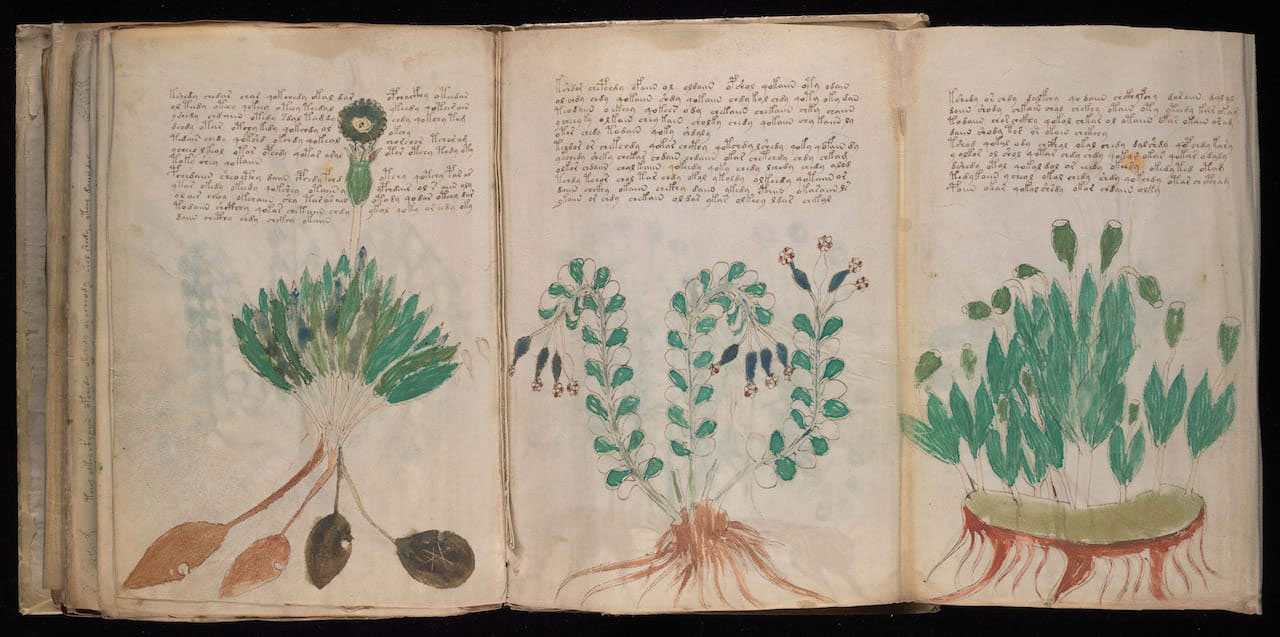
At first glance, the Voynich Manuscript does not look like an elaborate prank or a collection of random marks. The writing runs across the parchment in organized lines, with recurring symbols appearing in patterns that look remarkably consistent. The manuscript contains about 240 pages or leaves, including foldout sections, and its illustrations appear to be arranged into recognizable categories. Yale identifies broad sections devoted to plants, astronomy and astrology, bathing scenes, cosmological diagrams, pharmaceutical imagery and pages dominated by text.
That organization is part of what makes the manuscript so difficult to explain. A meaningless collection of symbols would be mysterious, but the Voynich Manuscript appears to follow some kind of internal system. Certain symbols repeat, words recur and the illustrations seem to correspond to different portions of the text. The problem is that nobody knows what that system represents.
Unravel the enigma of the Voynich Manuscript—history’s most puzzling book! Featuring bizarre alien plants, mysterious star charts, and an undecipherable language, this medieval artifact continues to baffle experts. Curious to see if this code can finally be cracked? Watch the full deep dive to uncover the secrets hidden within!
Its Pages Are Filled With Strange Plants And Unknown Symbols
The illustrations may be the most visually striking part of the manuscript. Some pages show plants that are difficult to identify with confidence, including unusual roots and flowers that do not correspond neatly to familiar botanical specimens. Other pages contain zodiac symbols, stars, circular diagrams and elaborate scenes involving figures in pools or connected by strange tubular forms.
These images provide clues, but they do not solve the mystery.
A plant illustration might suggest that a section concerns medicine or botany, while a constellation could indicate an astronomical or astrological subject. But without being able to read the accompanying text, researchers cannot determine precisely what the original author intended.
The manuscript therefore offers an unusual combination of familiarity and uncertainty. Its subjects often look recognizable. Its explanations do not.

Scientists Know It Is A Medieval Manuscript
For years, one possibility was that the entire object might be a much later forgery. Scientific testing made that explanation considerably harder to sustain.
Radiocarbon testing at the University of Arizona dated the parchment to the 15th century. Further analysis of the inks and pigments found materials consistent with those used in medieval manuscripts. Researchers also determined that the parchment was made from calfskin and estimated that the complete manuscript required the hides of roughly 14 to 15 calves.
The testing does not tell researchers what the writing means. It does establish something important: the physical manuscript is genuinely old.
Recent paleographic research has added another clue. Yale linguist Claire Bowern says analysis of the handwriting indicates that five different people collaborated on the manuscript. That means the strange writing may not be the work of a single isolated author. The more researchers learn about the physical object, the more complicated the mystery becomes.
Wilfrid Voynich Spent Years Trying To Understand It
The manuscript became famous in the modern era after antiquarian bookseller Wilfrid Voynich acquired it in 1912. He became fascinated by its unknown script and illustrations and spent years trying to determine where it came from and what it meant.
The manuscript had already passed through several owners before reaching Voynich, and parts of its earlier history remain uncertain. It eventually entered Yale’s Beinecke Rare Book and Manuscript Library in 1969, where it became one of the institution’s most famous mysterious manuscripts.
Voynich’s name therefore became permanently attached to the book, even though he was not its author.
His unsuccessful attempts to understand the manuscript also began a modern tradition that continues today. Historians, linguists, cryptographers and amateur codebreakers have proposed countless explanations, from an unknown natural language to an elaborate cipher and even a carefully constructed hoax. None has produced a generally accepted reading of the text.

Cryptographers Still Cannot Read The Writing
The central mystery is not simply that the alphabet is unfamiliar. It is that researchers cannot agree on what kind of writing system they are looking at.
Traditional cryptographic methods have been used repeatedly, while modern researchers have analyzed the frequency of symbols, word patterns and relationships between sections. Yale notes that the manuscript has resisted translation for more than a century, and even specialists caution that the many unknowns make it extremely easy to build a theory around assumptions that cannot yet be tested. That distinction matters.
Researchers can identify patterns without knowing what those patterns mean. They can determine that certain symbols occur more frequently in particular parts of the manuscript. They can compare handwriting and illustrations. They can even identify recurring structures within the text.
But none of those observations provides a reliable translation.
The manuscript may contain a language that has disappeared, a coded system, a constructed language or something else entirely. At present, there is no consensus that settles the question.

Yale Put The Mystery In Reach Of Everyone
The Voynich Manuscript was once available only to people who could gain access to an extremely rare and fragile medieval object. That changed with digitization.
Yale made digital images of the manuscript available, and in 2014 new high-resolution scans made it possible to examine the pages with much greater clarity. Conservation work also helped prepare delicate pages for scanning, while improved equipment captured more accurate colors and details.
That means the mystery is no longer confined to a locked library collection. Researchers and curious readers can inspect the manuscript page by page, zoom in on individual symbols and study the strange illustrations without handling the original. And that creates the most remarkable paradox of the Voynich Manuscript.
We can see the pages. We can study the parchment. We can analyze the pigments and handwriting. We know the manuscript is genuinely medieval, and we have identified broad themes running through its illustrations.
Yet the most important thing—a readable meaning behind the strange writing—still remains out of reach.
More than five centuries after the manuscript was created, the Voynich Manuscript is no longer hidden. It is available for anyone to examine. The mystery survives because, even when the entire book is placed in front of us, we still cannot make it speak.

The Voynich Manuscript remains fascinating because modern science has answered some of its biggest questions while leaving the most important one unresolved. Researchers know its parchment dates to the 15th century, have identified different scribes and can recognize broad themes in its illustrations. Yet the strange writing still has no accepted translation. Today, the entire manuscript can be examined in high-resolution digital images, bringing a centuries-old mystery closer to anyone curious enough to look. We can see almost every detail—but we still do not know what the book is saying.
The original Hyperallergic report introduced the new high-resolution scans that allowed the Voynich Manuscript to be examined in unprecedented detail. Yale’s research and library records provide additional background on the manuscript’s age, illustrations, physical materials and the continuing attempts to understand its mysterious writing. Source: https://hyperallergic.com/new-scans-of-the-voynich-manuscript-a-medieval-book-no-one-can-read/