For more than 500 years, one mysterious book has kept its secrets from historians, linguists and codebreakers. The Voynich Manuscript is filled with an unknown script, strange botanical illustrations, astronomical diagrams and curious human figures, yet no widely accepted translation has ever been produced. Researchers can determine when its parchment was made and study how the manuscript was created, but the meaning of its words remains one of history’s most enduring mysteries.
Someone Wrote a Book No One Could Read
The book now known as the Voynich Manuscript is formally identified by Yale as Beinecke MS 408. It was produced somewhere in Central Europe at the end of the 15th century or during the 16th century, although its exact origin and authorship remain unknown. The manuscript is written in an unidentified script that has resisted successful translation for generations.
That uncertainty is what makes the manuscript so unusual. Many ancient documents are difficult to understand because they use old languages, damaged writing or unfamiliar terminology. In the case of the Voynich Manuscript, researchers face a much more fundamental problem: they do not know what language or writing system they are looking at.
The text is not simply a collection of random marks scattered across a few damaged pages. It forms a consistent writing system that appears throughout the manuscript. Researchers have identified patterns in the way the symbols are arranged, and linguistic analysis can reveal information about word patterns even when the actual meanings remain unknown. Yale linguist Claire Bowern has also noted that paleographic research indicates that five different people collaborated on writing the manuscript.
That discovery adds another layer to the mystery.
The manuscript was not necessarily created by one person sitting alone and inventing an incomprehensible text. Several people appear to have participated in producing it, suggesting that whatever the book was intended to be, it may have been a serious project requiring considerable effort.
But its creators left behind no clear explanation of what they were writing.
Want to take a closer look at the world’s most mysterious book? Watch the video to explore the strange illustrations, unknown writing and centuries-old mystery behind the Voynich Manuscript.
Its Pages Are Filled With Images That Make Little Sense
If the writing were the only mystery, the Voynich Manuscript would already be fascinating. But its illustrations make the puzzle even stranger.
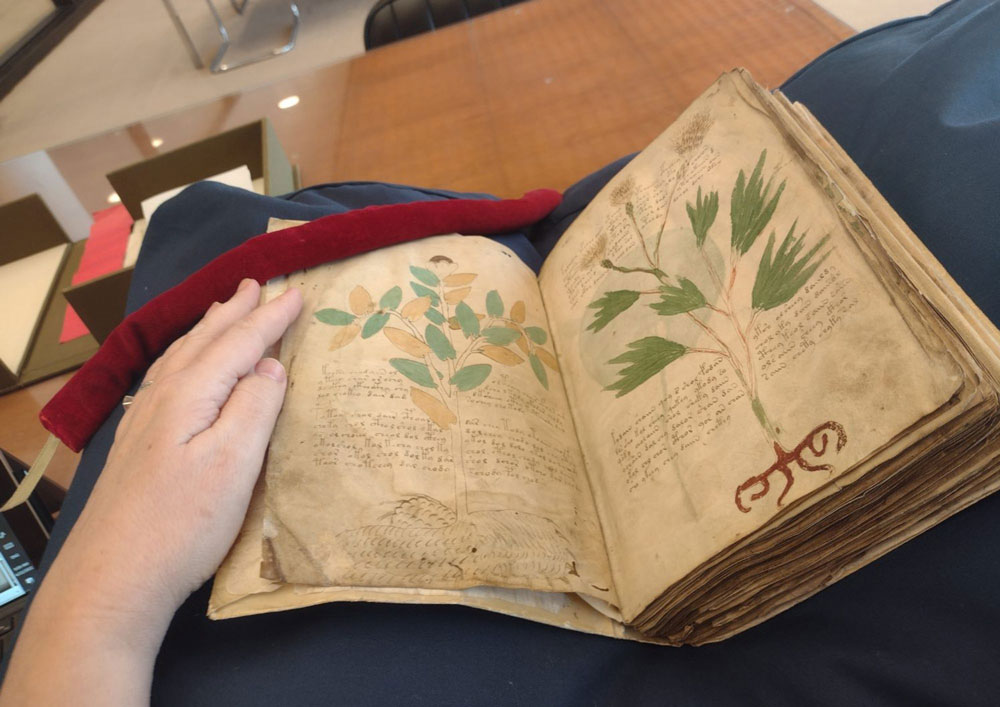
Yale divides the manuscript into several distinct sections based on its images. Some pages are filled with drawings of plants, while others contain astronomical and astrological diagrams. Another section depicts bathing scenes involving human figures and elaborate systems of pipes or containers. There are also large cosmological diagrams, pharmaceutical illustrations of herbs and roots, and pages containing text with small star-like symbols marking individual entries.
The plant illustrations are particularly intriguing because many of them do not correspond easily to recognizable species. Some look vaguely familiar, while others appear to combine characteristics from different plants. Without being able to read the accompanying text, however, researchers cannot determine with confidence whether the drawings represent real plants, stylized versions of known species or something entirely different.
The astronomical pages create another set of questions. Circular diagrams, stars and zodiac symbols suggest that at least some part of the manuscript may have been concerned with the heavens or astrology. Yet the accompanying writing remains impossible to interpret with certainty.
Other pages show groups of women in strange environments, surrounded by vessels, tubes and pools. These images have led to many theories about medicine, health, bathing and the human body, but the illustrations alone cannot establish what the original author intended.
The manuscript therefore seems to offer clues without actually explaining them.
Every drawing appears to promise an answer.
Instead, it creates another question.

The Manuscript Has a Strange History of Its Own
The Voynich Manuscript’s mysterious contents are matched by an unusually interesting history of ownership.
The first confirmed owner was Holy Roman Emperor Rudolph II, who reportedly purchased the manuscript for 600 gold ducats. Rudolph II believed the book might have been created by Roger Bacon, the English philosopher and Franciscan friar. However, Yale emphasizes that the connection to Bacon is speculation rather than established fact.
After Rudolph II, the manuscript passed through several hands in Prague. One owner was the pharmacist Jacobus Horčicky de Tepenec. It later came into the possession of the alchemist Georgius Barschius, who attempted to have the mysterious text understood.
Barschius sent material from the manuscript to Athanasius Kircher, a prominent Jesuit scholar in Rome. In 1666, Johannes Marcus Marci also sent the manuscript to Kircher, hoping that the scholar might be able to decipher it. The accompanying correspondence became an important part of the manuscript’s documented history.
Kircher could not solve the mystery.
For centuries afterward, the manuscript effectively disappeared from wider historical attention. Then, in 1912, it resurfaced when Wilfrid M. Voynich purchased it from the Jesuit College at Frascati near Rome. It was Voynich who gave the manuscript the name by which it is now famous.
After Voynich died, the manuscript passed through the hands of his wife, Ethel, and later Anne Nill. Rare-book dealer H. P. Kraus acquired it in 1961 but was unable to find a buyer. In 1969, he donated the manuscript to Yale University’s Beinecke Rare Book and Manuscript Library, where it remains today.
The irony is striking.
The manuscript’s ownership history can be reconstructed surprisingly well for such an old object.
Its meaning cannot.
Want to explore the mystery of the Voynich Manuscript in more detail? Watch the video to take a closer look at the strange writing, mysterious illustrations and centuries-old questions surrounding the world’s most enigmatic book.
Cryptographers Have Tried to Crack It for More Than a Century
Once Voynich acquired the manuscript, he became determined to understand its contents. Professional codebreakers and scholars soon became interested as well.
The manuscript attracted attention from some of the most capable cryptographic minds of the 20th century. Among them were William and Elizabeth Friedman, famous American cryptographers whose work included military codebreaking. Despite their efforts, they could not produce an accepted solution.
That pattern has continued.
Researchers have proposed that the manuscript might contain a cipher, an unknown natural language, an invented language or another kind of writing system. Some have claimed to have solved the manuscript, but no proposed translation has gained broad scholarly acceptance.
This distinction is important.
It is easy to find claims that someone has finally cracked the Voynich Manuscript. The much harder task is demonstrating that the proposed translation consistently explains the entire text, matches the manuscript’s structure and can be independently tested by other researchers.
So far, no solution has met that standard.
Yale describes the manuscript as having resisted translation for more than a century, while noting that cryptographic approaches have failed to decipher the text if it is indeed encoded.
The manuscript therefore remains a rare case where generations of researchers have been able to study the same object in extraordinary detail without reaching agreement about its basic meaning.
Modern technology has not made the mystery disappear.
It has simply allowed researchers to examine it more closely.

Scientists Can Tell Us More About the Book Than Its Words
Although researchers cannot read the manuscript, they have learned a surprising amount about the physical object itself.
Scientific testing has established that the parchment belongs to the 15th century, helping place the manuscript firmly within the historical period suggested by its appearance. Researchers have also examined its ink, pigments and binding in an effort to understand how it was produced.
This evidence is important because it rules out some of the simplest modern explanations.
The manuscript is not simply a recently created book pretending to be medieval. Its physical materials are consistent with a much older origin. That does not tell researchers what its text means, but it establishes that the mystery itself is centuries old.
Paleographic analysis has added another clue. Researchers have identified five different hands among the people who wrote the manuscript, suggesting that several individuals participated in creating the text.
That makes the manuscript even more difficult to explain.
If it were merely a modern hoax, its physical age would be difficult to account for. If it were a conventional medieval book, why has its writing resisted interpretation for so long? And if it is a cipher, what system was used to create it?
There are still no universally accepted answers.
What scientists can say with confidence is that the manuscript is a genuine historical object whose materials, construction and writing can be studied independently of its meaning.
In other words, we know more about how the book exists than about what the book says.
The Mystery May Never Have a Simple Answer
The Voynich Manuscript has inspired an enormous range of theories, but none should be treated as established fact.
The illustrations have led some researchers to suspect that the manuscript may contain information about plants, medicine, astronomy or astrology. The structure of the writing has encouraged others to investigate whether it represents an unknown language or an encrypted text. Some theories have gone much further, suggesting that the manuscript could be an elaborate hoax or an invented writing system.
The problem is that every theory must explain the entire manuscript rather than just a handful of attractive clues.
A researcher might identify a plant that resembles one of the illustrations, for example, but that does not automatically reveal what the accompanying text means. Likewise, finding statistical patterns in the writing does not by itself prove that the manuscript is written in a particular language.
This is why the mystery has survived for so long.
There are enough patterns to encourage investigation, but not enough certainty to produce a universally accepted translation.
Yale’s current research emphasizes this difficulty. Even without knowing what the words mean, linguists can study their patterns, while paleographers can examine the handwriting and identify different contributors. Researchers can also study the manuscript’s physical materials and historical provenance.
The result is an unusual situation in which knowledge continues to accumulate without resolving the central mystery.
- We know the manuscript is centuries old.
- We know where it has been for much of its documented history.
- We know that multiple people wrote it.
- We can examine its strange illustrations.
- We can study its parchment, pigments and ink.
But we still cannot confidently read the words.

For more than five centuries, the Voynich Manuscript has survived wars, changing owners and countless attempts to uncover its meaning. Researchers now know much more about its age, materials and construction, yet its mysterious script remains undeciphered and its true purpose is still uncertain. That may be what makes the manuscript so fascinating: we can study nearly every physical detail of this remarkable book, but the words written inside still belong to a world we have yet to understand.