On October 16, 1846, a patient lay on an operating table at Massachusetts General Hospital as doctors prepared to test an idea that could change medicine forever. Until then, surgery was often a race against time, with patients forced to endure procedures while fully conscious. But after inhaling ether, the patient remained sedated as a surgeon removed a tumor from his neck. The operation helped launch the age of modern anesthesia—yet the breakthrough that transformed surgery would soon trigger a bitter battle over credit, ambition and legacy.
Before Anesthesia, Speed Was One of a Surgeon’s Most Important Skills
Modern patients often think of surgery as a carefully controlled process involving anesthesia, monitoring equipment and highly specialized teams. In the early 19th century, however, the experience was dramatically different. Many patients underwent major procedures while fully conscious, and surgeons had limited ways to reduce suffering.
As a result, speed became an essential skill. The faster a surgeon completed a procedure, the less time a patient had to remain on the operating table. Quick operations could also reduce the risks associated with prolonged blood loss and physical shock. Some highly skilled surgeons became famous for completing amputations in remarkably short periods of time.
The problem was not simply that surgery was uncomfortable. The fear of pain itself could discourage people from seeking treatment. Operations were often viewed as a last resort because patients knew exactly what they might have to endure.
Medicine desperately needed a way to make surgery more humane. But finding a substance that could safely reduce or eliminate pain during an operation would prove far more complicated than anyone expected.
Watch the video to see the extraordinary story behind the operation that changed medicine forever. One successful demonstration of ether opened the door to modern anesthesia—but it also sparked a bitter fight over who deserved the credit.
Inside the Operating Room That Became Known as the Ether Dome
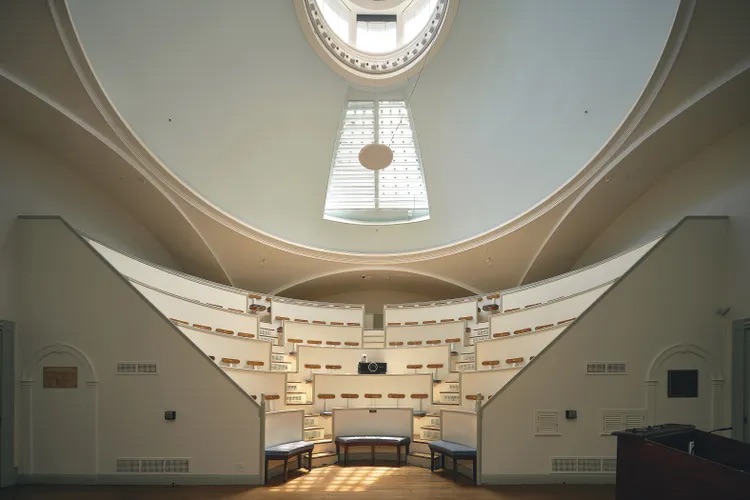
The setting for one of medicine’s most famous demonstrations was an operating theater at Massachusetts General Hospital in Boston. The room was built high in the hospital and designed to take advantage of natural sunlight, which was especially important before electric lighting became common.
The space also had theater-style seating, allowing medical students and physicians to observe procedures from above. Like many operating rooms of its era, it reflected a period before modern sterile practices and advanced surgical technology.
On October 16, 1846, the room was filled with anticipation. Surgeon John Collins Warren and other respected physicians gathered to observe a procedure involving an unusual possibility: performing surgery on a patient who had first inhaled an anesthetic substance.
No one could be certain that it would work.
The room would later become known as the Ether Dome, and the events that unfolded there would give it a permanent place in the history of medicine.

One Dentist Had Already Tried—and Failed in Public
The idea of using inhaled substances to reduce pain did not begin with the successful ether demonstration. A Connecticut dentist named Horace Wells had already explored the potential of nitrous oxide, commonly known as laughing gas.
Wells reportedly became interested in the substance after observing a person who appeared to suffer an injury while under its effects but did not seem to experience the expected pain. This observation led Wells to experiment with nitrous oxide during dental procedures.
After achieving encouraging results in his own practice, he brought the idea to Boston for a public demonstration. The procedure began, but the patient reacted during the extraction, apparently because the gas had been removed too soon.
The audience responded harshly. Wells was publicly embarrassed, and his failed demonstration became an important part of the later story.
Ironically, the words used to mock Wells would soon return in one of the most famous moments in medical history.

William Morton Arrived With a Different Approach
Two years later, another dentist, William T.G. Morton, prepared to demonstrate the use of ether. Morton had consulted with Charles Jackson, a Boston chemist and geologist, about substances that might produce a more reliable anesthetic effect.
For the demonstration, Morton used a specially designed inhaler containing a sponge soaked with ether. The patient inhaled the substance and gradually became sedated.
John Collins Warren then began a brief operation to remove a tumor from the patient’s neck.
This time, the procedure unfolded very differently from Wells’ earlier public demonstration. The patient did not struggle, and the operation was completed while he remained sedated.
For the physicians and students watching, the implications were enormous. The demonstration suggested that surgery no longer had to depend entirely on a patient’s ability to tolerate severe pain.
A new possibility had entered the operating room.

“Gentlemen, This Is No Humbug”
After the procedure, Warren reportedly turned toward the audience and delivered the words that became permanently associated with the event: “Gentlemen, this is no humbug.”
The phrase was more than a declaration that the demonstration had succeeded. It also echoed the ridicule that Horace Wells had faced during his earlier attempt to demonstrate anesthesia in the same medical environment.
The successful ether demonstration quickly became one of the defining moments in the history of surgery. It showed that inhaled anesthesia could allow patients to undergo procedures without experiencing the operation in the way previous generations had.
Over time, anesthesia developed into a major field of medicine. New substances, delivery methods and monitoring techniques gradually replaced or improved upon early approaches.
But while the medical world moved toward a future with less painful surgery, the people connected to the breakthrough entered a long and destructive battle over recognition.
The Great Question: Who Actually Deserved the Credit?
The history of anesthesia does not have one universally accepted hero. Several individuals made important contributions, and their roles became the subject of intense arguments.
William Morton was associated with the famous public ether demonstration of 1846. Charles Jackson argued that he had provided the crucial scientific guidance behind Morton’s use of ether. Horace Wells maintained that his earlier work with nitrous oxide had established the principle of inhaled anesthesia.
Then there was Crawford Long, a physician in Georgia who had reportedly used ether during surgery in 1842, several years before the Massachusetts General Hospital demonstration. However, Long did not publish his findings until 1849.
The dispute therefore depended partly on how one defined discovery. Was the key achievement the first successful use of an anesthetic? The first public demonstration? The scientific recommendation of a particular substance? Or the publication that allowed the idea to spread?
Historians generally recognize that the development of anesthesia was not the achievement of one person alone.
A Medical Breakthrough Turned Into a Bitter Rivalry
Instead of ending with universal celebration, the success of ether triggered a prolonged struggle for recognition.
Morton attempted to protect and profit from the discovery, even using the name “letheon” in connection with his anesthetic. He later sought official recognition and financial compensation, including through efforts involving the U.S. government.
Jackson, meanwhile, argued that Morton had received public credit for an idea that was fundamentally based on his scientific advice. Their conflict became increasingly personal and continued for years.
Wells also sought recognition for his earlier work with nitrous oxide. He gathered support from colleagues and attempted to establish his role in the history of anesthesia.
The extraordinary irony was difficult to ignore. A breakthrough intended to reduce human suffering had become the source of years of conflict for several of the people who believed they had helped create it.
The battle was no longer about the operating room. It had become a fight over legacy, reputation and historical memory.

The Human Cost of the Fight for Recognition
The rivalry took a heavy personal toll. Wells struggled in the years following his public humiliation and later death at a young age became one of the tragic elements associated with the history of the anesthesia dispute.
Morton spent years pursuing recognition and financial reward. According to Smithsonian’s account, the effort consumed significant amounts of his energy and resources, while other parts of his professional and personal life deteriorated.
Jackson continued his own campaign to establish his role in the discovery. His later years were also marked by serious personal difficulties.
These events are often remembered as a cautionary contrast to the medical achievement itself. The history of anesthesia was not simply a story of scientific progress. It was also a story about ambition and the enormous personal stakes that can surround a major discovery.
The people who helped move medicine toward a less painful future were unable to agree on who should stand at the center of that achievement.

Crawford Long Added Another Layer to the Story
Crawford Long complicated the debate even further. Long had reportedly used ether as an anesthetic during surgical procedures in Georgia as early as 1842.
That was four years before Morton’s famous public demonstration in Boston.
However, Long did not publish his findings until 1849. By that time, the 1846 demonstration had already received widespread attention and helped spread the idea of ether anesthesia internationally.
This difference between discovery and publication became one of the central questions surrounding Long’s place in history. A scientific or medical breakthrough can occur in one place, but its influence may remain limited until the knowledge is publicly communicated.
For this reason, historians often distinguish between Long’s earlier use of ether and Morton’s highly influential public demonstration. Both events remain important to understanding how anesthesia entered modern medicine.
Anesthesia Changed Surgery Around the World
Whatever disagreements existed over credit, the impact of anesthesia was impossible to deny.
In the year following the 1846 demonstration, Massachusetts General Hospital performed multiple operations using anesthesia. Over the following decades, the ability to control pain transformed surgical practice.
Surgeons could begin to focus less exclusively on completing procedures as quickly as possible. Patients could undergo operations that would previously have been almost unimaginable.
Anesthesia also continued to evolve. Ether itself eventually became less common as newer anesthetic agents were developed, offering important advantages such as reduced flammability and fewer unwanted effects.
Today, anesthesia includes a wide range of techniques, from local and regional anesthesia to general anesthesia supported by sophisticated monitoring systems.
What began with experiments involving gases and simple inhalation devices eventually became a central part of modern medical care.
The Ether Dome Is Now a Landmark
The room where the famous 1846 demonstration took place still exists. Today, the Ether Dome is preserved as a historic site connected to one of the most important developments in the history of surgery.
Its transformation is symbolic. The room was once an operating theater where students watched procedures performed under conditions that would seem extraordinary by modern standards.
Today, it serves as a reminder of how dramatically medicine has changed.
Boston also has a major monument dedicated to the discovery of anesthesia. Interestingly, the monument does not simply celebrate one individual as the sole hero of the breakthrough.
That decision reflects the complexity of the historical record.
The story of anesthesia belongs not to one name but to a series of experiments, observations, failures, demonstrations and competing claims that collectively changed the future of medicine.

Four Men Claimed the Discovery—History Gave Them Partial Credit
Horace Wells, William Morton, Charles Jackson and Crawford Long all became associated with the discovery of surgical anesthesia.
Each had a claim.
Wells demonstrated the potential of inhaled substances to reduce pain. Morton carried out the famous 1846 ether demonstration that convinced a major medical audience. Jackson contributed scientific advice regarding ether. Long had used ether in surgical practice before the Boston demonstration but published his findings later.
The debate over who deserves the greatest recognition has continued for generations.
Perhaps the most accurate answer is that modern anesthesia emerged through a process rather than a single dramatic moment. Individual ideas and actions built upon one another.
Scientific history is often more complicated than the stories told on monuments.
The development of anesthesia is a powerful example of that complexity.

The successful ether demonstration of October 16, 1846, helped transform surgery from an experience dominated by pain into one that could be controlled through anesthesia. Yet the achievement also produced a long and painful dispute among the people who believed they deserved recognition. Wells, Morton, Jackson and Long each played a different role in the story, and history has never completely settled the question of who should receive the greatest credit. Perhaps that is why the legacy of anesthesia is ultimately larger than any one name. The real achievement is the transformation that followed: a breakthrough that changed medicine and reshaped the experience of surgery for generations to come.