On the morning of November 20, 1980, workers on an oil-drilling platform in Louisiana thought they were dealing with a stuck drill pipe. Then the platform began to tilt. The crew escaped to shore, but moments later the 150-foot derrick disappeared into Lake Peigneur—a lake that had previously been only about 11 feet deep. The explanation was almost unbelievable: the drilling operation had opened a pathway into a massive salt mine beneath the lake. Water rushed underground, dissolved the salt and turned a routine drilling problem into a catastrophic whirlpool.
Two Industries Were Operating Around the Same Lake
Before the disaster, Lake Peigneur covered roughly 1,300 acres near Jefferson Island in Iberia Parish, Louisiana. It was broad but remarkably shallow, making what happened on November 20 seem almost impossible at first.
Two very different industries were operating in the same area.
Oil companies had been exploring beneath the region for decades. On the surface of the lake, drilling platforms were used to search for petroleum deposits beneath the lakebed. Far below, however, miners were working inside the Diamond Crystal salt mine.
The salt operation had begun in the early 20th century, and Diamond Crystal Salt Company had acquired it in the 1950s. Beneath the lake and surrounding land was an extensive network of underground chambers supported by pillars of unmined salt.
These were not small natural cavities. They were enormous industrial spaces where workers operated machinery and moved through underground passages.
Normally, the lake and the mine could exist directly above and below one another without interacting. Layers of rock and salt separated the surface water from the mine workings.
That separation was critical.
Salt, however, has a dangerous weakness when exposed to large amounts of flowing water: it dissolves. Once water finds a pathway into a salt formation, the opening can grow as more salt disappears. As the opening grows, more water can enter, which can accelerate the process even further.
That was exactly the kind of chain reaction about to begin beneath Lake Peigneur.

The Drilling Platform Began Leaning Toward the Water
The crew was drilling an exploratory oil well for Texaco, with equipment operated by Wilson Brothers Corporation. At first, nothing suggested that the lake itself was in danger.
The drill assembly became stuck at a relatively shallow depth. The workers tried to free it, treating the problem as a difficult but ordinary drilling complication.
Then things changed.
The platform began moving.
The workers noticed that the rig was tilting toward the water and heard unusual noises coming from below. The situation was clearly becoming dangerous, so the crew abandoned the platform and made their way to shore.
Their decision was crucial.
The drilling rig continued to lean until the platform overturned. Then the entire structure disappeared into the lake.
The sight was extraordinary. The derrick stood approximately 150 feet tall, while Lake Peigneur had previously been only about 11 feet deep.
How could a lake that shallow possibly swallow something that large?
The answer was beneath the lakebed.
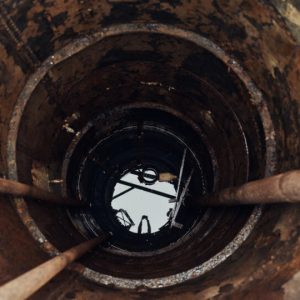
The drilling operation had created a connection between the lake and the underground salt mine. Water began rushing through the opening and into the mine. As the water encountered the salt, it dissolved the surrounding material and enlarged the passage.
The lake was no longer simply losing water.
Its entire bottom was beginning to collapse.
Watch the video to see how the Lake Peigneur disaster unfolded, from the drilling accident to the massive whirlpool that swallowed the oil rig and 11 barges.
Miners Raced Toward the Only Way Out
The danger was not limited to the people working on the drilling platform.
Far below the lake, miners were suddenly facing an entirely different emergency.
Water began entering sections of the Diamond Crystal mine that had previously been dry. The workers had to move through the underground passages toward the mine shaft and elevator before the advancing water cut off their escape route.
The situation was particularly frightening because the miners could not simply climb directly to the surface.
They depended on the elevator.
Only a limited number of people could be transported during each trip, meaning some miners had to wait underground while others were carried upward.
Meanwhile, water continued entering the mine.
The difference between escaping and becoming trapped came down to time.
Fortunately, every miner made it out.
The oil-drilling crew also reached safety, and people around the lake moved away as the shoreline began collapsing. Despite the enormous physical destruction that followed, no human lives were lost and no serious human injuries were reported.
Once the last miners had escaped, however, there was essentially nothing anyone could do to stop the flooding.
The mine contained a vast network of chambers. Water continued pouring into the underground spaces, dissolving more salt and destabilizing more of the structure.
A drilling problem had become a geological catastrophe.

The Whirlpool Began Pulling in Everything Nearby
As the underground opening grew, Lake Peigneur began behaving in a way that witnesses had never seen before.
The surface started rotating around a massive vortex.
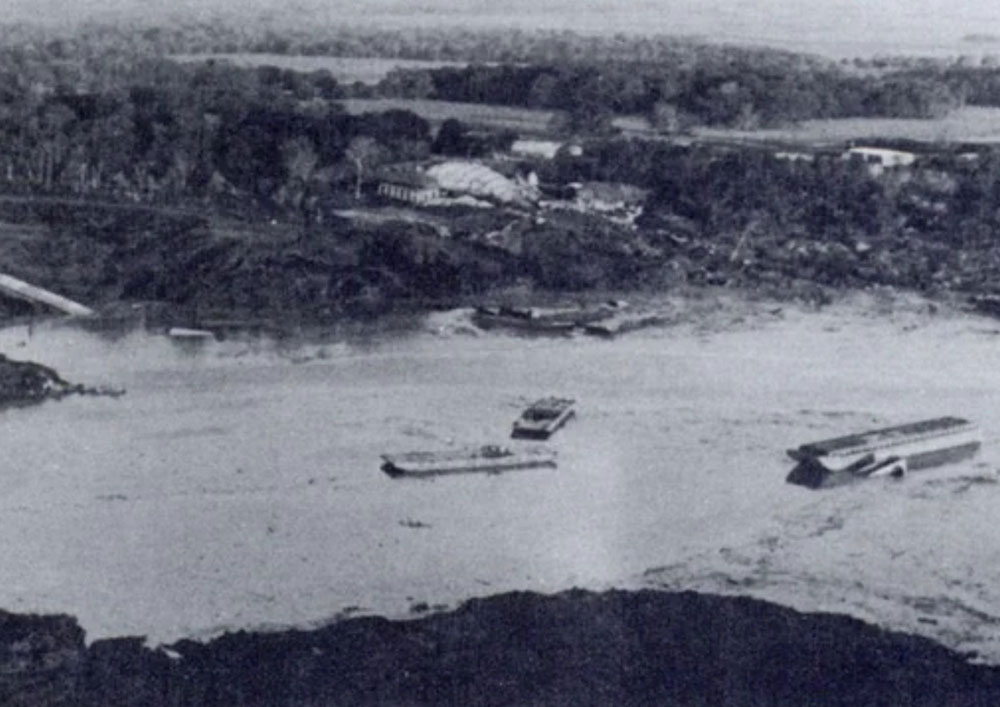
The whirlpool eventually reached roughly a quarter of a mile across. Water, mud and debris were pulled toward the center as sections of the shoreline collapsed.
The first drilling rig had already disappeared.
Then more objects followed.
Another drilling platform was pulled into the collapse. A loading dock, vehicles, trees and sections of nearby land were swallowed. Eleven barges associated with activity along the canal were drawn toward the whirlpool, along with a tugboat. Approximately 70 acres of shoreline and surrounding land were reportedly lost or damaged.
The scene was almost the opposite of a conventional flood.
In a flood, water rises and spreads outward.
At Lake Peigneur, the water was moving downward.
Billions of gallons were being pulled beneath the surface into the underground mine.
Objects that had been sitting safely on or beside a shallow lake were suddenly being dragged toward a hole leading into mine chambers more than a thousand feet underground.
The landscape itself was changing as the salt structure beneath Jefferson Island failed.
Trees slid into the water along with the soil supporting them. Equipment disappeared. Sections of land collapsed.
For several hours, the lake effectively became the entrance to an enormous underground drainage system.
Watch the video to see the incredible Lake Peigneur disaster unfold and discover how a drilling accident turned a quiet Louisiana lake into a massive whirlpool.
The Delcambre Canal Suddenly Flowed Backward
The strangest part of the disaster had not yet happened.
Before the accident, the Delcambre Canal carried water away from Lake Peigneur toward Vermilion Bay and the Gulf of Mexico.
But as Lake Peigneur drained into the mine, its water level dropped dramatically.
Eventually, the relationship between the lake and the canal reversed.
Water that normally flowed away from the lake began flowing toward it.
The Delcambre Canal suddenly started running backward, pulling salt water inland from the Gulf system. A huge waterfall formed where the canal entered the newly deepened lake basin.
The reversal also affected the barges.
Eleven were swallowed during the disaster, although nine eventually resurfaced after the violent currents subsided and the lake began filling again.
The returning Gulf water fundamentally changed the lake.
Before the accident, Lake Peigneur had been a shallow freshwater lake.
Afterward, it was much deeper and increasingly influenced by salt water.
The change in depth was extraordinary. Areas that had previously been approximately 11 feet deep eventually reached around 200 feet.
Air trapped inside the flooded mine was also forced upward as water filled the underground chambers. Witnesses reported dramatic eruptions of air and water as pressure escaped from below.
Eventually, the violent movement stopped.
The lake returned.
But it was no longer the same lake.

The Exact Chain of Errors Became a Legal Dispute
The broad physical cause of the disaster was clear: the drilling operation had created a connection between Lake Peigneur and the salt mine underneath it.
But determining exactly why that happened proved much more complicated.
Diamond Crystal filed a federal lawsuit shortly after the disaster, accusing the drilling operation of puncturing the salt structure and destroying the mine. Texaco disputed responsibility and argued that its crew had drilled at the location provided through the project’s mapping and permitting process.
Later accounts have frequently described the disaster as the result of a mapping or coordinate error that placed the drilling operation in the wrong location.
But reconstructing every technical detail was difficult.
The drilling equipment had disappeared into the flooded mine. The mine itself could no longer be safely entered, and investigators could not simply visit the original breach and examine it under normal conditions.
Instead, investigators had to rely on plans, coordinates, records and testimony.
The companies eventually pursued claims and counterclaims over the destruction. In 1983, Diamond Crystal accepted a $32 million out-of-court settlement from Texaco and Wilson Brothers. Other property claims were handled separately.
The salt mine never reopened.
Once it had been flooded, its underground chambers were permanently lost as a working industrial facility.
The Lake That Returned Was Permanently Different
Lake Peigneur eventually refilled, but the disaster had permanently changed its landscape.
The shallow freshwater lake that existed before November 20, 1980, was gone.
In its place was a much deeper body of water with a radically altered shoreline and ecosystem. Salt water entering through the reversed canal changed the environmental conditions in the lake, affecting the plants and animals that could survive there.
The abandoned salt mine remained beneath the lake, filled with water, debris and equipment carried into it during the collapse.
The objects that vanished during those chaotic hours became part of the underwater landscape.
The drilling rigs were gone.
Eleven barges were pulled into the vortex.
Sections of land disappeared.
And an underground mine that had once been a functioning industrial operation was permanently flooded.
Yet the most remarkable part of the story remains the human outcome.
Everyone escaped.
The drilling workers made it safely to shore. The miners reached the surface before the mine was completely overwhelmed. Despite the scale of the destruction, the disaster did not claim a human life.
What began with a stuck drill pipe ultimately transformed an entire lake.
Water entered the mine.
The water dissolved the salt.
The opening expanded.
The lake drained.
The canal reversed.
Gulf water flowed inland.
And the landscape was permanently redrawn.
The Lake Peigneur disaster remains one of the strangest examples of how a relatively small engineering mistake can trigger a chain reaction far beyond the original problem.
The Lake Peigneur disaster began with something that seemed almost routine: a drilling crew trying to free a stuck drill pipe. But once the operation opened a pathway into the salt mine below, water transformed a small breach into a massive underground collapse. The lake swallowed an oil rig, another platform, 11 barges and sections of the surrounding land before the canal reversed and refilled the newly deepened basin. Yet the most remarkable detail is that everyone escaped. The lake survived—but the shallow freshwater lake of 1980 never returned.