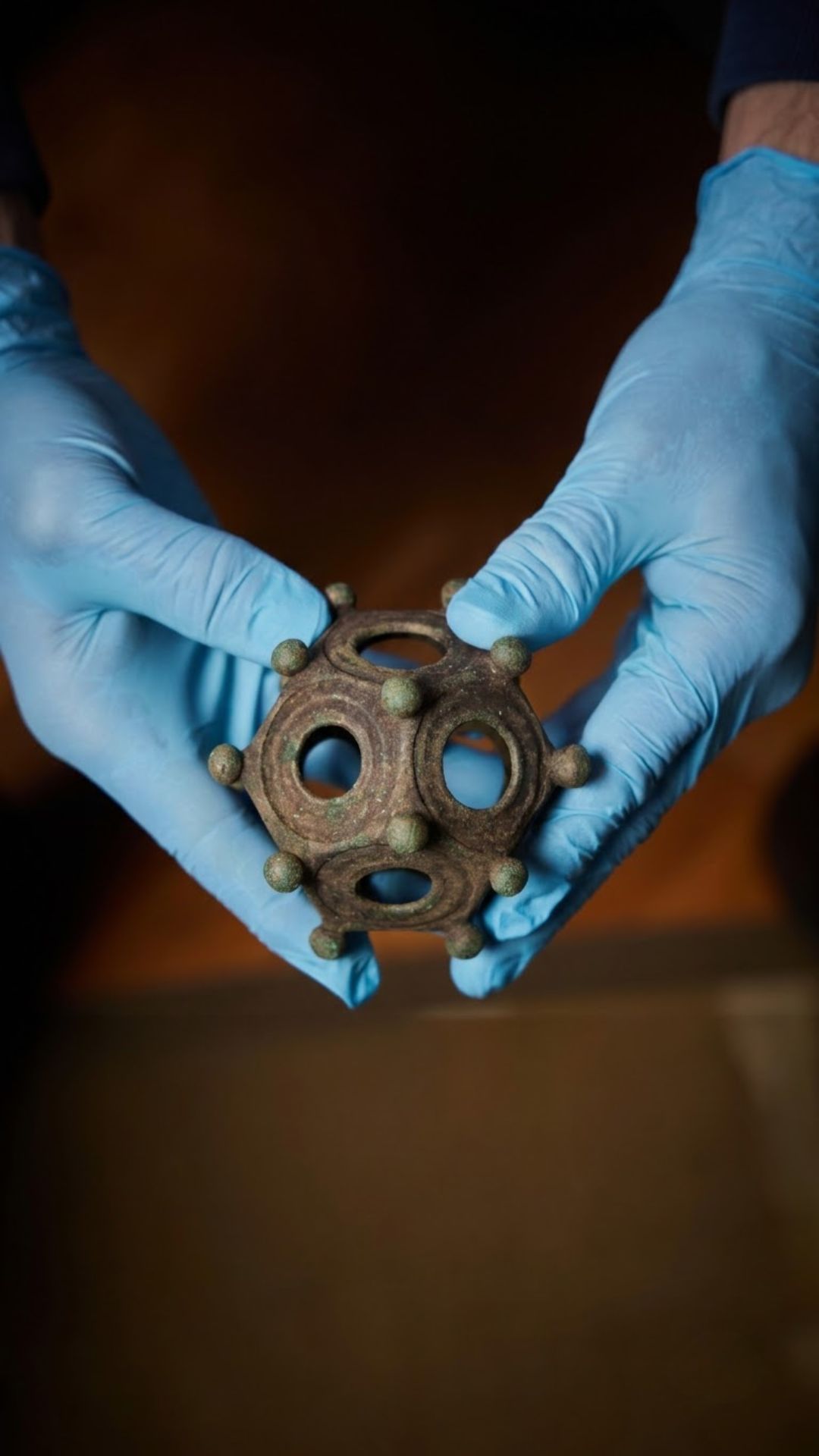
The Romans left behind roads, temples, coins, weapons and thousands of everyday objects that archaeologists can still identify today. But among those remains are more than 100 strange bronze objects that have resisted every attempt to explain them. Each has 12 pentagonal sides, a circular hole in each face and small knobs at the corners. They were carefully made, yet no Roman text or image tells us what they were used for. Archaeologists have proposed more than 50 theories, but nearly 2,000 years later, the purpose of the Roman dodecahedron remains a mystery.
A Strange Object With No Obvious Purpose
Roman dodecahedrons are among the most unusual surviving objects from the Roman world. They are generally made from copper alloy and are hollow, with twelve roughly pentagonal faces. Each face contains a circular opening, but the holes are usually different sizes, while small knobs project from the twenty corners. Many also carry incised or decorative markings.
The objects are also surprisingly sophisticated. Producing a hollow metal object with this shape would have required a skilled craftsman, and the amount of metal involved would have made it relatively expensive. English Heritage notes that they were likely important enough to be made to order rather than being simple mass-produced household objects.
That makes the mystery even more intriguing. These were not crude pieces of scrap metal. Someone deliberately designed them, someone had the skill to make them, and someone apparently had a reason to own them. The problem is that archaeology has not provided the final piece of the puzzle.
Unravel the mystery of the Roman Dodecahedron! These ancient 12-sided bronze artifacts have baffled historians for centuries. Were they tools for astronomy, religious rituals, or something more practical like knitting? Dive into this fascinating engineering enigma from The UnXplained and discover if the Romans were more advanced than we imagined.
Archaeologists Have Been Puzzled For Centuries
The earliest known discoveries of these objects date back to the 18th century, and they have remained difficult to interpret ever since. About 120 are known across the former Roman world, although the distribution is highly unusual. They have been found mainly in parts of northwestern Europe, including Britain, France, Germany and surrounding regions, while none are known from Italy, Spain, Africa or the Mediterranean.
Their archaeological context has not helped much. Many were found without enough surrounding evidence to establish what they were doing at the site. Some have been associated with settlements, others with military areas or burials, but there is no consistent pattern showing that they belonged to one particular group or activity.
That absence of context matters enormously. If dozens of them had been discovered inside Roman temples, archaeologists could reasonably suspect a religious function. If they were consistently found alongside military equipment, a military purpose would become more convincing. Instead, the objects appear in circumstances that do not point to one obvious use.
As a result, the dodecahedron has become an archaeological blank space: an expertly made object with no surviving explanation.
More Than 50 Theories Have Been Proposed
The most fascinating part of the mystery is the sheer number of possible answers.
One theory suggests that dodecahedrons were used as surveying or measuring instruments, perhaps to estimate distances or the size of distant objects. The different-sized holes appear tempting for such an explanation, although the lack of markings or scales makes the theory difficult to prove. Other researchers have suggested that the objects could have been used to determine the best time to sow winter grain.
Other explanations are much more mundane. Perhaps they were candle holders, dice, decorative objects or even children’s toys. Another famous theory proposed that the different-sized holes were useful for knitting gloves, with different openings corresponding to different finger sizes. The idea attracted attention, but knitters have pointed out practical problems with using the objects in this way.
There are also theories involving religion and ritual. The unusual geometry of the objects has led some researchers to consider whether they had symbolic or ceremonial significance. Others have suggested that they may have been components of a larger object or even decorative finials.
The sheer range of theories tells us something important: the problem is not a lack of imagination. It is a lack of evidence.

One Discovery Shows Why Context Matters
A Roman dodecahedron found at Corbridge, near Hadrian’s Wall in northern England, illustrates the problem particularly well.
Corbridge developed from a military fort into an important town and supply center on the northern frontier of the Roman Empire. Archaeologists have uncovered tens of thousands of objects there, including military equipment, tools, religious material, pottery and evidence of everyday life.
Yet even at a site this extensively studied, the dodecahedron does not provide an obvious answer. English Heritage describes the Corbridge example as one of the most intriguing objects in its collection. It is made of copper alloy, hollow, decorated and difficult to manufacture, but its original purpose remains unknown.
The problem is repeated across the wider archaeological record. Very few dodecahedrons have been found in clear enough contexts to connect them confidently with a particular activity. Even when archaeologists know approximately when an object was made, knowing when something existed is very different from knowing why it existed.
That distinction is easy to overlook. Archaeology can tell us where an object was buried, what material it was made from and sometimes when it was produced. But the missing piece here is the one modern people most want: what did its owner actually do with it?
The Shape May Be The Biggest Clue — Or A Distraction
At first glance, the twelve holes seem like the obvious clue. Why would an object have so many openings, and why would those openings vary in size?
That question has driven many of the proposed explanations. A measuring instrument would make use of the different diameters. A knitting device could theoretically use them as guides. A candle holder might explain the hollow structure. A rangefinder might explain the geometry. Yet each theory encounters another problem somewhere in the evidence.
The objects themselves are not identical, either. Their dimensions, decorations and details vary from one example to another. That variation makes it difficult to assume that every dodecahedron served precisely the same purpose. At the same time, their shared basic design suggests that the makers and users recognized some common concept.
This is what makes the mystery so resistant to a simple answer. Almost every proposed function can explain one feature, but struggles to explain all of them at once.
A good archaeological explanation has to account for the shape, materials, distribution, construction, context and variations between objects. So far, none has done that convincingly enough to end the debate.
Nearly 2,000 Years Later, The Mystery Remains
The Roman dodecahedron is unusual not because archaeologists have found nothing about it, but because they have found just enough to know that it was deliberately made while lacking the evidence needed to understand why.
More than 100 examples have survived. They were carefully crafted, sometimes elaborately decorated and important enough to justify the work and material required to produce them. Yet there is no surviving Roman instruction manual, inscription or clear artistic depiction that identifies their purpose. English Heritage notes that more than 50 different theories have appeared in academic literature alone.
That may be why these objects continue to fascinate people. The Roman world often feels remarkably familiar. We know what many Romans ate, how they traveled, what weapons they carried, how they built roads and how they organized their cities. Then archaeologists uncover a small bronze object that seems to say: there is still something you don’t understand.
Perhaps a future discovery will finally reveal what the dodecahedrons were for. Finding one in an unmistakable location, alongside an inscription or another object with a known function, could transform the debate overnight.
Until then, the strange twelve-sided objects remain exactly what they have been for centuries: carefully made Roman artifacts with a purpose that disappeared with the people who used them.
Roman dodecahedrons are a reminder that even one of history’s most extensively studied civilizations can still keep secrets. More than 100 of these carefully crafted bronze objects have been discovered across northwestern parts of the former Roman Empire, yet their purpose remains uncertain. They may have been tools, instruments, religious objects or something archaeologists have not yet considered. After centuries of discoveries and more than 50 theories, the most honest answer is still the simplest: we don’t know what they were for.
If you want to explore the mystery further, English Heritage has examined the dodecahedrons found at Corbridge and the many theories surrounding them. Source: https://www.mentalfloss.com/science/archaeology/are-roman-dodecahedrons-worlds-most-mysterious-artifact