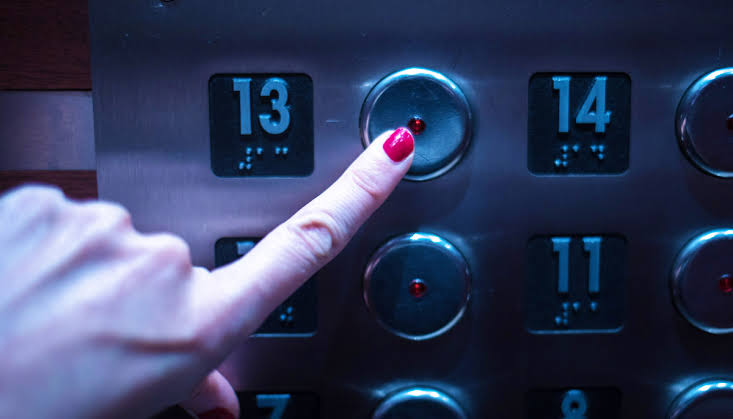
Walk into a tall building and look at the elevator buttons. In many parts of the world, you may see the numbers climb from 11 to 12 and then suddenly jump to 14. The 13th floor may physically exist, but its number has disappeared. This strange absence is the legacy of one of the world’s most persistent superstitions. For centuries, the number 13 has been associated with bad luck, betrayal and disaster—and modern society still has not completely escaped its influence.
A Number That Modern Buildings Still Avoid
The most fascinating thing about the fear of 13 is that it has survived into an age of skyscrapers, aviation and digital technology. Architects can design towers hundreds of meters high, but many developers still prefer not to label one of their floors with the number 13. Hotels may skip Room 13, while some airlines and other businesses have avoided using the number in their own systems.
Of course, removing the number does not remove the physical space. A building that jumps from the 12th floor to the 14th has not somehow escaped mathematics. The floor exists. Only the label has changed. But that decision reflects something deeper: superstition can influence human behavior even when people know there is no rational evidence that the number itself has supernatural power.
This is what makes 13 more interesting than an ordinary lucky or unlucky symbol. The fear has been powerful enough to leave visible marks on the modern world.
Why are we afraid of the number 13? Why do so many buildings skip the 13th floor? And is there any real evidence that Friday the 13th brings bad luck—or is it all just superstition? Watch the video and explore the strange history behind one of the world’s most feared numbers.
Before 13 Became Unlucky, 12 Was Already Special
One explanation begins with the number 12.
Throughout history, 12 has repeatedly appeared in systems humans used to organize the world. There are 12 months in a year, 12 signs of the zodiac and roughly 12 hours on a traditional clock face. Christianity has 12 apostles, while ancient traditions repeatedly treated groups of 12 as symbols of order and completeness.
The number was also practical. Twelve can be divided evenly by 2, 3, 4 and 6, making it useful long before modern decimal systems became dominant.
Against that background, 13 could appear disruptive.
If 12 represented completeness, 13 represented the number that came after completeness. It broke the pattern. It was the unexpected extra person at the table, the number outside the established order.
That idea alone probably cannot explain every superstition surrounding 13, but it provides an important foundation. The number may have become uncomfortable partly because it stood just beyond a number that humans had already filled with symbolic meaning.

The Thirteenth Guest Became a Dangerous Symbol
One of the most persistent explanations for the number’s reputation comes from the idea of thirteen people sitting together at a meal.
In Christian tradition, the Last Supper brought Jesus and his 12 apostles together, creating a group of 13. Judas Iscariot, who later betrayed Jesus, is often associated with the fatal symbolism of the thirteenth guest.
But Christianity was not the only tradition to connect the number with a disastrous gathering.
Norse mythology contains a similar story involving a banquet attended by 12 gods. Loki, the trickster god, arrived as an uninvited thirteenth guest. The events that followed led to the death of Balder, one of the most beloved gods in Norse mythology.
Whether these stories created the superstition or simply reinforced an older belief is difficult to determine. What matters is that the pattern became culturally powerful: twelve represented an ordered gathering, while the thirteenth arrival brought chaos.
That image survived for centuries.
Even today, some people remain uncomfortable with the idea of 13 guests sitting at the same dinner table.
Friday the 13th Made the Fear Even Stronger
The number became even more famous when it merged with another superstition: the idea that Friday itself was unlucky.
Christian traditions connected Friday with the crucifixion of Jesus, while various European beliefs attached negative associations to the day. Eventually, the combination of an unlucky number and an unlucky day produced one of the Western world’s most famous symbols of bad fortune: Friday the 13th.
A popular story also connects the date with the arrest of the Knights Templar on Friday, October 13, 1307. However, historians have noted that the modern fear of Friday the 13th is more complicated than a single medieval event and appears to have developed over time.
The superstition nevertheless became powerful enough to influence popular culture, literature and eventually the horror film industry. Today, even people who do not consider themselves superstitious immediately understand the dark symbolism of Friday the 13th.
The number had become more than a number.
It had become a warning.
The Fear of 13 Even Has a Name
The fear of the number 13 is known as triskaidekaphobia, a term derived from Greek words referring to thirteen and fear.
The existence of a name does not mean everyone who dislikes 13 has a clinical phobia. For many people, the superstition is mild. They may avoid the number in a hotel room, lottery ticket or important decision without genuinely believing that disaster will follow.
Yet the persistence of the belief is remarkable.
A person may know perfectly well that moving from the 12th floor to the 14th floor does not make a building safer. A traveler may understand that Seat 14 is not protected by supernatural forces simply because Seat 13 does not exist.
But businesses understand something important: customers do not always make decisions based purely on logic.
If skipping the number 13 makes some guests feel more comfortable, there is little commercial reason to insist on displaying it.
In that sense, superstition survives not because everyone believes it, but because avoiding it costs very little.

The Number 13 Is Not Unlucky Everywhere
Perhaps the most important point is that 13 is not universally feared.
Different cultures have developed different numerical superstitions. In several East Asian societies, the number 4 has historically carried negative associations because its pronunciation can resemble the word for death in certain languages. As a result, some buildings and businesses avoid using the number 4 in similar ways.
In Italy, the number 17 has traditionally been associated with bad luck, while other cultures have their own symbolic numbers connected with misfortune or good fortune.
This suggests that numbers themselves do not carry universal meanings.
Humans give them meaning.
The number 13 has no mathematical property that makes it inherently dangerous. Its power comes from stories, religious traditions, mythology and centuries of repetition. Generation after generation inherited the idea that something was strange about the number, even when the original reasons became less important.
That may be why the superstition has survived so well.
It does not require proof.
It only requires memory.

The number 13 has survived for centuries as one of the world’s most recognizable symbols of bad luck, leaving traces everywhere from religious stories and Norse mythology to hotel elevators and modern skyscrapers. Its reputation may have been strengthened by the symbolism of 12, the story of the thirteenth guest and the dark associations of Friday the 13th. Yet the most interesting part is that 13 is not universally unlucky at all. The number has power only because humans gave it power—and in many places, we are still designing buildings around that belief.