Ten days after a catastrophic flood tore through Nepal’s Himalayan valleys, rescue teams are still finding people alive. On September 5, rescuers pulled a Chinese worker from a 225-meter tunnel at the Upper Trishuli-1 hydropower project, while a 64-year-old Nepali woman was rescued from a mud-filled home in Nuwakot. Their survival came as more than 5,000 people remained missing and hundreds of hydropower workers were still feared trapped underground. The discoveries have given rescuers a reason to keep searching—even as the window for finding more survivors narrows.
The Flood Came With Almost No Time To Escape
The disaster began on August 26 after a glacier collapse in the Himalayan region triggered a devastating surge of water, ice, rock and mud. The torrent swept through communities near the Nepal-Tibet border, destroying homes, roads, bridges and major hydropower facilities along the Trishuli River. By September 5, Nepal had recorded more than 1,300 deaths, while thousands of people remained missing.
The destruction was particularly severe around hydropower projects, where hundreds of workers were underground when the flood hit. Authorities estimated that about 900 workers across a dozen projects were still unaccounted for, with roughly 500 believed to be trapped inside tunnels. Some entrances were buried under enormous quantities of mud and rock, turning the rescue into a race against both time and the landscape itself.
For rescuers, simply reaching a tunnel entrance could become a major operation.

Then Rescuers Found Two Men Alive
On September 4, rescuers made the first major breakthrough. Two Nepali workers, Sanjay Shah and Kabir Maharjan, were pulled alive from a tunnel at the Trishuli 3A hydropower project after spending nine days underground. Rescue teams had been working through debris and rock when they heard signs that people were still inside.
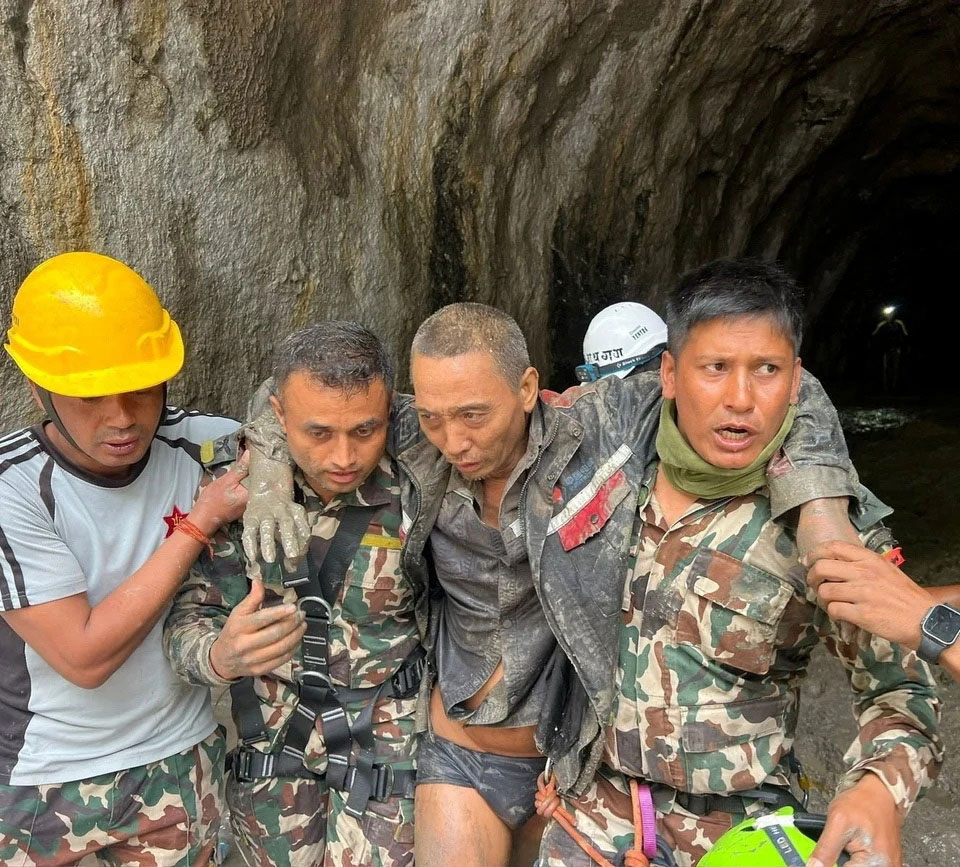
The next day brought another astonishing discovery. A joint team of Nepali military personnel and South Korean disaster experts rescued a Chinese worker identified as Lu Haitao from a 225-meter tunnel at the Upper Trishuli-1 hydropower project. He had been trapped for about 10 days. Images released after the rescue showed him being carried from the tunnel and later receiving medical treatment during a helicopter evacuation.
Officials said Lu had no visible major injuries, although he showed signs of mild hypothermia and was exhausted and disoriented. His rescue brought the number of workers pulled alive from tunnels in the Trishuli hydropower area to three in two days.
The timing mattered enormously. By then, rescuers had already spent more than a week searching through one of the worst disasters Nepal had seen in years.
Against all odds, hope remains in Nepal. Watch the incredible story of two survivors found 10 days after the devastating floods.
A Second Survivor Was Found In A House
The same day, rescuers made another discovery far from the hydropower tunnels.
In the town of Betrawati in Nuwakot district, they found 64-year-old Chandika Kumari Shrestha alive inside her mud-submerged home. Rescue workers worked in thick sludge and confined conditions to reach her, then transferred her for medical treatment.
The two rescues were completely different. One survivor had spent days inside a deep industrial tunnel; the other was found in the remains of a house overwhelmed by mud.
But they had the same effect on the wider rescue effort.
They showed that people could still be alive in places where rescuers had feared there was little chance of finding anyone.
The Underground Search Is Becoming The Main Focus
The hydropower tunnels present an especially difficult rescue problem because they are not simple caves with known entrances. They are extensive industrial structures, many of them damaged, flooded or blocked by debris after the disaster.
Search teams have used excavators, controlled blasting, drones and other specialized equipment to reach the trapped workers. In some places, rescuers have had to clear tunnels manually because heavy machinery cannot yet reach the blocked sections.
Drone operators have also tried using speakers to call out to people who might still be alive. Some searches involved playing music and waiting for a response, but teams quickly discovered that mud had filled many tunnel sections so completely that there was little open space for a drone or even sound to travel through.
That is what makes the latest rescues so significant.
They are not proof that hundreds of people are still alive underground. But they are proof that survival remained possible well after the disaster—and that uncertainty is enough to keep the search going.

Families Are Still Waiting For Answers
Across the affected region, families of missing workers continue to wait for information.
Reuters reported the case of Ishwor Poudel, a worker believed to have been inside the Hakubesi Hydroelectric Project when the flood struck. His brother said the family had been told by other survivors that Ishwor might still be inside and that voices had been heard from within the tunnel.
Such reports are difficult to verify, but they help explain why rescue crews continue entering dangerous areas long after the initial response would normally have shifted toward recovery.
Every new survivor changes the calculation.
A person found alive after nine or ten days means that another rescue attempt cannot simply be dismissed because too much time has passed.
But the danger is increasing too. Damaged tunnels can collapse, water can move unexpectedly through underground passages, and unstable hillsides continue to threaten crews working around the entrances. Experts have warned that the longer the disaster continues, the more difficult and dangerous the operation becomes.
The Disaster Is Far From Over
The rescue stories are extraordinary, but they are occurring in the middle of a catastrophe that has devastated entire communities.
The floods destroyed major transportation links and more than 40 bridges in the affected areas, making it difficult to move equipment and reach isolated locations. Villages have been buried beneath mud and debris, while thousands of displaced people remain dependent on relief centers and emergency assistance.
International teams from countries including South Korea, India, China and the United States have joined Nepalese responders. Yet the scale of the destruction means even sophisticated equipment cannot solve every problem. Some areas remain difficult to access, and the search for missing people has become a combination of engineering, patience and informed hope.
As of September 5, rescuers were still concentrating on the hydropower sites where hundreds could remain trapped. The question was no longer simply whether survivors existed. It was whether rescuers could reach them in time.
Ten days after Nepal’s devastating floods, the discovery of more survivors has brought a remarkable shift in a rescue effort overshadowed by thousands of deaths and disappearances. A Chinese worker was pulled from a 225-meter tunnel, while a 64-year-old woman was rescued from her mud-filled home, following the recovery of two Nepali workers the previous day. Their survival does not mean others underground are still alive, but it has made one thing clear: rescuers cannot yet know who has survived until they reach the places where people may still be trapped.
P.S. This article is based primarily on reporting from The Guardian, Reuters and The Associated Press on the ongoing Nepal flood rescue operation, including the recent discoveries of survivors in hydropower tunnels and the continuing search for missing workers. Source: https://www.theguardian.com/world/2026/sep/05/rescuers-nepal-find-two-more-people-alive-flood-disaster