What if some of the monsters people feared for centuries were born from things that actually existed? A strange creature seen in the deep ocean could become the Kraken; enormous bones buried underground could become a legendary beast; an unusually large bird could grow into a story about a creature capable of carrying an elephant. The truth behind these monsters is not always clear—but in several cases, the line between what people saw and what they imagined is far more interesting than the legend itself.
The Kraken May Have Had a Real Animal Behind It
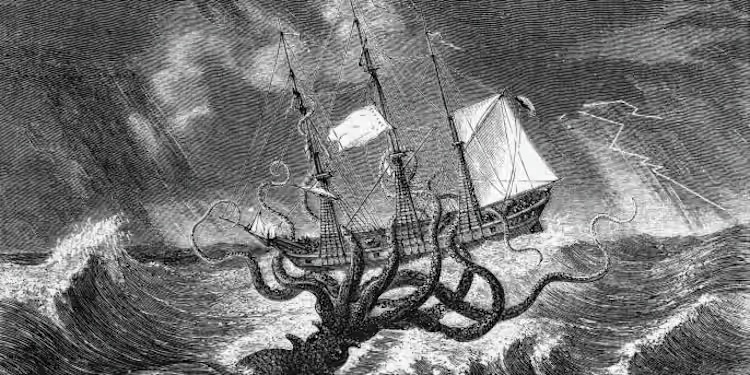
Few legendary creatures were more frightening to sailors than the Kraken. Its roots have been traced to the Norse creature known as the hafgufa, while later stories described a gigantic squid- or octopus-like beast off the coasts of Norway and Greenland, supposedly large enough for parts of its body to resemble a floating island.
In an 18th-century account, Bishop Erik Pontoppidan described the Kraken as capable of grabbing ships with its tentacles and creating a deadly whirlpool simply by submerging itself. The stories were clearly embellished, but the idea of a gigantic creature living far below the surface was not entirely absurd.
Real giant squid may have helped inspire the legend. History also notes that some paleontologists have proposed prehistoric cephalopods reaching enormous sizes, although that possibility does not prove that anything resembling the mythical Kraken ever attacked a ship. The intriguing part is that the ocean already contained animals strange enough to give frightened sailors the raw material for a monster.
The Kraken may have begun with stories about something real—but what if the legendary sea monster had actually existed? Watch the video to see what would happen if a creature large enough to drag ships beneath the waves truly lived in the oceans.
The Griffin May Have Started With Bones
The Griffin was an even stranger combination: the body and hind legs of a lion, paired with the wings, beak and talons of a hawk or eagle. The stories most likely originated in the Middle East before becoming a recurring figure in ancient Greek literature and later European writing.
By the 14th century, Sir John Mandeville’s largely fictional travelogue described Griffins as stronger than eight lions and a hundred eagles. The creature was portrayed as intelligent and fiercely formidable, capable of carrying victims into the air and dropping them from great heights.
One of the most fascinating explanations came from researcher Adrienne Mayor, who suggested that the legend could have been influenced by dinosaur fossils. Scythian nomads in Central Asia may have encountered the bones of Protoceratops and interpreted the remains as evidence of an unknown creature with bird-like features. It remains a theory, not proof of the Griffin’s origin, but it offers a remarkable example of how fossils could have been transformed into mythology.

The Manticore Turned a Distant Land Into a Nightmare
The Manticore came with almost every frightening feature ancient storytellers could imagine. It was said to have the head of a blue-eyed man, the body of a lion and the stinging tail of a scorpion, with three rows of teeth and a voice supposedly resembling a trumpet.
The story began with Greek writers such as Ctesias, who wrote about India, a distant land that was poorly understood by many people in the Mediterranean world. The Manticore was portrayed as extraordinarily fast, capable of attacking with its claws and tail and, most terrifyingly, possessing an appetite for human flesh.
Unlike the Kraken or Griffin, History does not offer a specific real animal or fossil as a likely source for the Manticore. What the story does show is how accounts of distant places could become increasingly fantastic as they traveled from one storyteller to another, turning unfamiliar geography into a home for creatures that seemed completely outside ordinary experience.

The Basilisk Could Kill Without Touching You
The Basilisk began appearing in written accounts as early as the first century, when Pliny the Elder described a snake-like creature with markings resembling a crown. By the Middle Ages, the animal had changed dramatically into a hybrid with the head of a rooster and the wings of a dragon or bat.
Its supposed powers were even more extraordinary. The Basilisk was said to possess a deadly bite and poisonous breath, but its most famous weapon was its gaze: according to legend, it could kill a person simply by looking at them. Medieval stories responded with an equally strange solution—use a mirror and let the creature kill itself with its own reflection. Weasels were also believed to be immune to its poison.
A particularly dubious story from 1587 Poland tells of a man wearing a leather suit covered in mirrors who supposedly hunted and captured a Basilisk after it had killed two girls and a nursemaid. The tale illustrates something important about medieval monster stories: once a creature entered folklore, the story could accumulate increasingly elaborate details long after its original source had disappeared.

The Headless Men and the Bird That Could Carry an Elephant
Not every legendary monster was an animal. Ancient and medieval travelers also brought back stories of strange humanlike races, including the Blemmyae, who were supposedly headless with their faces located on their chests. Herodotus described such “headless men” in North Africa, and later references appeared in the works of Pliny the Elder, Sir Walter Raleigh and even Shakespeare.

The Roc, meanwhile, was imagined as a gigantic bird of prey powerful enough to carry away an elephant. Arabic folklore gave the creature its origins, and travelers such as Marco Polo helped bring the story into Western accounts; Ibn Battuta later described seeing something so large that he confused it with a floating mountain.
Here again, there may be a real-world clue behind the legend. Researchers have suggested that sightings of Madagascar’s enormous elephant birds, which survived until as recently as the 17th century, may have contributed to stories about a gigantic bird. Elephant birds could not fly and certainly could not carry elephants, but their extraordinary size was real—and sometimes a real animal is all a legend needs to become much bigger.

The Kraken, Griffin, Manticore, Basilisk, Blemmyae and Roc were products of very different cultures and traditions, yet their stories reveal the same human instinct: when we encounter something strange, we try to explain it with the knowledge we have. Sometimes that meant turning a giant squid into a sea monster, interpreting fossils as evidence of a legendary beast or transforming an enormous bird into a creature that could carry an elephant. The monsters may not have been real, but the mysteries that inspired some of them may have been.