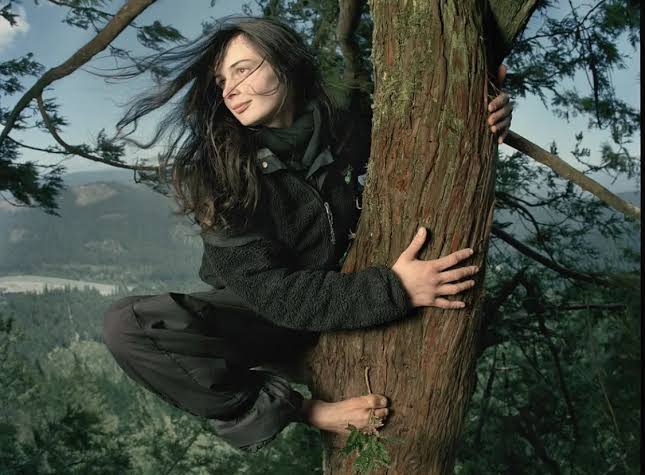
What would happen if you climbed into a tree for two weeks—and then realized you could no longer come down? On December 10, 1997, Julia Butterfly Hill climbed into an ancient redwood in Northern California that she named Luna, intending to prevent it from being cut down. Two years later, she finally returned to the ground, after turning a tiny platform high in the canopy into her home and forcing a major logging company to negotiate over one tree.
The Tree Was Supposed to Be Cut Down
Hill’s decision began with a redwood known as the Stafford Giant, an ancient tree in Humboldt County, California. The surrounding forest was being threatened by logging, and Hill chose to occupy the tree as an act of civil disobedience designed to stop the planned cutting. She climbed about 180 feet into the canopy on December 10, 1997, expecting the protest to last only a few weeks.
But the weeks became months, and the months became years. Hill named the tree Luna, and what began as a short protest became a continuous stay in the canopy that lasted 738 days, ultimately making her one of the most recognizable tree-sitters in American environmental activism.
The decision was not made in comfortable conditions. Hill was living on a platform roughly 6 by 8 feet, about 180 feet above the ground, with tarps providing basic shelter. For more than two years, she could not simply climb down whenever she wanted; returning to the ground would have ended the protest.
She climbed 180 feet into a redwood expecting to stay for just two weeks. Instead, Julia Butterfly Hill spent 738 days in the canopy. Watch the video to see how she survived storms, isolation and relentless pressure while living on a tiny platform—and why she refused to come down until Luna was protected.
How Do You Actually Live in a Tree for Two Years?
The survival challenge was practical as much as physical. Hill needed food, water, clothing and other supplies while remaining in the canopy, and supporters helped move provisions up to her platform. Her own account describes a life built around extreme simplicity, with limited space and no normal way to walk for more than two years.
Weather was one of the biggest dangers. Winter brought heavy rain and strong winds, and Hill has described the storms as among the hardest parts of living in the tree. She also had to move carefully around the platform because a fall from that height could have been fatal.
Then there was the problem of staying awake and alert while the company tried to make the protest harder. Contemporary reporting described helicopters flying close to Luna and using the rotor wash to make the platform sway, while security personnel were placed around the tree in an effort to pressure Hill into leaving.

The Longer She Stayed, the Bigger the Standoff Became
Hill initially saw her action as a way to protect one tree, but the protest grew far beyond Luna’s branches. News organizations including the Los Angeles Times, Time and People began reporting on the woman living in the canopy, turning a local logging dispute into a national story.
The visibility changed the balance of the standoff. Hill could not physically overpower a logging company, but she could make it much harder for the company to remove the tree without drawing public attention. Her tiny platform became a symbol of a much larger argument over California’s remaining old-growth redwoods.
The company continued its pressure campaign, and Hill eventually endured what her own biography describes as a 10-day siege by company security guards. What had started as a person sitting in a tree had become a prolonged test of endurance between one protester and a powerful commercial operation.
She Stayed Until the Company Agreed to Protect Luna
The turning point was not a dramatic rescue or an eviction. It was a negotiation. After more than two years in the tree, Hill, Pacific Lumber and the nonprofit Sanctuary Forest worked toward an agreement that would permanently protect Luna.
On December 18, 1999, after exactly 738 days, Hill finally climbed down. The agreement provided permanent protection for Luna and a surrounding buffer zone of nearly three acres, with Sanctuary Forest becoming the trustee responsible for the conservation easement.
The apparent victory, however, was not the end of Luna’s story. In November 2000, someone cut into the tree, severing almost two-thirds of its trunk. Scientists, tree specialists and supporters responded by stabilizing Luna with metal cables and other measures to help the damaged tree survive.

Luna Survived—and So Did the Story
Today, Luna remains on a ridge above Stafford, California, and is monitored by Sanctuary Forest, which conducts regular inspections and a more detailed annual assessment of the tree’s condition. The site is protected by a conservation agreement, and public access is restricted because foot traffic around the root system could increase erosion and weaken the tree.
Hill’s two-year stay also left a permanent mark on how the protest was remembered. What made the story so unusual was not simply that she was protecting a redwood; it was that she committed to staying in one place, high above the ground, until the people who controlled the tree agreed to a different outcome.
The result was a survival story built less on wilderness skills than on endurance. For 738 days, a 6-by-8-foot platform was her home, a storm shelter, a workplace and the center of a national standoff. She eventually came down because the tree was given permanent protection, and Luna remains standing today.

Julia Butterfly Hill climbed 180 feet into Luna on December 10, 1997, expecting to remain there for only a few weeks. Instead, she stayed for 738 days, enduring storms, isolation and pressure from Pacific Lumber while living on a platform just 6 by 8 feet. On December 18, 1999, she finally came down after an agreement permanently protected Luna and nearly three acres around it. The protest was extraordinary not because Hill defeated a logging company by force, but because she turned endurance into leverage—and stayed in that tree until the terms changed.