Every year, eels leave the rivers and coastal waters where they have spent years growing and begin an extraordinary journey across the Atlantic. Many are believed to travel thousands of miles toward the remote Sargasso Sea to reproduce, yet scientists have never directly witnessed the spawning process in the wild. Modern tracking has revealed more about their mysterious migration, but one question remains: what exactly happens when these eels finally reach their destination?
These Eels Travel Thousands of Miles to Reproduce
The life cycle of an eel is unlike that of most freshwater fish.
American and European eels begin their lives in the ocean before their larvae travel toward coastal waters. As they grow, they move into rivers, estuaries and other inland habitats, where they can spend years developing.
Eventually, mature eels undergo another transformation.
They become silver eels, with physical and physiological changes that prepare them for their final migration. Instead of remaining in the rivers where they spent much of their lives, they begin moving downstream toward the ocean.
For European eels, this journey can cover thousands of miles across the Atlantic toward the Sargasso Sea.
It is an extraordinary commitment.
An eel may spend years growing in a river, only to leave that habitat permanently when it reaches maturity. After reaching its presumed spawning grounds and reproducing, the adult is believed to die, completing its life cycle. But for centuries, scientists had no idea where this final journey ended.
Want to explore the mystery behind these extraordinary eels? Watch the video to follow their thousands-of-miles journey toward the Sargasso Sea and the unanswered question of what happens when they finally arrive.
The Sargasso Sea Holds the Secret to Their Life Cycle
The destination is the Sargasso Sea, a unique region in the North Atlantic.
Unlike conventional seas, it is not surrounded by land. Instead, its boundaries are largely formed by major ocean currents. The region is also famous for floating mats of Sargassum, which create an important habitat for numerous marine species.
The Sargasso Sea is strongly associated with the reproduction of European and American eels.
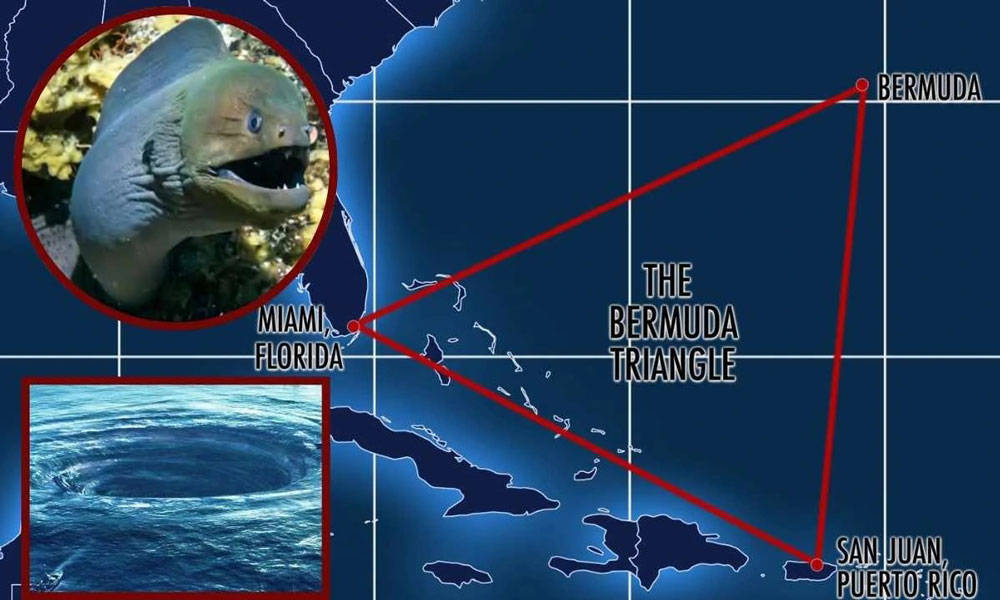
It is sometimes mentioned alongside the Bermuda Triangle, but the two should not be confused. The Sargasso Sea is a real oceanographic region defined by currents, while the Bermuda Triangle is a popular term associated with stories about mysterious disappearances.
The eel mystery is not supernatural.
It is a scientific mystery.
The remarkable question is how these animals can leave rivers thousands of miles away and find their way toward a remote region of the Atlantic to complete their life cycle.
Even more remarkably, scientists have still never directly observed the entire process.

Scientists Spent Centuries Trying to Find Where Eels Come From
The mystery of eel reproduction is far older than modern biology.
Ancient thinkers struggled to explain where eels came from. Aristotle, for example, proposed ideas about eel reproduction that were very different from what scientists understand today.
Centuries later, the mystery remained.
Scientists could find adult eels in rivers and tiny eel larvae in the ocean, but they could not directly connect the two stages.
Even Sigmund Freud, before becoming famous for psychoanalysis, investigated eels during his early scientific career. He dissected hundreds of specimens while searching for evidence of their reproductive anatomy.
A major breakthrough eventually came from Danish zoologist Johannes Schmidt.
Schmidt spent years collecting tiny eel larvae known as leptocephali across the Atlantic. He noticed a striking pattern: the larvae became progressively smaller as he moved toward the Sargasso Sea.
The smallest larvae were found in that region.
This suggested that they were the youngest larvae—and therefore that the Sargasso Sea was likely where the eels reproduced.
Schmidt had finally found a crucial piece of the puzzle.
But he still had not seen adult eels spawning.
He had found the babies, not the parents.
Want to learn more about the mysterious journey of these eels? Watch the video to explore their remarkable migration across the Atlantic and the unanswered questions surrounding their journey to the Sargasso Sea.
Modern Technology Finally Tracked the Eels Across the Atlantic
For decades, scientists had to rely largely on indirect evidence.
Then technology gave them a new way to investigate the mystery.
Researchers began using pop-up satellite archival tags, or PSATs, to track migrating eels. These devices can record information such as depth, temperature and movement before eventually transmitting data after separating from the animal.
This allowed scientists to follow adult eels rather than simply studying their larvae.
In 2018 and 2019, researchers tagged adult European eels near the Azores before their migration toward the presumed spawning region. The resulting data provided direct evidence that some of these eels were traveling toward the Sargasso Sea. The findings were significant.
For the first time, scientists could actually follow adult eels during part of their extraordinary Atlantic migration.
The technology helped confirm what researchers had suspected for more than a century.
But it did not solve everything.
Tracking an eel toward the Sargasso Sea is not the same as watching it reproduce.
Scientists still could not see exactly where the animals gathered, how they found one another or what happened during the spawning event.

The Biggest Mystery Still Hasn’t Been Solved
Scientists now have a much clearer picture of the eel’s life cycle.
They know that larvae are associated with the Sargasso Sea.
They know that young eels travel toward continental waters.
They know that mature eels eventually transform into silver eels and begin migrating back toward the Atlantic.
And satellite tracking has provided evidence that adult European eels reach the presumed spawning region.
Yet one important piece remains missing. No one has directly observed European eels spawning in the wild.
Scientists still do not know the precise location of the spawning grounds, the exact depth at which reproduction occurs or precisely how the eels navigate to the correct location.
Researchers have considered several possible navigation mechanisms, including ocean currents and environmental cues, but the full process remains under investigation.
The mystery is especially important because eel populations face serious threats. Habitat loss, barriers such as dams, pollution, fishing pressure and changes in ocean conditions can affect different stages of their complicated life cycle.
Understanding where and how eels reproduce could therefore help scientists better protect them.
For now, however, one of nature’s strangest migrations still ends with a question mark.
Scientists have spent centuries trying to understand these animals. They have followed their larvae, studied their bodies and eventually tracked adults across thousands of miles of ocean.
But the final moment remains hidden. They know where the eels are going. They still don’t know exactly what happens when they get there.

The mystery of the eels is one of the strangest unfinished stories in marine science. Researchers now know that these fish can travel thousands of miles toward the Sargasso Sea to complete their life cycle, and modern tracking has provided strong evidence of their extraordinary migration. Yet no one has directly witnessed the eels spawning in the wild or fully explained how they find their exact destination. Scientists have finally discovered where the eels go. The mystery is what happens when they get there.