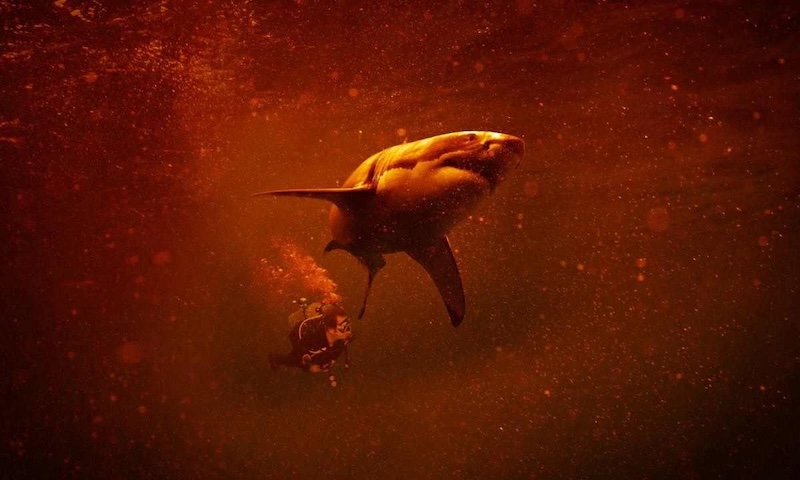
Deep beneath the Pacific Ocean, an active volcano has become home to something scientists never expected to find: sharks. At Kavachi in the Solomon Islands, researchers captured footage of scalloped hammerheads and silky sharks swimming in waters shaped by volcanic activity. The discovery earned the volcano the nickname “Sharkcano,” but the real story is far more fascinating than the name suggests. How can these predators survive in an environment that seems almost impossible for marine life?
The Volcano Known As “Sharkcano”
Kavachi is an active submarine volcano located south of Vangunu Island in the Solomon Islands. Unlike a typical volcano rising above a landscape, much of Kavachi sits beneath the Pacific Ocean.
Its summit is shallow enough for volcanic activity to affect the surrounding seawater, and eruptions can send steam, ash and volcanic material toward the surface. At times, temporary islands have even appeared above the volcano before disappearing again.
Because scientists found sharks in and around its crater, Kavachi earned a memorable nickname: “Sharkcano.”
The nickname is catchy, but the real story is even more interesting.
Kavachi is not simply a volcano with sharks swimming nearby. It is an unusual natural laboratory where researchers can observe how marine life responds to an environment shaped by active volcanic processes.

Scientists Really Did Find Sharks There
In 2015, researchers used baited drop cameras to investigate the underwater environment around Kavachi’s crater.
What they saw was unexpected.
The cameras recorded scalloped hammerhead sharks and silky sharks, along with other marine life including fish, gelatinous organisms and microbial communities.
The discovery was significant because the waters around an active submarine volcano can be chemically and physically challenging. Volcanic activity can introduce gases and minerals into the surrounding water and alter local conditions.
Yet these sharks were there.
That does not mean they are “mutant sharks,” despite the dramatic wording sometimes used in online headlines. There is no evidence that the sharks had mutated into a new species or developed extraordinary physical characteristics because of the volcano.
The remarkable part is simpler: ordinary sharks from two known species were observed living in an extraordinarily unusual environment.
What would you expect to find inside an active underwater volcano? Watch this fascinating video and take a closer look at the mysterious world of Kavachi and its unexpected shark inhabitants.
What Makes Kavachi Such A Hostile Place?
An active volcano is not exactly the environment most people imagine when they think about marine life.
Kavachi releases volcanic gases and heat into the surrounding water. The chemistry of the water can change, and volcanic activity can disturb the environment dramatically.
For animals, that creates a constantly shifting habitat.
Conditions inside and around the crater are not necessarily the same as those found in ordinary tropical waters. Yet the presence of sharks suggests that at least some marine animals can tolerate conditions that appear extremely challenging.
Scientists still do not have a complete explanation for exactly how these animals use the volcano.
One possibility is that they do not remain in the most extreme parts of the crater continuously. They may move through different areas depending on the conditions, allowing them to take advantage of food or shelter while avoiding the harshest zones.
That distinction matters.
Finding a shark near an active volcano does not automatically mean the animal can tolerate every condition the volcano produces.

The Sharks May Be Teaching Scientists Something Bigger
The real scientific value of Kavachi goes beyond the novelty of finding sharks near a volcano.
The site provides researchers with an opportunity to study life in an extreme environment.
How do marine animals respond when water chemistry changes? How quickly can an ecosystem recover after volcanic activity? Which species can tolerate conditions that eliminate other organisms?
These questions are important because underwater volcanoes are not rare curiosities. Submarine volcanic activity is part of the Earth’s natural system, and volcanic environments can create highly unusual habitats.
Kavachi therefore acts almost like a natural laboratory.
Instead of creating extreme conditions inside a laboratory, scientists can observe what happens when nature creates them on its own.
And the animals already living there may reveal just how adaptable marine ecosystems can be.
What happens when scientists drop a camera into an active underwater volcano? Watch this incredible National Geographic footage to see the sharks discovered swimming inside Kavachi’s crater.
Kavachi Has A Story Older Than Modern Science
There is another part of Kavachi’s story that is easy to overlook.
The volcano is not simply a scientific object. It also has cultural significance for Indigenous communities in the Solomon Islands.
Kavachi is associated with traditional stories and beliefs among the people of nearby islands. Its name is connected to a sea god, while another traditional name, Rejo te Kvachi, has been translated as “Kavachi’s Oven.”
For generations, people living in the region have understood the volcano as part of their environment and cultural landscape.
Modern science may use underwater cameras, research vessels and geological monitoring to study Kavachi, but the volcano was part of local knowledge long before researchers began documenting its eruptions.
That gives the “Sharkcano” story another layer: the same volcano can be a scientific mystery, a dangerous natural phenomenon and a meaningful part of local culture.
We Still Don’t Know Exactly Why The Sharks Are There
The discovery answered one question but created many others.
Are the sharks permanent residents of Kavachi’s crater, or do they move in and out depending on conditions?
What attracts them to the area?
How do they respond to changes in temperature and water chemistry?
Does volcanic activity alter the food chain around the crater?
And how does the ecosystem change before and after an eruption?
Scientists need more observations to answer these questions.
The underwater environment itself makes that difficult. Researchers cannot simply send divers into an active volcanic crater whenever they want. Remote cameras and other technologies allow scientists to study the area without exposing people to unnecessary danger, but observations remain limited compared with research conducted in more accessible environments.
That is one reason Kavachi remains so fascinating.

The Real Mystery Isn’t That The Sharks Are “Mutants”
The most interesting part of the Kavachi story is not that scientists discovered some bizarre new breed of volcanic shark.
They didn’t.
The real discovery is that scalloped hammerheads and silky sharks were observed in an environment that seems remarkably hostile to life.
That challenges a common assumption about extreme environments: that if conditions look dangerous to humans, they must be impossible for other organisms as well.
Nature is often more complicated.
Life does not always require comfortable conditions. Some organisms survive by adapting to environments that appear almost impossible from a human perspective.
Kavachi gives scientists a rare opportunity to watch that process unfold in one of the most unusual places on Earth.
And perhaps the most intriguing question is not why sharks can live near a volcano.
It is how many other forms of life may already be thriving in extreme environments that humans have barely explored.
Ever wondered what it’s really like inside an active underwater volcano? Watch this fascinating video to see Kavachi up close and discover the incredible marine life living in its waters.
Kavachi’s sharks are fascinating not because they are “mutants,” but because they reveal how adaptable life can be in one of Earth’s most extreme environments. Scientists still have much to learn about why these sharks enter the volcano’s waters and how they cope with its constantly changing conditions. For now, Kavachi remains both a geological mystery and a remarkable natural laboratory — a place where an active volcano and an unexpected community of marine life exist side by side.