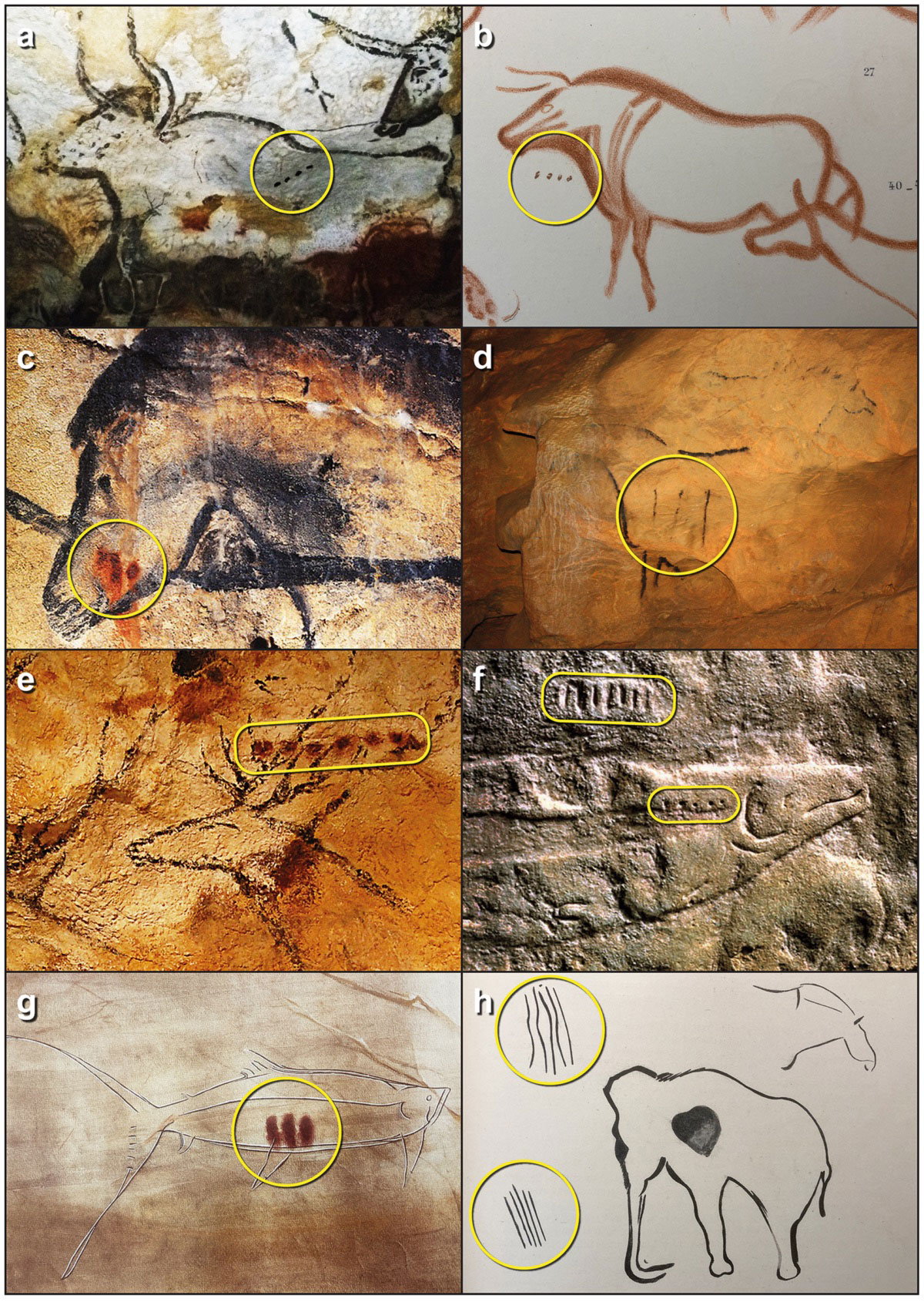
Some of the oldest cave paintings in Europe may contain more than pictures of animals. They may contain information. Ben Bacon, a furniture conservator from London, noticed that repeated sequences of dots, lines and Y-shaped symbols appeared alongside animals painted between roughly 15,000 and 40,000 years ago. He proposed that the markings could represent a kind of prehistoric lunar calendar, and archaeologists from Durham University and University College London later helped test the idea.
The Symbols Were There Long Before Anyone Understood Them
The paintings themselves have fascinated researchers and the public for generations. Horses, deer, bison and other animals appear across Paleolithic cave walls, often rendered with remarkable skill. But scattered among those images are sequences of dots, lines and other marks that have remained difficult to explain.
One earlier possibility was that the marks simply counted animals that prehistoric people had seen or killed. It was a reasonable idea, but it did not fully explain why similar sequences appeared repeatedly in connection with particular animals.
Bacon noticed something different while looking at digitized cave paintings online. He began to suspect that the marks were not random numbers at all. Instead, he wondered whether they might encode when something was likely to happen.
An Amateur Saw a Pattern
Bacon described himself simply as a “person off the street,” but he approached the problem like someone trying to crack an unknown code. He collected examples of the markings and focused on three recurring elements: lines, dots and Y-shaped symbols.
His central idea was surprisingly practical. For people living during the Upper Paleolithic, knowing the timing of animal migrations, mating periods and births could have been far more useful than keeping a simple count of animals encountered.
That would make the symbols something closer to a seasonal information system. Instead of saying how many animals had been seen, they may have helped people remember when certain animals were likely to gather or become especially important resources.
The hypothesis also offered an explanation for an unusual limitation in the markings: the sequences reportedly never exceeded 13 lines and dots. Bacon suggested that this could fit a lunar-based system, with the number of marks corresponding to lunar months or cycles.
Did Ice Age humans have a secret code? Discover how an amateur researcher just cracked a 20,000-year-old mystery hidden in cave art! Watch the full story here.
The Researchers Put the Pattern to the Test
A striking theory is easy to propose. Testing it is much harder.
To see whether the markings behaved like a real information system, the researchers created a database containing more than 600 sequences of lines and dots without the Y symbol, along with roughly 250 sequences that included Y.
They then examined whether the number of marks and the position of the Y symbol appeared randomly or followed an organized pattern. According to the study summarized by HistoryNet, the results supported the researchers’ hypothesis rather than showing a purely random distribution.
That does not mean archaeologists have definitively “translated” an Ice Age language. Instead, the research suggests that the markings may have followed rules capable of conveying information—and that the information may have been connected to the seasonal life cycles of animals.
That distinction matters. The discovery is intriguing precisely because it is a proposed interpretation of patterns, not a Rosetta Stone that suddenly reveals every meaning hidden in prehistoric art.
What Would These Symbols Have Been Used For?
The proposed answer is survival.
For hunter-gatherers living thousands of years ago, the movements and reproduction of animals were not abstract biological facts. They could determine when food would be available, where animals were likely to gather and which periods offered the best chance of a successful hunt.
A system for recording those cycles could therefore have had practical value. A sequence of marks next to a painted animal might have functioned less like a sentence and more like a compact calendar or scheduling tool.
This idea also changes how we might look at cave art. The paintings may not have been purely symbolic or artistic. Some of them could have served as information storage, preserving knowledge that mattered to an entire community and could be transmitted across generations.
Could This Really Be Writing?
This is where the discovery becomes much bigger than cave paintings.
If the interpretation is correct, then humans were using standardized marks to encode information tens of thousands of years before the writing systems traditionally discussed in history classes. Bacon argued that this could push the history of writing back by tens of thousands of years.
But “writing” is a complicated term. A system does not necessarily need full sentences and an alphabet to preserve meaningful information, yet researchers still need to establish exactly how the signs functioned and whether people consistently understood them in the same way.
The current evidence therefore points toward something fascinating but not fully settled: Paleolithic people may have possessed a structured notation system capable of recording numerical or calendrical information.
The Bigger Mystery Is What It Says About Ice Age Humans
Perhaps the most important implication is not about the symbols themselves, but about the people who created them.
For decades, prehistoric humans were often imagined as physically capable but intellectually distant from modern society. The proposed interpretation challenges that picture by suggesting that Upper Paleolithic people could observe patterns in nature, quantify them, encode them symbolically and preserve that knowledge.
In other words, they may not have simply painted the animals they saw. They may have been building a system for predicting the future behavior of those animals.
That would make the cave walls something more than ancient galleries. They could have functioned as a prehistoric information network—a place where observations about the natural world were converted into symbols that others could understand.

For generations, mysterious dots, lines and Y-shaped marks in European cave paintings resisted explanation. Ben Bacon’s hypothesis, later examined with archaeologists, suggests they may represent an early system for recording seasonal animal cycles rather than random marks or simple counts. Researchers tested more than 600 sequences and found patterns supporting the idea, although the interpretation remains a hypothesis rather than a definitive translation. If correct, the discovery would suggest that Paleolithic humans were recording, organizing and transmitting information far earlier than previously believed.
This article was compiled and adapted from reporting on the remarkable attempt to decipher ancient cave paintings and what their mysterious symbols may have meant. The original story provided the key details and historical context behind the discovery. Sources: https://historynet.com/ancient-cave-paintings-amateur-may-have-deciphered-them/