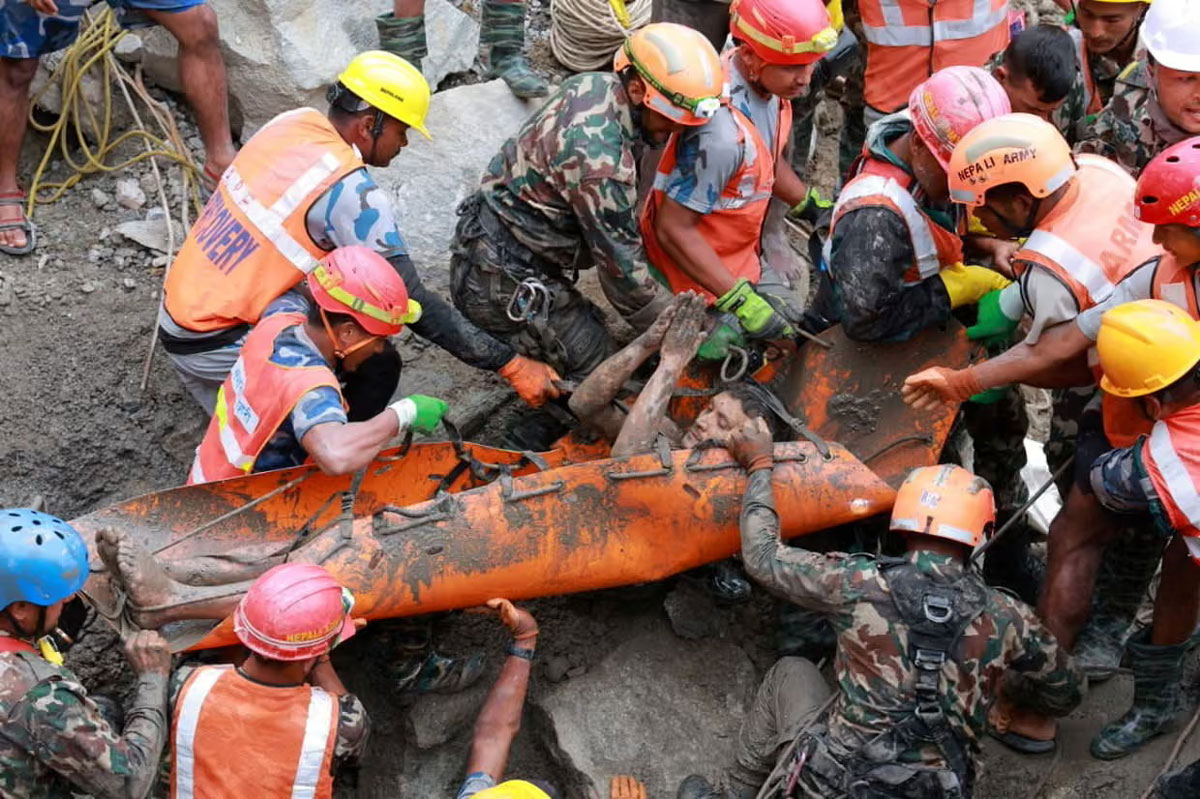
Nine days after catastrophic flooding tore through Nepal’s Trishuli valley, rescuers reached two workers trapped deep inside a hydropower tunnel and pulled them out alive. Sanjay Shah and Kabir Maharjan were found about 170 meters inside the Upper Trishuli 3A project, where mud and debris had sealed off parts of the underground system. Their rescue became a rare moment of hope in a disaster that killed more than 1,200 people and left thousands missing across Nepal and Tibet.
The Flood Turned a Mountain Valley Into a Disaster Zone
The disaster began after a glacier collapse near the Nepal-China border sent an enormous surge of water, mud and rock through the mountain valleys. The flood swept through the Trishuli region, destroying roads, bridges, settlements and several hydropower facilities along the river system. At multiple projects, workers and other people were believed to have been trapped underground as entrances were buried beneath debris.
Hydropower tunnels are built to carry water and provide access deep inside mountainous terrain, which can make them especially difficult to search after a major flood. Entrances can be blocked, underground routes can be altered by debris and rescuers may have little information about which chambers remain accessible.
By the end of the first week, the scale of the search was enormous. Officials believed hundreds of workers could still be unaccounted for across several hydropower sites, while rescue teams faced unstable ground, damaged infrastructure and enormous quantities of mud and rock.
Against all odds, two workers were pulled alive from a Nepal hydropower tunnel after being trapped for nine days! Watch this incredible moment of hope amidst a devastating flood disaster. Witness the relentless rescue efforts and the miracle of survival in this emotional, must-see report on the ongoing crisis.
Two Workers Were Still Inside
Among those feared trapped were Sanjay Shah, a foreman, and Kabir Maharjan. They were eventually located inside the Upper Trishuli 3A tunnel, around 170 meters from the entrance. By the time rescuers reached them, nine days had passed since the flood.
Shah later told rescuers that he had tried to help other workers evacuate when the disaster struck before becoming trapped himself. That detail adds another dimension to the rescue: the men were not simply waiting somewhere safe underground. They had been caught in an emergency that unfolded with little warning.
The discovery came at a moment when rescuers were beginning to understand that some underground spaces might still contain breathable air and dry areas. Voice contact from inside tunnels had also given authorities reason to believe that other workers could have survived.
Then the search shifted from recovery to rescue.

Finding Them Required More Than Heavy Machinery
Reaching people buried inside a damaged hydropower system is not simply a matter of digging faster. Rescuers must know the layout of the tunnels, understand where debris has shifted and avoid creating new collapses while opening a path underground.
Engineers working remotely became an important part of the operation. According to Reuters, a group coordinating the response through WhatsApp was sharing tunnel maps and engineering drawings with rescue teams on the ground. Those plans helped crews understand the underground layouts even after entrances and other landmarks had been transformed by the flood.
Heavy machinery was used alongside other methods to clear blocked areas. Rescue teams also used oxygen pipes and other equipment while trying to identify spaces where trapped workers might still be alive. The effort combined engineering information, machinery and direct searches in an environment where ordinary access routes had disappeared.
That combination ultimately helped rescuers reach Shah and Maharjan.
The Rescue Came Nine Days Later
When Shah was finally brought out, images released by the Nepali army showed him covered in mud and being carried from the site on a rescuer’s shoulder. Both men were reported to be in stable condition and were taken to a hospital in Kathmandu.
Their survival did not mean the wider crisis was over. Officials estimated that about 900 people remained missing across 12 hydropower sites, while rescue teams continued concentrating on locations where underground chambers might still contain survivors. At the Rasuwagadhi power plant, authorities believed dozens of workers could still be alive inside a room-like underground structure.
That made the rescue of the two men more than a remarkable individual survival story. It also became evidence that people trapped underground could remain alive long after a major flood, giving rescuers another reason to keep searching.

Why Hydropower Tunnels Became Critical
The tragedy exposed a vulnerability created by geography and infrastructure. Hydropower projects are concentrated in river valleys and mountain regions where enormous amounts of water can move through narrow spaces. When a flood carries mud, rock and debris into a construction or power site, underground facilities can become both shelter and trap at the same time.
Reuters reported that six hydropower plants were among the major search areas after the disaster, with engineers using digital communication to help teams navigate damaged tunnels. The floods also caused major disruption to Nepal’s electricity infrastructure, showing how a disaster can affect both the people working underground and the systems on which communities depend.
The lesson is not simply that underground workers need better rescue equipment. It is that disaster planning for mountain infrastructure must account for how quickly access roads, bridges, tunnel entrances and surface landmarks can disappear.
In a disaster of this scale, the map rescuers started with may no longer match the world in front of them.
A Rescue That Changed the Search
The survival of Shah and Maharjan offered something the wider disaster desperately needed: proof that hope underground was not necessarily misplaced. Their rescue showed that even after days of isolation, some workers could still survive in protected spaces within damaged tunnel systems.
That does not mean every missing person can be saved. Conditions differ from site to site, and many workers remain unaccounted for. But the two men changed the emotional and practical meaning of the search, encouraging rescue teams to keep looking for signs of life rather than assuming that time alone had ended every possibility.
The broader disaster will be remembered for the scale of the destruction, but this part of the story deserves to be remembered for something else.
Nine days underground had not been the end for everyone.
The flood that struck Nepal’s Trishuli valley destroyed infrastructure on a scale that overwhelmed entire communities and left thousands missing. Yet deep inside one damaged hydropower tunnel, two workers survived for nine days before rescuers reached them. Their rescue demonstrated the value of persistence, engineering knowledge and careful underground search operations after a disaster. It also offered a crucial reminder: when tunnels contain trapped workers, the passage of time does not automatically mean that every chance of survival is gone. For the families still waiting for news, that distinction can mean everything.
P.S. This account draws on The Guardian’s reporting on the rescue of Sanjay Shah and Kabir Maharjan, alongside Reuters’ coverage of the engineering and communications efforts helping rescuers navigate Nepal’s damaged hydropower tunnels. Sources: https://www.theguardian.com/world/2026/sep/04/nepal-tunnel-found-alive-flood-two-workers-hydropower-rescue