For years, the Internet has loved stories about forgotten fortunes—especially photographs of enormous collections of classic cars supposedly discovered in abandoned barns. Many of those stories turned out to be exaggerated or completely false. But there was a real collection that looked almost too extraordinary to believe: more than 200 classic cars gathered by one New Zealand collector and stored away for decades. Some were rare, some remarkably well preserved, and others had been sitting under layers of dust for so long that they seemed frozen in another era. Behind the collection was not a mysterious millionaire, but a man who simply could not stop collecting cars.
The Barn-Find Story That Wasn’t Real
The fantasy of finding hundreds of valuable classic cars in an abandoned building is almost impossible to resist. Rows of old vehicles covered in dust immediately suggest hidden wealth, forgotten secrets and a story that has been waiting decades to be discovered. That is exactly why photographs of a supposed “barn find” in Portugal became an Internet sensation. The images appeared to show around 200 classic cars packed into an enormous building, apparently abandoned by their owner and left untouched for years.
There was only one problem: the story attached to those photographs was a hoax. The photographs themselves were genuine, but the dramatic explanation circulating online was not. The images had been taken from a real collection and given an entirely different backstory, turning an unusual gathering of old cars into an irresistible Internet mystery.
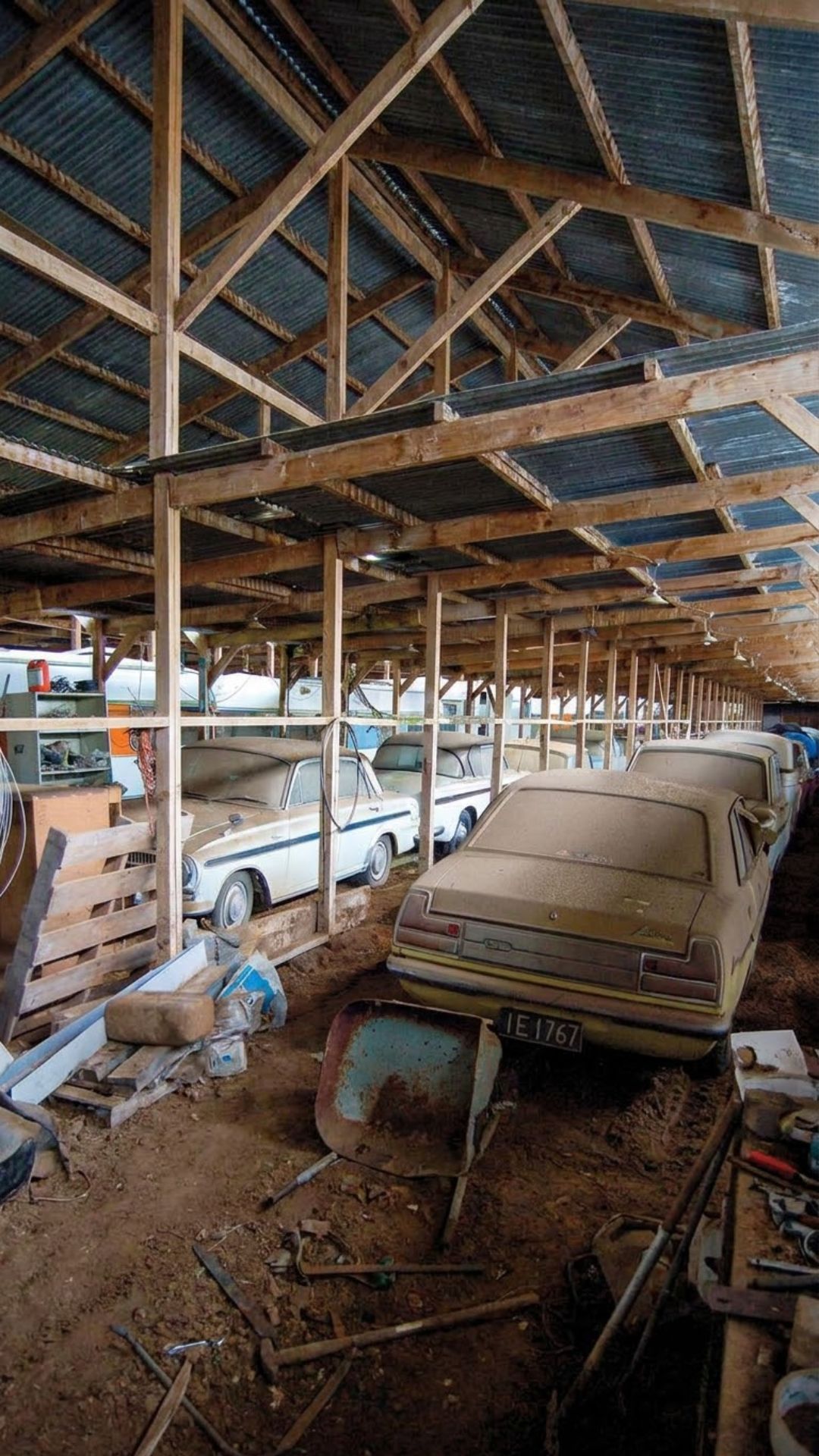
Yet the truth was almost as fascinating. In New Zealand, collector Peter Markham really had accumulated more than 200 classic vehicles. These cars were not abandoned by a mysterious millionaire or discovered accidentally after decades of secrecy. They were the result of years of collecting, buying, preserving and, in many cases, simply refusing to let an interesting old car disappear.
That distinction matters because Markham’s collection offered something the fictional barn story never could: a genuine look at how an enormous collection of ordinary and unusual automobiles can preserve an entire era of motoring.

Discover an incredible automotive treasure trove in New Zealand! Join us as we explore Peter Markham’s massive collection of over 250 vintage British and Japanese cars. From beautifully restored classics to hidden gems waiting for a new owner, this barn find is a must-watch for every car enthusiast. Don’t miss out!
Inside A Collection Frozen In Time
Peter Markham bought a former chicken farm in Waikato in 2002 and began seriously building his collection there in 2004. By the time the collection was photographed, it contained just over 200 vehicles, most of them British. Austin, Morris, MG, Wolseley, Riley, Vauxhall, Hillman, Humber, Singer, Sunbeam and Ford were among the marques represented, along with a smaller number of Japanese cars and at least one American classic.
Walking among them was very different from visiting a modern car museum. There were no immaculate rows of freshly restored vehicles sitting beneath perfect lighting. Many of the cars were stored close together, bumper to bumper, carrying dust and the evidence of long-term storage. Getting one particular car out could take most of a day because so many others had to be moved first.
But the dust could be misleading. Some cars were far better preserved than their appearance initially suggested. Certain interiors had survived remarkably well, with original materials, polished wood and vinyl that remained supple decades after the cars had left the showroom.
One Singer Vogue estate was particularly evocative. The car had originally been purchased by a New Zealand couple after they won an Art Union, and they traveled to Britain to buy it. When they later returned, they even managed to purchase a set of Cosmic alloy wheels from the same dealer. The body remained rust-free, the interior was close to its original condition and the polished wood still gave the car the character of another era.
That kind of detail is what makes the collection so much more interesting than a simple photograph of 200 old vehicles. The cars were not merely objects. Many still carried traces of the people, places and lives they had passed through.

Some Cars Had Barely Been Driven
Among the most fascinating vehicles were those that had somehow escaped the ordinary life of a car. One Ford Escort Mk II 1.6 Ghia had covered only about 12,600 kilometers. Its first owner was a woman who apparently used it for everyday activities such as shopping, church and a cards group, but the car had accumulated remarkably little mileage before Markham acquired it.
Another Morris Minor had remained with a single owner, while a Nissan 300Z had passed through only two owners. A yellow Chrysler Hunter had also had just one owner before Markham, and he believed it was the final example to leave the Todd Motors production line.
Cars like these are particularly valuable to historians and collectors because restoration can never completely recreate originality. A restored vehicle may look spectacular, but an untouched car can preserve details that would otherwise disappear: the original upholstery, the wear patterns on controls, factory fittings, old accessories and even the way a previous owner actually used the vehicle.
Some of Markham’s cars had stories that went beyond private ownership. A white Hillman Super Minx with a red stripe had once served as a rapid-response vehicle for Linwood Fire Station. It was no longer racing toward emergencies, but its unusual past remained embedded in the car itself.
There were also two Ford Cortina Mk I models that had once belonged to the same couple. The husband drove the station wagon while his wife had the saloon. Elsewhere in the collection sat a black Consul Mk I that had also reportedly spent its life with one owner.
Taken individually, these cars might not all qualify as automotive royalty. Together, however, they tell hundreds of small stories about the way people once lived with their cars.

The Collector Who Could Not Stop Collecting
Markham’s collection did not appear overnight. He had been collecting cars since 1991, and at one point he owned 75 Vauxhall PA models. That extraordinary number earned him the nickname “Captain Vauxhall” and says almost everything about how a hobby can gradually become something much larger.
Collectors often begin with one car because they love its design, its engineering or the memories attached to it. Then they discover another example that needs saving. A rare part appears. Someone offers an interesting vehicle. Before long, the collection has expanded beyond anything the owner originally imagined.
Markham also had the practical skills to keep such a collection alive. By trade he was a cabinet maker and machinist/polisher, and over roughly three decades he taught himself mechanical work, panel beating and painting. He could therefore do much of the work that would otherwise make a collection of this size prohibitively expensive.
That helps explain why so many vehicles remained with him for so long. He was not simply accumulating cars as investments. He understood them, worked on them and knew the individual histories behind many of them. The collection was personal in a way that a commercial museum could never quite reproduce.
There was, however, a limit to how much one person could realistically manage. Markham eventually acknowledged that he had accumulated enough projects to keep several lifetimes busy. Some cars had already been sold or reserved, and he was looking to reduce the size of the collection.
The irony was obvious. The same passion that had allowed him to preserve so many cars had also created a problem of scale. More than 200 vehicles are not simply 200 possessions. They are 200 machines that require space, maintenance, parts and attention.

Why Old Cars Become Time Capsules
The most compelling thing about a collection like this is not necessarily rarity. It is memory. Old cars were once part of ordinary life in a way that modern vehicles increasingly are not. They carried families to work and school, waited outside shops, traveled across rural roads and became familiar landmarks in neighborhoods. Then they disappeared.
Manufacturers closed or merged. Models were replaced. Cars were traded in, scrapped or left outside until rust consumed them. The process happens so gradually that it is easy to forget just how many different vehicles once filled the roads.
Markham’s collection interrupted that disappearance. A Vauxhall, Hillman or Singer that might otherwise have vanished from the historical record could still be seen decades later, sometimes almost exactly as it had been when its owner stopped driving it.
That is why a dusty old car can produce such a powerful reaction in someone who remembers the period. A person who grew up in the 1950s, 1960s or 1970s may recognize the shape of a particular model immediately. The badge on the grille, the dashboard layout or the distinctive curve of a fender can bring back memories that have been dormant for half a century.
For younger generations, the same vehicles can look almost incomprehensible. They belong to a time when cars had far more individual shapes and identities, before globalized manufacturing and modern technology made many vehicles look increasingly similar.
In that sense, Markham’s collection was not simply an archive of automobiles. It was an accidental archive of everyday life. The cars preserved the design, technology, habits and aspirations of generations that had largely moved on.

The Real Treasure Was Never Just The Cars
It would be easy to look at more than 200 classic cars and immediately ask how much the collection was worth. But financial value is only one way of measuring what survives. A relatively ordinary family car can sometimes tell a more revealing story about the past than an extremely rare and expensive automobile.
Consider the low-mileage Escort. Its significance comes partly from its condition, but also from the ordinary life it represents. It was not built to become a museum exhibit. It was built to be someone’s everyday car. The fact that it survived with so little use is precisely what makes it interesting today.
The same is true of the former fire-service Hillman. Its importance comes from its history of service, not simply from its age. Somewhere along the way, it stopped being an emergency vehicle and became a relic of a particular community and a particular period.
The value of Markham’s collection therefore lies partly in its variety. There were rare cars, humble cars, unusually preserved cars and vehicles with distinctive histories. Some could eventually be restored, while others might be more valuable left largely untouched.
And time is not on their side. Every year, more old cars disappear. They are dismantled for parts, crushed for scrap or simply left to deteriorate beyond recovery. Once that happens, the tiny details that made each vehicle unique disappear with them.
That is why the collection mattered. Behind the dust was an enormous amount of automotive history that had somehow survived long enough for someone to preserve it.

A Barn Full Of Cars, And A Different Kind Of History
The strangest part of this story is that the real collection never needed the Internet hoax. The fictional story about a mysterious Portuguese barn was certainly more dramatic, but the truth was arguably more fascinating: one determined collector had spent decades gathering more than 200 vehicles that represented a rapidly disappearing automotive world.
Some had barely been driven. Some had unusual previous owners. Some had served practical roles, such as the Hillman that once belonged to a fire station. Others were simply ordinary cars that survived because someone believed they were worth saving.
They were not priceless treasures abandoned by accident. They were something quieter and, in many ways, more meaningful. They were evidence of everyday life.
Behind every dusty windshield was a story about a person who once sat behind that wheel, a family that once depended on that car, or a period when that particular shape was a familiar sight on the road. Put more than 200 of those stories together, and the result becomes something much larger than a car collection. It becomes a snapshot of a world that has almost disappeared.

Now, take a closer look at some of the remarkable classic cars hidden inside this extraordinary collection.


More than 200 classic cars gathered in old sheds would be an extraordinary sight under any circumstances. But what makes Peter Markham’s collection memorable is not simply the number of vehicles. It is the history contained within them: forgotten manufacturers, one-owner cars, remarkably low-mileage survivors and vehicles that once served ordinary communities. The Internet invented a dramatic barn-find story around photographs of classic cars, but the real story was better. These cars were not abandoned treasure. They were pieces of everyday history, preserved because one collector cared enough to keep them alive.
This article is based on the original report and photographs published by New Zealand Classic Car about Peter Markham’s collection of more than 200 classic vehicles. Source: https://classiccar.co.nz/2016-1-13-the-collectors-200-dusty-classic-cars-found-in-a-barn/