In 1986, BMW introduced a car built for a very specific purpose: to bring its racing ambitions to the road. That car was the original M3, a compact performance machine that would go on to become one of the most influential automobiles of its era. Forty years later, the BMW M3 has survived changing technologies, new engines and shifting expectations while remaining a symbol of driving performance. From the race-focused E30 to today’s advanced G80, its story is one of constant evolution—and an automotive icon that refuses to stand still.
The E30 M3: Born for the Racetrack
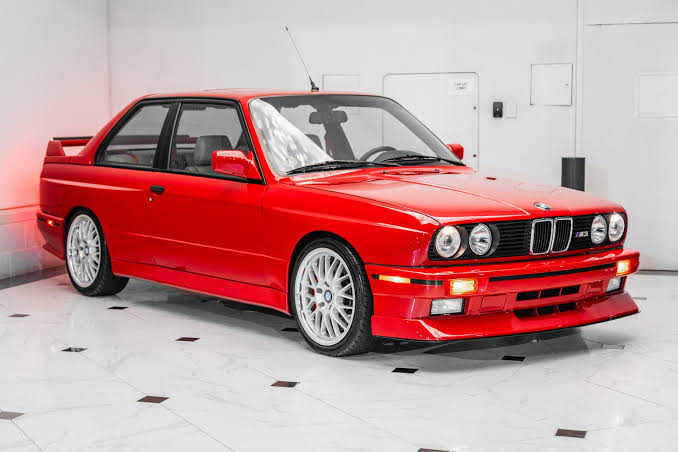
The original BMW M3 arrived in 1986 with a purpose that clearly separated it from an ordinary 3 Series.
BMW needed a homologation model for touring-car competition, and the result was the E30 M3. Although it was based on the regular E30 platform, BMW Motorsport extensively reworked the car. According to BMW, only the doors and roof were retained from the standard production model, while much of the rest was newly developed or adapted.
Its naturally aspirated four-cylinder engine and distinctive aerodynamic bodywork gave the E30 M3 a personality unlike that of other performance cars of the era. BMW produced 16,949 examples of the first-generation M3, far exceeding the 5,000 units originally associated with homologation requirements.
The car quickly became a motorsport legend.
More importantly, it established the formula that would define the M3 for decades: relatively compact dimensions, strong performance, precise handling and a direct connection between the racetrack and the road.
The E30 was not simply a faster BMW 3 Series. It created an entirely new benchmark for what a high-performance compact executive car could be.

The E36 M3: More Power, More Refinement
When the E36-generation M3 arrived in 1992, BMW took the formula in a different direction.
The new model introduced a high-revving straight-six engine and offered a more refined experience than the raw, competition-focused E30. This was an important transition for the M3 because it demonstrated that BMW did not intend to create the same car forever.
The E36 was more powerful and more usable in everyday conditions while still retaining the sporting character expected from the M badge. BMW describes this generation as a move toward greater refinement without losing the distinctive M edge.
This generation also expanded the M3’s appeal.
The original E30 had been closely connected to homologation and touring-car racing. The E36 broadened the concept, showing that an M3 could become a sophisticated high-performance road car rather than simply a race car adapted for public streets.
That shift would have a major influence on every generation that followed.

Watch the video to see how the BMW M3 evolved across six generations and four decades. From the race-bred E30 to the advanced G80, each generation helped shape one of the most influential performance cars ever created.
The E46 M3: The Generation Many Enthusiasts Still Love
For many enthusiasts, the BMW M3 E46 represents the ideal balance between classic M3 character and modern performance.
Produced during the early 2000s, the E46 used BMW’s naturally aspirated S54 straight-six engine, producing 252 kW, or roughly 343 horsepower. BMW continues to describe the model as one of the defining generations of the M3 family.
The E46 combined a relatively compact chassis with an engine that loved to operate at high revs. Its flared bodywork made the car look more aggressive than a standard 3 Series, but it retained the overall proportions and usability of a road-going BMW.
That balance is one reason the E46 has remained so influential.
It was powerful without becoming overwhelmingly large. It was technologically advanced for its era without losing a mechanical and direct driving character. It could perform on a circuit but still function as a usable daily car.
The E46 also helped cement the idea that the M3 was more than a model name.
It had become an automotive benchmark.

The E90 and E92 M3: The V8 Experiment
The next major change was one of the most dramatic in M3 history.
The E90-generation M3 arrived in 2007 with a naturally aspirated V8 engine. It remains the only M3 generation to use this engine configuration.
This marked a major departure from the straight-six engines that had become closely associated with the M3.
The V8 delivered greater power and a distinctive high-revving character, pushing the M3 into a different performance category. BMW describes the generation as bringing supercar-level performance into the 3 Series family.
The E90-era M3 also existed in multiple forms, including sedan, coupe and convertible versions.
Today, this generation occupies a unique position in M3 history.
The E30 is remembered for its motorsport origins. The E46 is celebrated for its balance. But the E90 and E92 generation is remembered above all for its V8.
BMW would never repeat that formula in the M3.

The F80 M3: A New Turbocharged Era
In 2014, BMW introduced the F80 M3 and returned to the straight-six layout.
But this was not a return to the naturally aspirated engines of earlier generations.
The F80 used a turbocharged straight-six, bringing the M3 into a new era of torque, efficiency and turbocharged performance. BMW described the generation as the return of the six-cylinder engine, now combined with TwinPower Turbo technology.
This generation also marked an important naming change.
BMW separated the sedan and coupe versions into different model lines. The four-door performance sedan retained the M3 name, while the two-door coupe became the BMW M4.
The F80 therefore represented more than an engineering transition. It also redefined the structure of BMW’s high-performance 3 and 4 Series models.
For some enthusiasts, turbocharging changed the character of the M3. For others, the enormous increase in torque and everyday performance represented a necessary evolution.
Either way, the M3 had entered a new technological age.

The G80 M3: More Technology Than Ever Before
The current G80 generation, introduced in 2020, represents the most technologically advanced version of the M3 so far.
BMW retained the turbocharged straight-six layout but pushed performance further. The modern M3 also introduced technologies and configurations that would have seemed extraordinary during the E30 era, including M xDrive all-wheel drive on certain versions.
The G80 generation also expanded the concept of what an M3 could be.
In addition to the sedan, BMW introduced the M3 Touring, bringing high-performance M3 engineering to a station-wagon body style for the first time in the model’s production history.
This development reflects the broader evolution of the M3.
The original car was closely connected to racing homologation. The modern M3 is a global performance vehicle capable of delivering extraordinary speed while offering advanced electronics, multiple driving modes and practical everyday usability.
It is dramatically more complex than the E30.
Yet BMW still presents it as part of the same six-generation story.

Six Generations, One Core Philosophy
Looking at the history of the M3 reveals how dramatically performance cars have changed since 1986.
The original E30 relied on a naturally aspirated four-cylinder engine, lightweight construction and aerodynamic development linked directly to motorsport.
The E36 moved toward refinement with a straight-six.
The E46 perfected the naturally aspirated six-cylinder formula for many enthusiasts.
The E90 and E92 introduced a V8.
The F80 embraced turbocharging.
And the G80 added advanced all-wheel-drive technology and the first production M3 Touring.
Despite those changes, the basic philosophy has remained remarkably consistent.
The M3 has always attempted to combine two different identities.
It must be capable of serious performance.
But it must also remain recognizably connected to a practical BMW.
That combination is perhaps the real reason the M3 became an icon.
Why the BMW M3 Became an Automotive Legend
The automotive world has produced many faster cars and many more expensive cars.
But few vehicles have maintained the same cultural influence across four decades.
The BMW M3 succeeded because it created a category of its own.
It was neither an exotic supercar nor a conventional family sedan. It occupied the space between them, offering high-level performance in a car that could still be driven to work, used for long journeys and lived with every day.
Its motorsport heritage also gave the name credibility.
The E30 M3 was not simply marketed as a racing-inspired car. It was created specifically to satisfy racing homologation requirements and went on to build a formidable competition reputation.
Each generation then interpreted that heritage differently.
That ability to evolve may be the M3’s greatest strength.
A car that had remained mechanically identical to the 1986 original would not have survived for 40 years. But a car that abandoned everything that made the original special would no longer deserve the name.
The M3 has survived by continuously negotiating between those two demands.
The BMW M3 began as a car built to satisfy the demands of motorsport. Forty years later, it has become one of the most recognizable names in performance motoring. From the lightweight E30 and refined E36 to the celebrated E46, the one-of-a-kind V8 generation, the turbocharged F80 and the technology-packed G80, every version reflects the engineering priorities of its era. The M3 has changed almost completely over six generations, yet its central mission has remained familiar: bringing exceptional performance, precision and motorsport-inspired engineering into a car that can still be part of everyday life. That is why, four decades after its debut, the BMW M3 remains far more than a fast 3 Series—it remains an automotive icon.