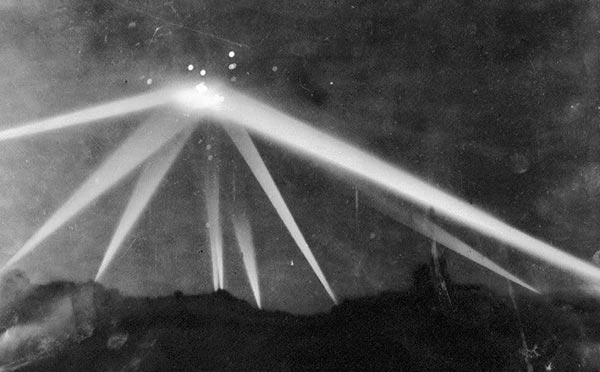
At 2:25 a.m. on February 25, 1942, Los Angeles went dark. Searchlights swept across the sky while anti-aircraft batteries opened fire, sending roughly 1,400 shells toward an unidentified target over the city. For about an hour, people watched explosions flash above the rooftops, convinced that a Japanese attack had finally reached Southern California. But when the guns stopped, no enemy aircraft had been confirmed. The strange event became known as the “Battle of Los Angeles,” and it remains one of the most remarkable episodes of wartime fear in American history.
Los Angeles Was Already Waiting For A Japanese Attack
The city did not enter that February night in a calm state of mind.
Less than three months had passed since the attack on Pearl Harbor, and military authorities on the American West Coast were preparing for the possibility of further Japanese operations. Blackouts and air-raid drills had become familiar parts of life, while coastal defenses were being strengthened around Los Angeles and other important industrial areas.
Then, on February 23, a Japanese submarine shelled the Ellwood oil field near Santa Barbara. The attack caused relatively little physical damage, but its psychological impact was much larger. It demonstrated that Japanese forces could reach the American coastline and intensified fears that a larger attack might follow.
That context matters because the events two nights later did not begin with a completely unexplained panic. Los Angeles had just been reminded that the Pacific war could reach the American mainland.
What really happened during the mysterious Battle of Los Angeles in 1942? Was it a genuine UFO sighting or a wartime misunderstanding? Dive into the declassified files, conflicting reports, and lingering secrets behind this historic event. Watch the full investigation now to uncover the truth behind this fascinating mystery!
An Unidentified Object Appeared Over The Coast
In the early hours of February 25, reports of unidentified aircraft or objects triggered a military response around Los Angeles. Radar information and observations from the ground were interpreted as evidence that something was approaching or already over the city.
The first warnings quickly produced a citywide response.
Air-raid sirens sounded. Searchlights began scanning the night sky. Anti-aircraft crews moved into position while civilian air-raid wardens were called into action. The city entered blackout conditions, with residents instructed to turn off lights that might make Los Angeles easier to target from the air. Then the guns began firing.
What started as an uncertain radar or visual report became a huge spectacle across the city, with searchlights and exploding anti-aircraft shells illuminating the darkness. Nobody on the ground could clearly see what the guns were supposed to be hitting.

The City Went Dark And Searchlights Filled The Sky
For approximately an hour, Los Angeles became a wartime scene.
Searchlights crossed one another over the city while anti-aircraft batteries fired repeatedly at the suspected intruder. Contemporary accounts and later archival reports put the number of rounds fired at roughly 1,400, with the Los Angeles Times citing 1,433 rounds in one reconstruction. The scale of the response created a strange problem of its own.
Searchlights illuminated clouds and shell bursts, while people on the ground tried to interpret flashes and moving shapes from a distance. In a city already expecting a possible Japanese attack, almost anything in the sky could become significant.
Los Angeles was therefore dealing with two separate uncertainties at once: something had triggered the warning, but nobody could reliably identify the thing being reported.
And once the firing began, every new flash in the sky had the potential to reinforce the belief that an attack was underway.
More Than 1,400 Shells Were Fired
By around 4:14 a.m., the firing had stopped. The city was still standing, but the supposed enemy aircraft had never been confirmed as an actual Japanese formation. The U.S. Navy later described the episode as a case of nerves, noting that the Japanese had not sent aircraft over Los Angeles that night. That created an extraordinary historical contradiction.
One of the most intense anti-aircraft barrages ever experienced by Los Angeles had been directed at an unidentified target that no one could ultimately prove was an enemy aircraft.
The morning newspapers reflected the confusion. Early reports described what looked like a Japanese air raid, while government officials offered changing explanations for what had been seen. The uncertainty did not disappear simply because the shooting stopped.
The event had already become a story before anyone knew exactly what had happened.
But Nobody Could Agree On What They Had Seen
One reason the Battle of Los Angeles remains fascinating is that the explanation changed over time.
The National Park Service identifies a loose weather balloon as the likely trigger for the incident. A later Army explanation also pointed to weather balloons carrying lights, suggesting that the balloons could have been mistaken for aircraft and that shell bursts illuminated by searchlights may then have created additional visual confusion. But the surviving records are not perfectly consistent.
Some military officials initially claimed that enemy aircraft had been present. Later statements suggested different numbers and types of aircraft, despite the absence of confirmed Japanese planes over Los Angeles. The Japanese government later stated that it had not flown aircraft over the city that night.
That leaves historians with a more interesting story than a simple “false alarm.”
A possible weather balloon may have triggered the first response. The wartime environment made an attack seem plausible. Searchlights and exploding shells then created additional objects and flashes in the sky, making the original reports even harder to interpret. In other words, the confusion may have helped create more confusion.

The “Battle” Became A Lesson In Wartime Fear
The Battle of Los Angeles is remembered because the event sits at the intersection of technology, uncertainty and psychology.
Radar was still a relatively new tool. Air defense systems were learning how to interpret incomplete information. Civilians had been trained to expect attacks, while military personnel were operating in a period of genuine fear after Pearl Harbor and the recent Japanese submarine attack on California.
Under those conditions, an unidentified object did not remain merely unidentified for long.
It became a possible enemy aircraft.
That interpretation triggered searchlights, sirens and artillery. The artillery created flashes that complicated visual observation, while the blackout made the surrounding landscape even harder to read.
The result was a remarkable feedback loop: uncertainty produced a military response, and the response itself made the original mystery harder to solve.
More than 80 years later, the exact sequence of observations is still debated, but one fact is remarkably clear. Los Angeles fired roughly 1,400 anti-aircraft shells into the night because officials believed an attack might be underway. No confirmed Japanese aircraft were found.
That is what makes the episode so memorable. The city did not need an actual invasion to experience the reality of wartime fear. For one extraordinary hour in February 1942, the sky itself was enough.
The Battle of Los Angeles remains fascinating because the city responded to an uncertain threat with the full force of a wartime air defense system. Sirens sounded, searchlights swept the sky and roughly 1,400 anti-aircraft shells were fired, yet no Japanese aircraft was ever confirmed over Los Angeles that night. Later explanations pointed to weather balloons and visual confusion, while wartime records remained inconsistent. Whatever triggered the alarm, the episode revealed how quickly uncertainty could turn into a citywide military response when fear and incomplete information met a nation at war.
The original Devil’s Hideout account revisits the mysterious events of February 1942 and the conflicting explanations that followed. Historical records from the U.S. Navy, National Park Service and Los Angeles Times provide additional context on the Japanese threat, the anti-aircraft barrage and the uncertainty surrounding what was actually seen over the city. Source: https://devilshideout.com/case/battle-of-los-angeles-1942/