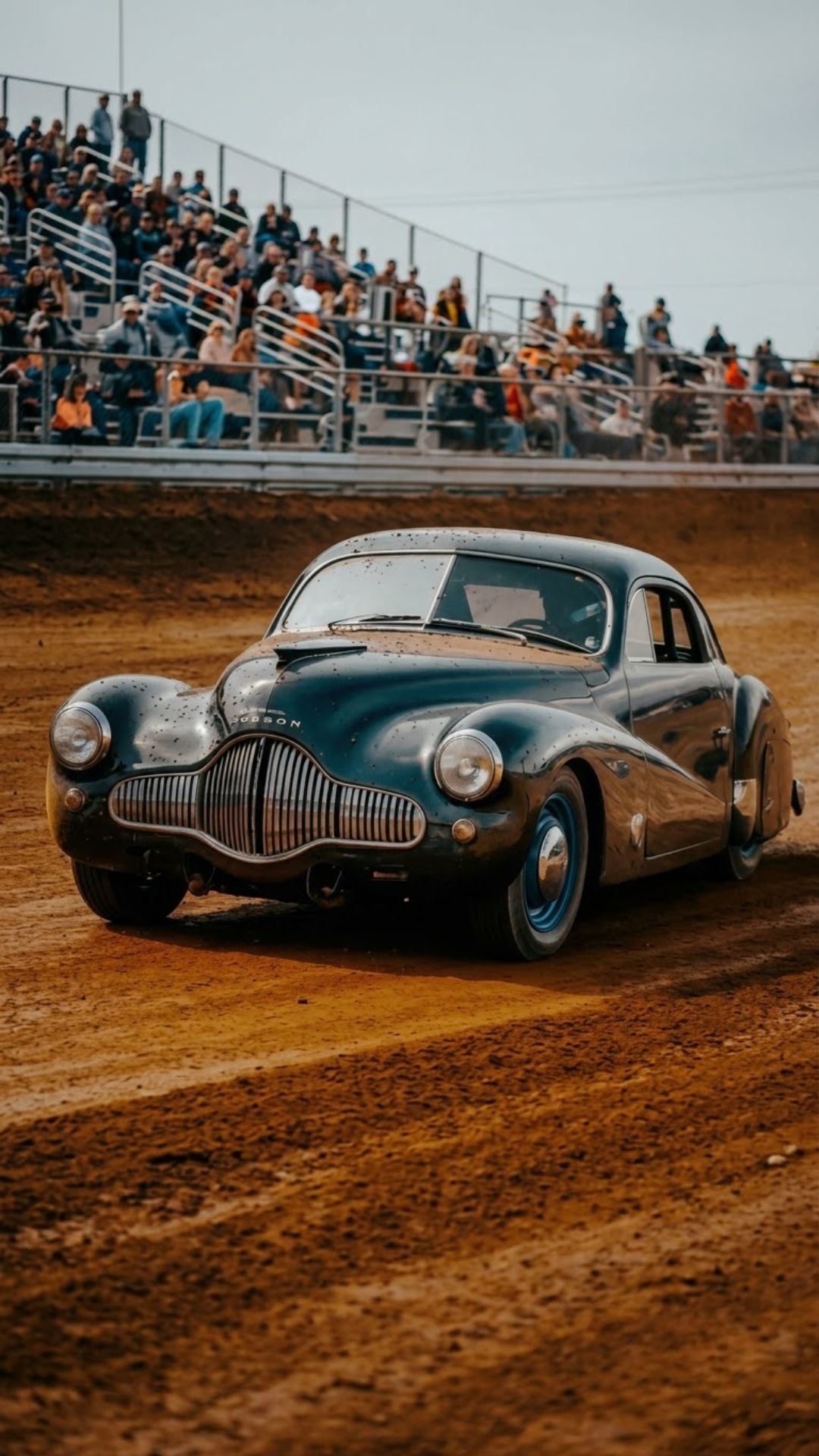
In the early 1950s, a struggling American automaker built a car that suddenly became almost unbeatable on the NASCAR circuit. The Hudson Hornet was low, powerful and unusually well balanced, and drivers quickly discovered that it could outrun larger and more powerful cars from much bigger manufacturers. It won the first NASCAR race it entered, captured three championships and dominated dozens of races. But there was a strange ending to the story. The Hornet became a racing legend while Hudson Motor Car Company continued to lose ground. By 1957, the Hudson name had disappeared completely. The car had won. The company had not.
Hudson Was Already In Trouble When The Hornet Arrived
When the Hudson Hornet appeared for the 1951 model year, Hudson was not one of America’s dominant automakers. The company had a long history and had built some innovative cars, but it was facing increasingly intense competition from the much larger manufacturers that were reshaping the American automobile market after World War II. Hudson needed something that could make buyers notice it again. The answer was the Hornet.
Introduced in October 1950 for the 1951 model year, the Hornet was built around one of Hudson’s most distinctive engineering ideas: the company’s “step-down” design. Instead of placing the passenger compartment high above the frame, Hudson dropped the floor between the frame rails. The result was a lower center of gravity, a lower seating position and a car that could handle corners with an advantage that was not immediately obvious from the showroom floor.
Under the hood was a 5-liter-class inline-six known as the H-145. The 308-cubic-inch engine was rated at 145 horsepower, a substantial figure for the time, particularly when compared with some of the smaller engines competing in NASCAR. The combination of a powerful straight-six and low-slung chassis gave Hudson something it had not necessarily set out to create: a family-sized automobile with the ingredients of a very capable race car. Then a local driver borrowed one.
Ever wondered what makes this classic car so iconic? Check out our latest deep dive into the history and performance of this beauty! Click the link to watch now!
Then Marshall Teague Took One To Daytona
On February 11, 1951, roughly 10,000 spectators gathered at Daytona Beach to watch the opening race of NASCAR’s third season. Fifty-four other drivers were competing, including several names that would eventually become legends of the sport.
Marshall Teague arrived in something different.
He had borrowed a brand-new Hudson Hornet from a Florida dealer and brought it to the beach course. The car was low, powerful and unfamiliar compared with many of the machines surrounding it. Teague had to protect the borrowed Hudson from damage because he had promised to return it to the dealership in good condition. Then he went racing.
The race appeared to be heading toward a victory for Tim Flock until Flock’s team made an unexpected fuel stop near the finish. Teague seized the opportunity and crossed the line first, giving both himself and Hudson their first NASCAR victories. He had beaten 54 other cars in a machine that had not originally been developed as a dedicated racing car.
The reaction from Hudson was almost comically understated. When the company’s public-relations department was informed about the victory, the initial response was reportedly along the lines of, “That’s nice.” Hudson’s executives did not yet see themselves as a racing company. Teague did. So he went to Detroit.
Rather than waiting for Hudson to discover what it had, Teague showed up at company headquarters and pushed executives to support his racing efforts. He asked for cars, parts and factory technical assistance. Hudson eventually agreed, and the company began moving from an automaker that happened to have won a race toward something much more ambitious: a factory-backed NASCAR program. The Hornet was no longer simply a fast road car. It was becoming a weapon.

Hudson Suddenly Became The Car To Beat
One of the people who helped turn the Hornet into a racing phenomenon was mechanic Smokey Yunick. Working with drivers and Hudson engineers, he helped develop performance parts that could be used within NASCAR’s rules because they carried factory part numbers. The Hornet received upgraded components and eventually the Twin H-Power setup, which used two carburetors and helped raise output substantially. Later developments pushed the engine even further. But horsepower was only part of the secret.
The Hornet’s low center of gravity and handling characteristics allowed drivers to carry speed through corners in ways that made the car extremely competitive even as larger American manufacturers began bringing increasingly powerful V8 engines to the track. The Hornet was not simply winning because it had the biggest engine. It was winning because the entire package worked. Then came Herb Thomas.
Thomas was a tobacco farmer who treated racing as a profession rather than a party. He became the driver most closely associated with the Fabulous Hudson Hornet, and his combination of skill and the car’s engineering made him one of the defining figures of early NASCAR. In 1951, he won the Grand National championship in a Hudson. Two years later, he became NASCAR’s first repeat champion, again driving a Hornet. The numbers were extraordinary.
Hudson won 27 of the 34 NASCAR Grand National races in 1952. In 1953, Hornets won 22 of 37 races. In 1954, despite the company’s increasingly serious financial problems, Hudson machines still captured 17 of 37 races. Across the four seasons from 1951 through 1954, the Hornet became one of the defining cars of early NASCAR.
And then there was Tim Flock.
Flock won the 1952 championship driving a Hudson Hornet and sometimes had an unusual co-driver riding alongside him: a rhesus monkey named Jocko Flocko. It was one of the stranger episodes in early NASCAR, but it also illustrated just how colorful the sport was before it became the highly organized professional spectacle it is today.
On the track, Hudson had found exactly what an automaker dreams about.
The problem was that the racetrack was not the showroom.
Winning On Sunday Couldn’t Save Hudson On Monday
Hudson’s racing success did help create attention for the company. More than 44,000 Hornets were sold in 1951, and the spectacular performance of the cars gave Hudson an image far more powerful than its size might suggest. But racing victories could not solve the company’s deeper financial and product problems.
Hudson made a costly bet on a new compact car called the Jet for the 1953 model year. The development and tooling expenses were enormous for a company of Hudson’s size, while much of the rest of its lineup began to look increasingly dated beside newer offerings from larger competitors. Sales weakened, and Hudson’s financial position deteriorated.
For 1954, Hudson made one last major push with the Hornet. The company developed the powerful 7-X version of its inline-six, incorporating larger valves, higher compression and other performance modifications. The engine could produce around 210 horsepower and helped the Hornet remain competitive against the increasingly powerful V8-powered cars arriving from larger manufacturers.
But the company was running out of time.
In 1954, Hudson merged with Nash-Kelvinator to form American Motors Corporation. The Hudson plant in Detroit closed later that year, and production moved to Nash’s facilities in Kenosha, Wisconsin. The Hornet’s racing career was effectively entering its final chapter just as the car was proving how competitive it could still be.
Herb Thomas continued to race the Hornet and won 12 races in 1954, finishing second in the championship behind Lee Petty. But on October 30, 1954, the Hudson plant in Detroit shut down. The company that had built the car that dominated NASCAR was no longer operating as an independent automaker. The irony was difficult to miss. Hudson had built one of the greatest racing cars of its era. It still could not save Hudson.

The Car Survived Even When The Company Didn’t
After the merger, the Hudson name continued for a few more years, but the independent Hudson Motor Car Company was gone. Hudson-branded vehicles increasingly shared their underlying architecture with Nash products, and sales continued to decline. On June 25, 1957, the last vehicle to carry the Hudson name left the production line. The brand that had once ruled NASCAR had disappeared.
The drivers associated with the Hornet also carried their own stories beyond Hudson.
Herb Thomas eventually walked away from NASCAR after a career that included 48 victories in 228 starts. A serious 1955 crash had ended his full-time racing career, and although he attempted several returns, he never recovered his former position. His legacy, however, was already secure. He had become one of the defining drivers of NASCAR’s early years, largely remembered behind the wheel of the No. 92 Fabulous Hudson Hornet.
Marshall Teague’s story ended even more tragically. After leaving NASCAR, he continued competing in other forms of racing and won AAA championships in 1952 and 1954. On February 11, 1959, exactly eight years after his famous Daytona victory, Teague was attempting to set a closed-course speed record at the newly opened Daytona International Speedway when his car crashed. He was killed at 37.
The Hornet itself, however, survived in museums and private collections.
One of the most important surviving examples is a 1952 Fabulous Hudson Hornet associated with Herb Thomas, now displayed at the Ypsilanti Automotive Heritage Museum in Michigan. It represents not only the history of Hudson, but the birth of factory-backed racing in the early years of NASCAR. And then Hollywood gave the old Hudson an entirely new life.

The Hornet That Became Doc Hudson
For an automaker that disappeared in 1957, Hudson has an unusually recognizable legacy among people who may never have heard of Hudson Motor Car Company. His name is Doc Hudson.
The character from Pixar’s Cars was based on the career and image of Herb Thomas and the Fabulous Hudson Hornet. Voiced by Paul Newman in the original film, Doc Hudson introduced a new generation to the silhouette and history of a car that had been gone for decades.
That is an extraordinary second life for a forgotten automobile.
The real Hornet had once thundered around rough early NASCAR tracks while drivers fought for championships in cars that were still closely related to what ordinary Americans could buy. Its company had hoped that winning races would help sell cars. Instead, the racing victories became one of the few parts of Hudson’s legacy that survived.
The Hornet therefore represents one of the most fascinating paradoxes in American automotive history.
It was a commercial product from a company that could not survive.
It was a racing machine that helped define the early years of NASCAR.
It was driven by champions whose names became part of the sport’s history.
And decades after the Hudson name disappeared, a fictional version of the same car became famous all over again. The company lost the race for survival. The Hornet won the race for memory.
The 1951 Hudson Hornet arrived when Hudson needed a breakthrough, and it delivered something far greater than anyone expected. Its low-slung chassis, powerful inline-six and talented drivers turned it into one of NASCAR’s dominant cars, winning championships and dozens of races during the early 1950s. Yet racing success could not overcome Hudson’s financial problems, and the company disappeared as an independent automaker before the decade was over. The Hornet survived, however, through museums, racing history and eventually Doc Hudson. Hudson lost its company. Its most famous car became immortal.
This story draws primarily on Automotive History’s accounts of the 1951 Hudson Hornet, its extraordinary NASCAR career and the eventual decline of Hudson Motor Car Company. Additional historical details come from NASCAR’s coverage of Herb Thomas and his place in the sport’s early history. Together, these sources show the remarkable contradiction at the heart of the Hornet’s story: a car that became a racing legend even as the company behind it was running out of time. Source: https://automotivehistory.org/1951-hudson-hornet-debut/