In 1982, truck driver Larry Walters decided he was tired of dreaming about flying and built his own aircraft from a lawn chair and 42 helium balloons. He expected a short, controlled flight, but the chair suddenly shot nearly three miles into the sky, carrying him into the airspace above California. What began as a homemade experiment quickly became one of the strangest—and most dangerous—flights in American aviation history.
The Truck Driver Who Tried to Fly in a Lawn Chair
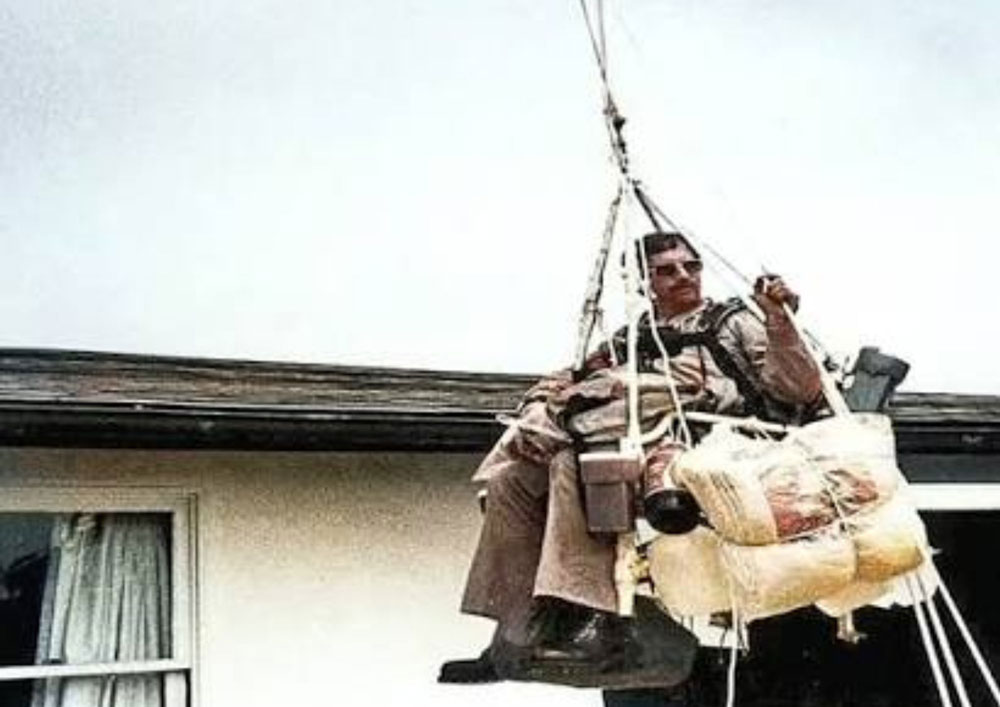
On July 2, 1982, a 33-year-old truck driver named Larry Walters sat down in an ordinary aluminum lawn chair in a backyard in San Pedro, California, and prepared to do something that sounded more like a joke than an aviation experiment. Attached to the chair were 42 helium-filled weather balloons. Walters had no pilot’s license, no conventional aircraft and no sophisticated flight controls. He did, however, have a parachute, a CB radio, water jugs for ballast and a pellet gun that he planned to use to shoot the balloons when it was time to descend. He called his homemade aircraft Inspiration I.
Walters had dreamed of flying for years. Poor eyesight had prevented him from becoming a military pilot, but the desire never disappeared. He eventually decided that if he could not fly an airplane, he would find another way to get into the sky.
What followed became one of the strangest episodes in American aviation history. Walters expected to make a relatively controlled flight, but his chair suddenly shot upward to about 16,000 feet, carrying him into the airspace around Los Angeles. Commercial pilots reported seeing a man sitting in a lawn chair several miles above the ground.
For roughly the next hour, Walters had to figure out how to get himself back down.

He Spent Years Thinking About How to Fly
Larry Walters did not wake up one morning and randomly decide to attach balloons to a chair. His fascination with flying had been developing for roughly two decades. According to accounts published after the flight, he had dreamed of becoming a pilot but was unable to pursue that path because of poor eyesight. Instead, he spent years thinking about other ways to get airborne.
The idea eventually became surprisingly practical. Walters and his girlfriend purchased dozens of large weather balloons, and he assembled a crude flying machine around a Sears aluminum lawn chair. The chair was equipped with water containers that could serve as ballast, while a parachute and CB radio were intended to provide some degree of safety and communication.
His plan was not to climb thousands of feet into the sky. He intended to make a controlled ascent and then drift with the prevailing winds toward the Mojave Desert. The pellet gun was supposed to provide a simple way of controlling his altitude by allowing him to puncture individual balloons when he wanted to descend.
There was, in other words, a certain logic behind the madness.
The problem was that Walters had calculated one crucial thing incorrectly: how much lift those balloons would actually generate.
On the afternoon of the flight, he was still attached to the ground by ropes connected to a vehicle. When one of the lines was cut, the remaining line could not handle the strain.
It snapped. And instead of gently floating upward, Walters and his lawn chair accelerated toward the sky.He had spent years figuring out how to fly. He hadn’t figured out how to stop.
Watch the video for a closer look at Larry Walters, “Lawnchair Larry,” and the bizarre 1982 flight that turned a garden chair, weather balloons and a lifelong dream of flying into an unforgettable aviation story.
Three Miles Above California, He Realized He Was in Trouble
Walters expected a modest flight. Instead, Inspiration I climbed rapidly, eventually reaching roughly 16,000 feet—about three miles above the ground. At that altitude, the situation became far more serious than a backyard experiment. The temperature was extremely cold, oxygen levels were lower, and Walters had drifted into controlled airspace near Los Angeles International Airport.
Commercial pilots began reporting the bizarre object to air traffic controllers. From their perspective, there was no obvious explanation for what they were seeing: a man sitting in a lawn chair suspended beneath a cluster of balloons.
Walters carried a CB radio and was able to communicate with people on the ground. He also had the pellet gun he intended to use to bring himself down, but the weapon soon became another problem. At one point, he accidentally dropped it.
Now the man who had designed his entire flight around shooting balloons had lost the very tool he needed to control his descent.
Walters was also becoming dangerously cold.
Yet despite the obvious danger, there was something almost surreal about his situation. He had finally achieved the thing he had wanted for most of his adult life. He was flying.
The difference was that he was doing it from a lawn chair at 16,000 feet.
He had even brought a camera with him, but later admitted that he was so amazed by the view that he never took a photograph.
For a brief moment, the ridiculousness of the machine almost disappeared.
He was simply looking down at California from the sky.
Then he had to figure out how to get home.
He Had to Shoot His Way Back to Earth
Walters eventually began shooting some of the balloons with his pellet gun, carefully trying to reduce the lift without creating an imbalance. As the balloons lost their buoyancy, the lawn chair slowly began descending.
But the flight was still far from over.
He was drifting toward Long Beach, and the descent was not taking him toward the open desert as he had originally hoped. The homemade aircraft had no rudder, engine or conventional control system. Walters could influence his altitude, but he had very little ability to determine exactly where he would land.
Eventually, the balloons and their dangling lines became entangled in power lines in Long Beach.
The result was an abrupt and rather fitting end to one of the strangest flights in American history.
Walters survived, but the power lines caused a blackout affecting part of the neighborhood for about 20 minutes. When authorities arrived, they found the lawn-chair pilot suspended in the wires.
He had successfully flown.
He had also created a power outage on his way back down.
The FAA was considerably less amused by the achievement than the public was.
Walters was eventually fined for multiple aviation violations, including operating an aircraft without an airworthiness certificate and entering controlled airport airspace without maintaining the required communication with air traffic control. The original penalty was $4,000 and was later reduced to $1,500.
His flight had lasted less than two hours, depending on the account, but it was enough to make him famous.
The Flight Made Him Famous. But That Wasn’t Really the Point.
Lawnchair Larry
The story spread rapidly after Walters returned to the ground. Newspapers and television programs around the country picked up the bizarre tale of the truck driver who had flown thousands of feet above California in a patio chair.
He became known as “Lawnchair Larry.”
He appeared on television programs including The Tonight Show and Late Night with David Letterman, and for a time he left truck driving and traveled as a speaker. His homemade aircraft became a piece of aviation history, although Walters later regretted giving the original lawn chair away after the flight.
Today, part of that chair is preserved by the Smithsonian’s National Air and Space Museum. The museum records that the chair, along with its water jugs and other components, was lifted by 42 helium balloons to 16,000 feet above San Pedro on July 2, 1982.
The flight also earned Walters a place in the Guinness World Records for the highest altitude reached by a chair attached to balloons: approximately 4,880 meters, or 16,000 feet.
Yet the most interesting part of his story isn’t the record.
It is why he did it.
Walters had spent around 20 years thinking about flying. He could not become the pilot he originally wanted to be, but instead of simply abandoning the dream, he found an absurd alternative.
That alternative was dangerous, uncontrolled and completely impractical.
But it worked.
At least for one unforgettable afternoon.
A Very American Kind of Dream
There is an obvious temptation to look at Larry Walters and see nothing more than a reckless man who got extraordinarily lucky. And there is certainly plenty of recklessness in the story. He entered controlled airspace, created a hazard for aircraft and ultimately became entangled in power lines.
But there is another reason the story has survived.
Walters represents a particular kind of American character: the person who looks at an obstacle and starts asking whether there is another way around it.
He could not fly an airplane.
So he built something that could fly.
He did not have an aircraft.
So he used a lawn chair.
He did not have an engine.
So he bought balloons.
The result was ridiculous, dangerous and strangely ingenious all at once.
And perhaps that is why people still remember Lawnchair Larry decades later. His machine was not sophisticated, but his desire was remarkably simple. He wanted to know what it felt like to leave the ground.
For one afternoon in 1982, he found out. He just went considerably higher than he intended. Sometimes the strangest stories begin with a man who simply refuses to let go of an old dream.

Larry Walters never became the conventional pilot he once dreamed of becoming, but he found his own way into the sky. His lawn-chair flight was reckless and dangerous, yet it also showed the determination of a man unwilling to abandon a dream simply because the obvious path was closed to him. He rose thousands of feet above California, survived a flight he could barely control, and left behind one of the strangest aviation stories in American history. Sometimes, the most unforgettable journeys begin with an idea that sounds impossible.