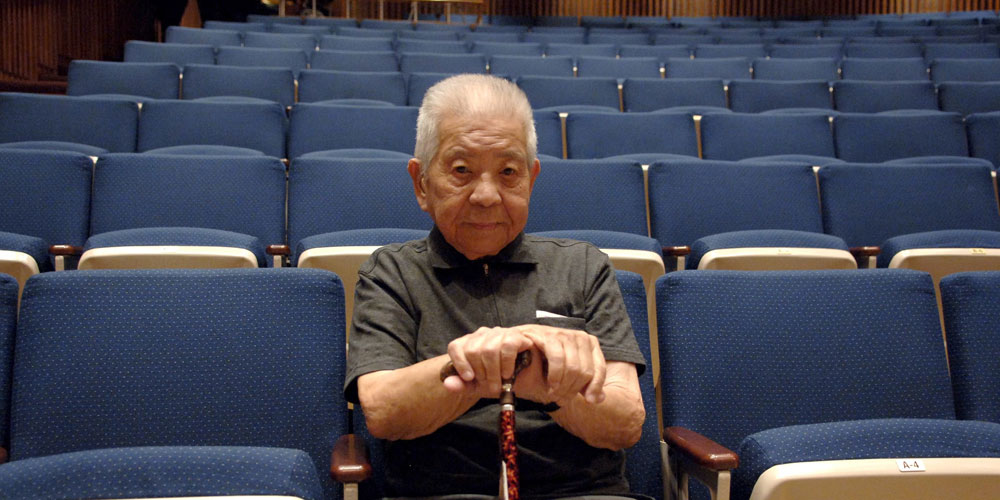
Tsutomu Yamaguchi was in Hiroshima on August 6, 1945, when the first atomic bomb used in warfare exploded over the city. He survived the blast with severe burns and somehow made the journey back to his hometown of Nagasaki. Three days later, while speaking at work about what he had witnessed, another atomic bomb exploded outside. Yamaguchi survived that blast too. More than six decades later, Japan officially recognized him as a survivor of both attacks.
The First Bomb Found Him In Hiroshima
Yamaguchi was 29 years old and working for Mitsubishi Heavy Industries when he traveled to Hiroshima on business in the summer of 1945. His assignment was ending, and on August 6 he was preparing to leave the city and return home to Nagasaki.
At about 8:15 in the morning, an American B-29 dropped an atomic bomb over Hiroshima. Yamaguchi was within roughly three kilometers of the blast, close enough to suffer serious burns to his upper body and be knocked down by the explosion. He survived, but Hiroshima around him had been transformed in an instant.
He spent the night in Hiroshima before beginning the difficult journey home. He had every reason to believe that the worst event of his life had already happened. It had not.
Discover the incredible true story of Tsutomu Yamaguchi, the only person officially recognized as a survivor of both the Hiroshima and Nagasaki atomic bombings. How did he defy impossible odds twice? Watch this harrowing account of resilience and survival in the face of history’s darkest moments. Don’t miss this gripping story!
He Went Home To Nagasaki
The journey from Hiroshima to Nagasaki took Yamaguchi through a devastated landscape. Despite his injuries, he made it back to his hometown and prepared to return to work.
Nagasaki was hundreds of miles away from Hiroshima and was still standing. For Yamaguchi, that distance should have meant safety. Instead, it placed him directly in the path of the second atomic bombing.
On August 9, just three days after Hiroshima, Yamaguchi reported for work at Mitsubishi in Nagasaki. He was still suffering from the burns he had received in Hiroshima, but he was alive and able to speak to his supervisor about what he had seen. Then the sky flashed again.

The Second Atomic Bomb Exploded As He Talked
At 11:02 a.m. on August 9, an American B-29 dropped the plutonium bomb known as Fat Man over Nagasaki. Yamaguchi was again within roughly three kilometers of the blast. The explosion knocked him down and tore away the bandages covering the injuries he had received three days earlier.
The sequence is almost impossible to absorb when reduced to dates alone.
- August 6: Hiroshima.
- August 9: Nagasaki.
Yamaguchi had been close enough to both explosions to be officially certified as a survivor of each. He also survived a third terrible circumstance that followed: his wife and infant son were in Nagasaki and survived the second bombing as well.
For Yamaguchi, there was no second chance to escape. The second attack simply happened around him.
Why Japan Did Not Officially Recognize Him For Decades
Yamaguchi was already recognized as a hibakusha, a survivor of the Nagasaki bombing. But the Hiroshima part of his story was not initially included in his official records.
His survivor documentation eventually confirmed that he had been within the relevant distance of the hypocenter in both cities. Yet when he renewed his paperwork in Nagasaki in 1960, the reference to Hiroshima was removed. Officials did not consider a special double-survivor designation necessary because it would not change his existing medical and welfare benefits.
That changed in 2009. At the age of 93, Yamaguchi was officially recognized as a survivor of both Hiroshima and Nagasaki. Japanese officials described him as the first person officially certified in that way, while also acknowledging that other people may have experienced both bombings.
That distinction is important. Yamaguchi was the only person officially recognized by the Japanese government in this specific category, not necessarily the only human being who survived both attacks.

His Life Continued Long After The Bombs
Yamaguchi did not die in 1945, or even in the years immediately afterward. He went on to work, raise a family and eventually return to Mitsubishi. He also became increasingly willing to speak publicly about what he had experienced.
As he grew older, his story took on a purpose beyond survival. He became an advocate for nuclear disarmament and used his firsthand experience to warn younger generations about the consequences of nuclear war. His official recognition in 2009 mattered to him partly because it would preserve a documented record of what had happened.
Yamaguchi died in Nagasaki in January 2010 at the age of 93. His death marked the passing of a man whose life had become an extraordinary historical record: one civilian who had lived through both atomic attacks that ended Japan’s role in World War II.

The Dates Explain Why His Story Is So Extraordinary
Many wartime stories involve remarkable survival. Yamaguchi’s is different because of the timing.
He was not simply caught in one atomic bombing and later survived its consequences. He was caught in Hiroshima, survived, traveled home injured, returned to work, and then experienced another atomic bombing only three days later. The second blast occurred while he was trying to explain the first one to his supervisor.
That sequence gives the story its almost unbelievable quality, but it also makes the history painfully human. Yamaguchi was not a military commander or a figure making decisions that shaped the war. He was an ordinary worker whose movements happened to intersect with two of the most consequential moments of the 20th century. For the rest of his life, he carried the memory of both.
Tsutomu Yamaguchi’s life is one of the most extraordinary survival stories to emerge from World War II, but its significance goes beyond the fact that he lived through two atomic bombings. He experienced Hiroshima on August 6, 1945, returned to Nagasaki, and was there when the second bomb exploded on August 9. Decades later, Japan officially recognized him as a survivor of both attacks. Yamaguchi ultimately used that distinction not as a badge of luck, but as a reason to remind future generations of the human cost of nuclear weapons.
P.S. This article draws on reporting from CBC, the Associated Press, The Guardian and Japanese officials’ accounts of Tsutomu Yamaguchi’s experiences and his 2009 official recognition. Source: https://www.cbc.ca/news/world/japanese-man-recognized-as-double-a-bomb-survivor-1.824346