In 1999, David Phillips was doing something millions of Americans do every week: walking through a grocery store looking for a good deal. Then he noticed a promotion from Healthy Choice that offered frequent-flyer miles in exchange for product bar codes. At first, the offer looked useful but ordinary. Then Phillips, a civil engineer who happened to be very comfortable with numbers, spotted something that changed the calculation completely: some Healthy Choice pudding cups cost only 25 cents, yet their bar codes could earn airline miles worth far more than the pudding itself. What followed turned an ordinary grocery run into one of the strangest loyalty-program stories ever reported.
The Promotion Looked Better Than It Should Have
The Healthy Choice promotion was straightforward. Customers could mail in 10 Universal Product Codes from qualifying products and receive 500 frequent-flyer miles. There was an early-bird bonus as well: qualifying submissions mailed during May 1999 could earn 1,000 miles for every 10 bar codes.
Phillips immediately started doing the math. He later described himself as the kind of person who naturally turns a complicated problem into a spreadsheet, and this was exactly the sort of puzzle that interested him. A promotion that seemed designed to encourage people to buy Healthy Choice food suddenly looked less like a discount and more like an opportunity to convert very cheap products into something much more valuable.
Then he found the product that made the numbers work.
How did one engineer turn 12,150 pudding cups into 1.25 million frequent flyer miles? Discover the wild true story of the ultimate mathematical loophole that left airlines powerless. Watch this incredible hack to see how he beat the system!
The Pudding Changed Everything
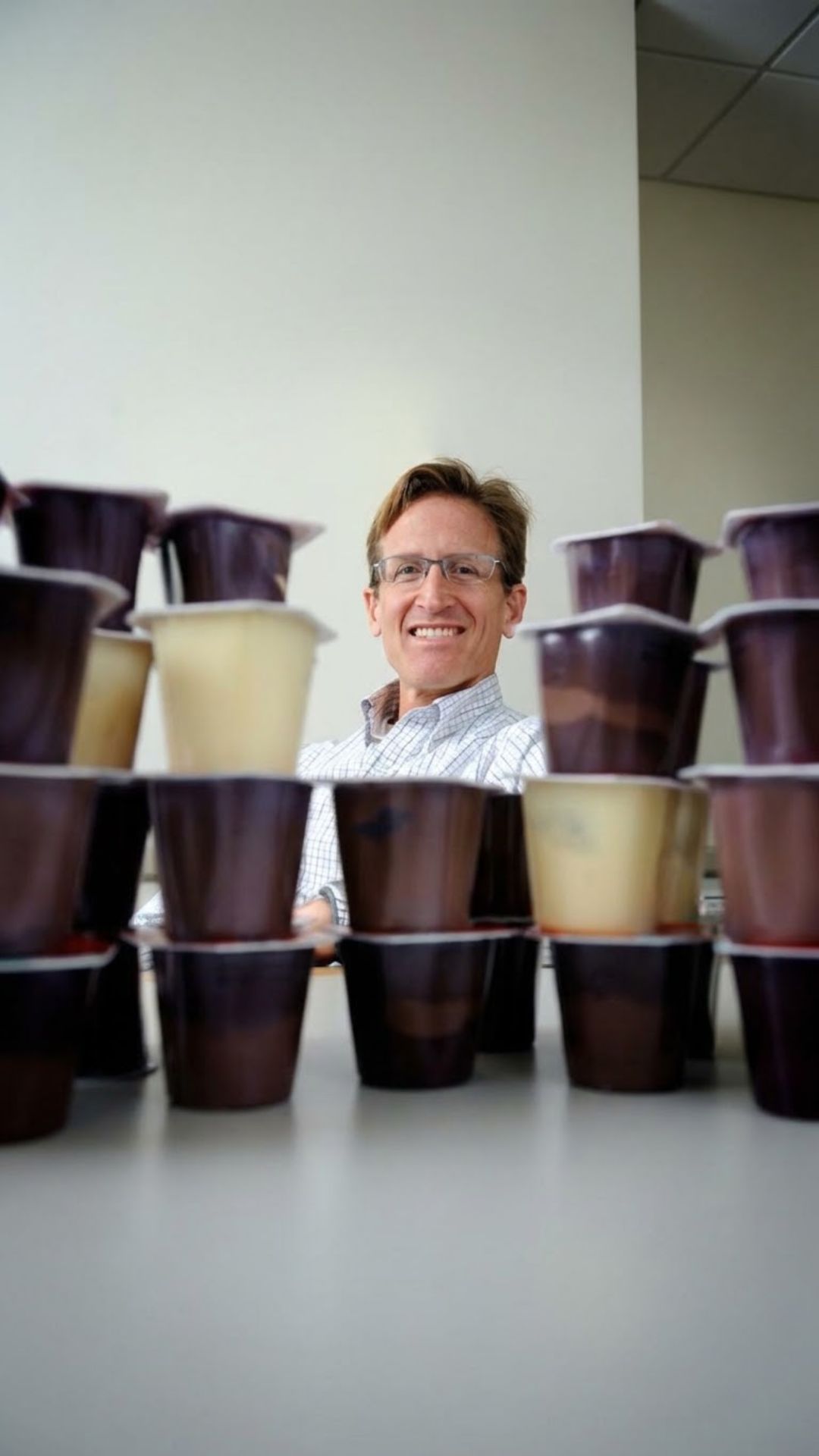
At a Grocery Outlet store, Phillips discovered Healthy Choice chocolate-fudge pudding cups selling for about 25 cents each. Unlike some of the other qualifying products he had considered, each individual pudding cup carried its own qualifying bar code. That meant the reward was tied to the number of packages rather than the amount he spent on food.
Phillips realized that the cheapest way to collect the miles was not to buy expensive frozen meals or large quantities of ordinary groceries. It was to buy pudding by the cup. He bought the store’s available supply, then began checking other Grocery Outlet locations around the region. Eventually, he purchased more than 12,000 individual cups, spending roughly $3,140 according to UC Davis’ account of the story.
The scale of the purchase was so unusual that store employees started calling him the “Pudding Guy.” At one point, Phillips reportedly told people he was stocking up because of Y2K, an explanation that sounded eccentric enough to discourage further questions.
By now, this was no longer a clever grocery-store trick. It was a logistics operation.
He Had Thousands Of Puddings And A Deadline
There was one major problem with Phillips’ plan: he had to remove the bar codes and submit them before the promotional deadline to receive the larger early-bird mileage award. Thousands of pudding containers meant thousands of labels, and doing the work himself would have taken far too long.
So he found another solution. Phillips arranged for members of a local Salvation Army organization to help remove the codes, and in return the pudding was donated rather than simply thrown away. The effort turned an absurd stockpile into something useful, while also reducing the amount of work Phillips had to do himself.
The sheer quantity was difficult to comprehend. UC Davis later noted that he had purchased 12,560 cups, while other contemporary accounts put the total at roughly 12,150. The exact count varies among later retellings, but the central fact is consistent: he bought more than 12,000 cups of pudding and used their bar codes to pursue an enormous mileage bonus.
Then came the part that made the whole scheme worth doing.

The Pudding Became 1.25 Million Miles
After Phillips submitted the required bar codes, Healthy Choice honored the promotion and awarded him roughly 1.25 million frequent-flyer miles. UC Davis reported the final figure as 1.25 million, while other records give a more precise figure of 1,253,000 miles.
That was an extraordinary return on a grocery purchase. Phillips estimated that the miles were worth as much as $150,000 when calculated according to possible flight redemptions, although later he gave a more conservative valuation of around $50,000 based on how he actually used them, mostly for coach travel. UC Davis said the balance was enough, by his calculations, for about 50 round-trip flights within the United States, 21 trips to Australia and back, or 31 trips to Europe.
The important point is not that every mile could literally be exchanged for a fixed amount of cash. Frequent-flyer miles do not work that way. Their value depends on how they are redeemed, and the real-world value changes with airfare, availability and the particular airline program.
But there was no doubt that Phillips had found a remarkable mismatch between the price of the product and the reward attached to its packaging.
The Company Actually Paid Him
The strangest part of the story may be what did not happen.
Healthy Choice did not reject the submission simply because Phillips had found an unusually efficient way to use the promotion. The company awarded the miles, making the deal perfectly real rather than an urban legend about someone supposedly beating a promotion. Snopes later confirmed the core story, while UC Davis documented the details directly through Phillips and its own reporting.
Phillips did not simply collect the miles and forget about them, either. He used them extensively for travel, including trips with his family, and his unusual success made him a minor celebrity among frequent-flyer enthusiasts. Newspapers and television programs picked up the story, and he became known internationally as the “Pudding Guy.”
The story also demonstrated something that was becoming increasingly important in the world of loyalty programs: the advertised purpose of a promotion and the mathematical reality of the rules are not always the same thing.
The Pudding Wasn’t Really The Point
Phillips was not obsessed with chocolate pudding. He was interested in the rules surrounding the pudding.
That distinction explains why the story remains memorable more than two decades later. He looked at a promotion in the same way an engineer might look at a system: identify the inputs, calculate the outputs and find the most efficient route between them. Once he realized that a 25-cent product could qualify for the same mileage reward as much more expensive products, the economic logic became difficult to ignore.
He also went on to exploit other travel promotions. In 2000, he earned another million miles through the LatinPass promotion by flying on 10 Latin American airlines within six months. Years later, UC Davis reported that his overall mileage balance had reached several million miles, and that he continued to watch for unusual promotions and pricing mistakes.
The pudding stunt was simply the one that made him famous.
Hollywood Even Borrowed The Idea
The story became so well known that it eventually reached Hollywood.
Paul Thomas Anderson’s 2002 film Punch-Drunk Love, starring Adam Sandler, includes a plot element involving large quantities of pudding and the accumulation of airline miles. UC Davis later explicitly noted that Phillips’ real-life story inspired the pudding angle in the film.
The movie, of course, is not a literal retelling of Phillips’ life. But the connection shows just how unusual the original story was. A mundane grocery promotion had produced a real-world character, a memorable nickname and eventually a place in popular culture.
And all of it started with something almost embarrassingly ordinary: a man paying attention to the fine print on a package.
David Phillips did not discover a hidden airline loophole by hacking a computer or breaking a rule. He found an imbalance inside an ordinary consumer promotion, where the value of the reward could exceed the cost of the product carrying it. By buying more than 12,000 Healthy Choice pudding cups for roughly $3,140, removing their bar codes and submitting them during the promotion’s bonus period, he ultimately received about 1.25 million frequent-flyer miles. The pudding was donated, the miles were used for years of travel, and Phillips became known as the “Pudding Guy.” The lasting lesson is surprisingly simple: sometimes the most valuable part of a deal is not what the seller is trying to sell you, but what they forgot to calculate.
P.S. The story is unusually well documented. UC Davis reported on Phillips in 2000 and again in 2011, while Snopes later confirmed the core details. Contemporary coverage also appeared in TIME and the frequent-flyer press, making this one of those rare Internet-era stories that actually survives a fact check. Sources: UC Davis, Snopes, TIME, InsideFlyer. Source: https://www.snopes.com/fact-check/pudding-on-the-ritz/