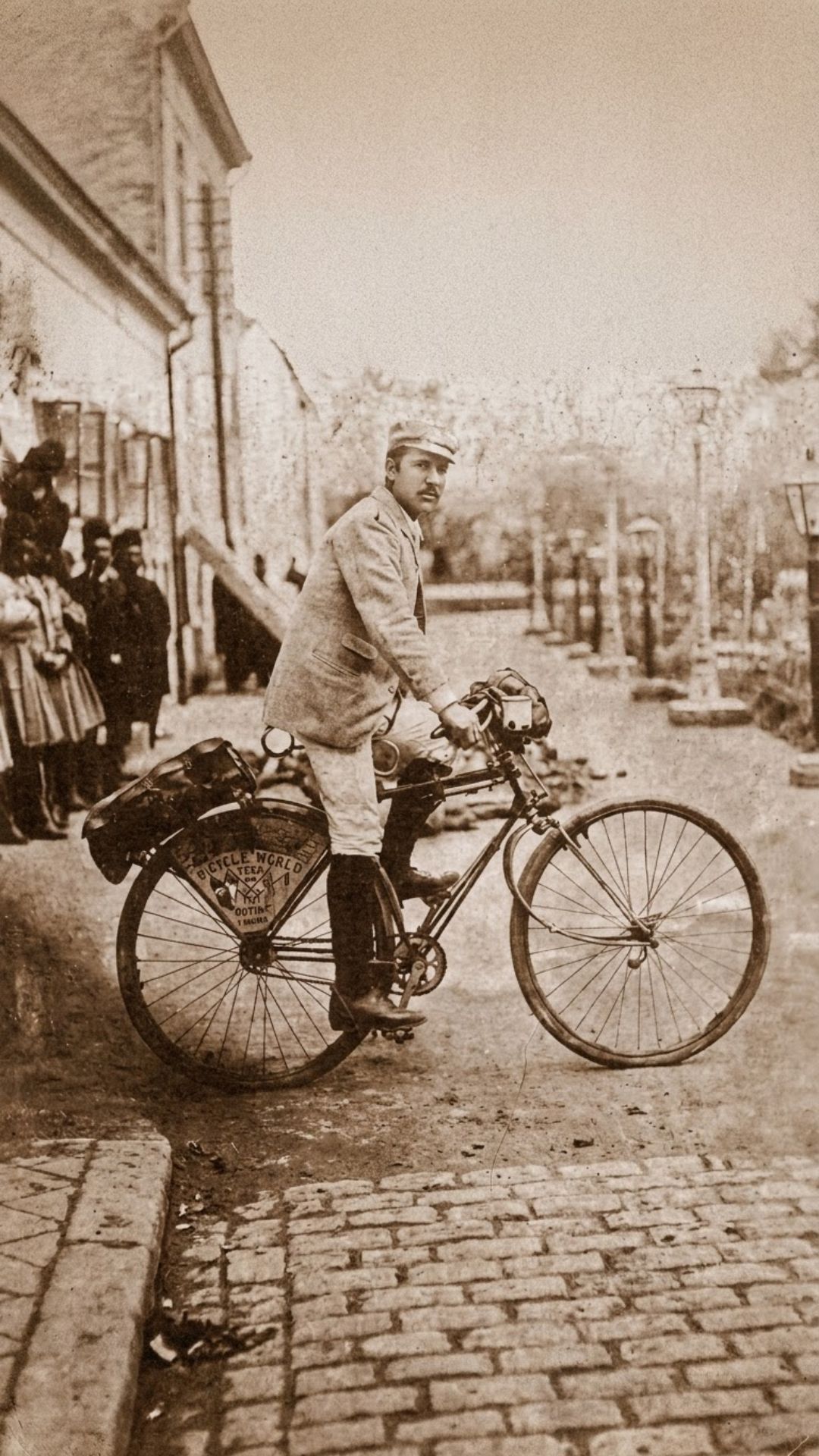
In 1892, Frank Lenz left Pittsburgh with a bicycle and an extraordinary plan: he would ride around the world. He was not simply chasing an adventure. He had been hired to promote the new “safety bicycle,” a machine that promised to make cycling safer and more practical than the dangerous high-wheelers of the era. For a time, Lenz became a celebrity, sending stories and photographs back home as he crossed continents. Then he reached eastern Turkey. In the spring of 1894, somewhere on the road toward Erzurum, Frank Lenz disappeared. His body was never found, and more than a century later, no one can say with certainty what happened to him.
He Was Trying To Prove That A Bicycle Could Cross The World
When Frank Lenz began his journey, long-distance cycling was still a relatively new spectacle. The bicycle boom that would transform American transportation and recreation had not yet fully arrived, and cycling was still associated with adventurous young men willing to ride machines that could be difficult and dangerous to control. Lenz had already attracted attention with long rides across the United States, including journeys from Pittsburgh to St. Louis and from Pittsburgh to New Orleans.
The new “safety bicycle” changed the possibilities. Unlike the enormous high-wheeler, it had two similarly sized wheels and a lower center of gravity, making it much closer to the bicycles people would recognize today. Lenz was recruited by Outing magazine to travel around the world and document the journey, while also promoting this emerging technology. He set out in 1892, believing that the bicycle could take him farther than most people imagined.
At first, the journey was as much about discovery as endurance. Lenz was not traveling inside the protected world of wealthy tourists, where steamships, coaches, servants and luggage separated travelers from the people and places they encountered. On a bicycle, there was almost no barrier between the traveler and the road. He had to deal directly with local people, weather, terrain and whatever happened to be waiting around the next bend.
That intimacy was one of the great advantages of traveling by bicycle, but it was also one of its greatest dangers. Lenz was a foreigner traveling through unfamiliar countries on an unusual machine that attracted attention wherever he went. Crowds gathered to watch him ride, and people frequently wanted to see the strange bicycle demonstrated. He was never simply passing through unnoticed.
Dive into the incredible and tragic story of Frank Lenz, the man who tried to cycle the world alone. Watch now to uncover the truth behind his disappearance.
The Journey Took Him Across A World Few Americans Had Seen
Lenz’s journey gradually became more ambitious and more difficult. His reports from the road gave readers in America a remarkable view of places that most could only imagine, while photographs showed him surrounded by people who had never seen anything quite like the bicycle he was riding.
In Japan, crowds gathered around him as he traveled along the road between Tokyo and Kyoto. In China, the bicycle again made him a curiosity, while the journey itself proved considerably harder than Lenz had initially expected. He had apparently believed he could cross China in about two months. Instead, the country took him roughly seven months to traverse.
The journey also changed him. A near-death experience in China appears to have made him more cautious, and the young man who had initially approached the trip with some confidence gradually developed a more serious view of what he was attempting.
Lenz eventually described his journey as something larger than a bicycle expedition. Beyond promoting a new machine, he believed the trip could demonstrate that people from different nations were capable of understanding one another. The bicycle gave him an unusual way to meet people directly, without the barriers that separated conventional travelers from the societies they visited. But there was a growing danger ahead.

He Was Warned Not To Take The Road Through Turkey
By 1894, Lenz had traveled through much of Asia and was approaching the final stages of his journey. To reach Europe, he had a choice. He could take a longer route through Russia, which missionaries had advised him was considerably safer, or he could travel directly through Turkey. He chose Turkey.
It is tempting to look backward and see that decision as the obvious moment when everything went wrong. But Lenz did not necessarily believe he was choosing death over safety. He had already survived difficult journeys across China and other parts of Asia, and the direct route offered a much more natural path toward Europe.
The problem was that eastern Turkey was not an easy place for a lone foreign traveler to cross. Roads were difficult, political and ethnic tensions were high, and the region could be dangerous for outsiders traveling without protection. Lenz was also no longer at the beginning of his journey. He had endured years of physical hardship and several serious illnesses.
His fellow cyclist William Sachtleben would later identify one decision as particularly important: Lenz was traveling alone. Sachtleben knew better than most what long-distance bicycle travel could demand, having himself crossed the globe by bicycle. For him, the absence of a companion may have been Lenz’s most serious vulnerability. Still, Lenz continued eastward toward Erzurum. Then the trail went cold.
The Last Photograph Was Taken Just Two Weeks Before He Disappeared
The final known photograph of Frank Lenz was taken in Tabriz, Persia, in April 1894. He was photographed by the crown prince of Persia, and the image would later become one of the most haunting pieces of evidence in the entire story because it is the last known glimpse of Lenz alive.
There was something different about him by then. Historian David V. Herlihy, who spent years researching Lenz’s journey, noted that the cyclist appeared to have aged considerably and may already have been physically weakened by the time he reached Turkey. About two weeks later, Lenz was gone.
The exact circumstances remain unclear. He had entered Turkey and was traveling toward Erzurum when he disappeared somewhere along the route. Reports later emerged that he had been attacked, and pieces of his camera equipment and other belongings were reportedly found near a town associated with a man named Moostoe Niseh.
But the evidence never produced a definitive answer. There was no body, no confirmed grave and, perhaps most importantly, no bicycle. Without those pieces, investigators could not establish exactly where Lenz died or even prove with certainty how the final part of his journey unfolded.
There were reports that he had been killed farther along the road, roughly 30 miles into the foothills near Erzurum. Other accounts pointed toward different suspects. The story began to accumulate competing versions of the same disappearance, and each new clue seemed to create another question.
Then Another Cyclist Went Looking For Him
Frank Lenz might have become nothing more than a missing traveler in a distant land if not for what happened next.
William Sachtleben was not an ordinary investigator. He was another American cyclist who had already achieved something extraordinary: together with Thomas Allen, he had successfully traveled around the world by bicycle. When news reached America that Lenz had disappeared, Sachtleben became involved in the effort to determine what had happened. He eventually went into the region to follow the clues himself.
That transformed the story. What had begun as the disappearance of one adventurous cyclist became an international investigation involving American officials, local witnesses and competing accounts of what had happened on the road. Sachtleben attempted to reconstruct Lenz’s movements and determine whether the scattered evidence pointed to murder.
One theory focused on Kurdish attackers who were believed to have targeted foreigners along the caravan routes. Another centered on Moostoe Niseh, a man whom Sachtleben considered capable of attacking Lenz. The discovery of pieces of Lenz’s equipment provided some evidence that he had been assaulted, but it did not establish that the attack was fatal. That distinction became crucial.
If Lenz had been attacked but survived, he might have continued farther along the road. If he had been robbed and killed, where was his body? If he had drowned while crossing one of the rivers on the route, why had no remains been found? And if someone had deliberately murdered him, why was the bicycle never recovered?
Sachtleben searched for answers, but he could not produce a definitive solution.
More Than A Century Later, The Mystery Still Has No Ending
The simplest explanation may be that Lenz was murdered. Herlihy, who spent four years conducting intensive research into the case, said his own instinct was that Lenz had been killed. But he also acknowledged that an accidental death remained possible. Lenz had to cross several rivers after entering Turkey, and the currents were particularly strong at that time of year. His previous illnesses may also have left him physically vulnerable.
The murder theory has its own problems. There is evidence that Lenz may have been attacked, but evidence of an attack is not the same thing as evidence of a murder. Without a body or grave, investigators cannot establish where he died. Without the bicycle, they cannot even use its location to reconstruct the final stage of his journey.
More than a century later, the most responsible conclusion is therefore also the least satisfying one: nobody knows exactly what happened.
What is known is that Frank Lenz died in 1894 and almost certainly died somewhere in Turkey. What remains unknown is whether he was murdered for his possessions, killed by one of the men suspected by Sachtleben, or lost his life through an accident while attempting to cross the difficult terrain.
And then there is the final mystery: why was someone who had once been famous almost completely forgotten?
The World Moved On And Left Frank Lenz Behind
When Lenz disappeared, the reaction was very different from the way his story is remembered today. His family, friends and supporters received considerable public sympathy, and his disappearance attracted attention precisely because he had been such a recognizable figure during the bicycle boom. But the world was changing rapidly.
By the early twentieth century, bicycles no longer seemed like the ultimate technology for long-distance travel. Motorcycles and automobiles were beginning to take their place, and the idea of circling the globe by bicycle quickly became old-fashioned. The bicycle itself changed in the public imagination, going from an exciting symbol of modernity to something increasingly associated with ordinary transportation.
Lenz’s disappearance therefore became trapped between two eras. He had helped promote a machine that would become enormously important, but the particular adventure that made him famous soon looked like a relic of another age. The celebrity who had once sent reports from the other side of the world gradually disappeared from public memory almost as completely as he had disappeared on the road.
It took a historian more than a century later to bring the case back into focus. David V. Herlihy uncovered photographs, family collections and government records, including files connected to the State Department’s efforts to investigate Lenz’s disappearance. He even found evidence suggesting that more letters written by Lenz during his journey may still exist somewhere, perhaps hidden in an old family collection.
That possibility gives the story an unusual ending. The mystery may not be completely closed. Somewhere, another photograph, letter or forgotten document could still exist that changes what we know about Frank Lenz’s final journey.
Frank Lenz set out in 1892 believing that a bicycle could carry him around the world and perhaps even help prove that people from distant nations could understand one another. For nearly two years, he survived difficult roads, illness, unfamiliar cultures and the dangers of traveling alone. Then, somewhere in eastern Turkey, the journey ended without an explanation. His last known photograph was taken only weeks before his disappearance, yet no body, grave or bicycle was ever found. William Sachtleben searched for answers, but the evidence remained incomplete. More than a century later, Frank Lenz is still remembered for the journey he began—and the mystery he left behind.
The story is based primarily on Smithsonian’s interview with historian David V. Herlihy, whose book The Lost Cyclist reconstructs Frank Lenz’s journey and the investigation that followed his disappearance. Source: https://www.smithsonianmag.com/history/the-unsolved-case-of-the-lost-cyclist-57021309/