In 1989, a man browsing a flea market in Pennsylvania bought an old landscape painting for just four dollars. He was not searching for rare art, antiques or historical documents. In fact, he barely cared about the painting itself. What caught his attention was the frame, which he believed was worth reusing. But after taking the painting home and removing the canvas, something unexpected appeared behind it: a folded piece of old paper. That forgotten document turned out to be one of the earliest printed copies of the Declaration of Independence—and it would eventually sell for $2.42 million.
He Didn’t Buy the Painting for the Painting
The discovery began at a flea market in Adamstown, Pennsylvania. Among the countless old objects, secondhand furniture and forgotten decorations, one landscape painting caught the buyer’s attention.
The artwork itself was not particularly impressive. It was an ordinary old painting, and there was nothing about the image that suggested it might contain a hidden historical treasure.
What interested the man was the frame.
He believed the frame was worth the four-dollar price, so he bought the painting and took it home. At that point, he had no idea that the object he wanted most was actually the least valuable part of his purchase.
The real treasure was hidden behind the canvas.

When He Took the Frame Apart, Something Fell Out
After bringing the painting home, the man began removing the canvas because he wanted to keep the frame. As he worked, a folded piece of old paper slipped out from behind the painting.
At first, there was little reason to assume that the document was extraordinary. It was simply an old printed sheet that had apparently been hidden behind the canvas for an unknown number of years.
But instead of throwing it away, the man looked more closely.
The document contained a text that immediately appeared familiar. It was connected to one of the most important events in American history: the Declaration of Independence.
That discovery would transform a four-dollar flea market purchase into one of the most remarkable historical finds ever made by accident.
Watch the video to discover the incredible story behind a $4 flea market painting that hid a priceless piece of American history. What looked like an ordinary old picture turned out to contain a rare Declaration of Independence that would eventually sell for $2.42 million.
The Old Sheet Wasn’t a Reproduction—It Was History
The document was eventually examined by experts, who made an astonishing discovery.
It was not a modern reproduction.
It was not a commemorative print.
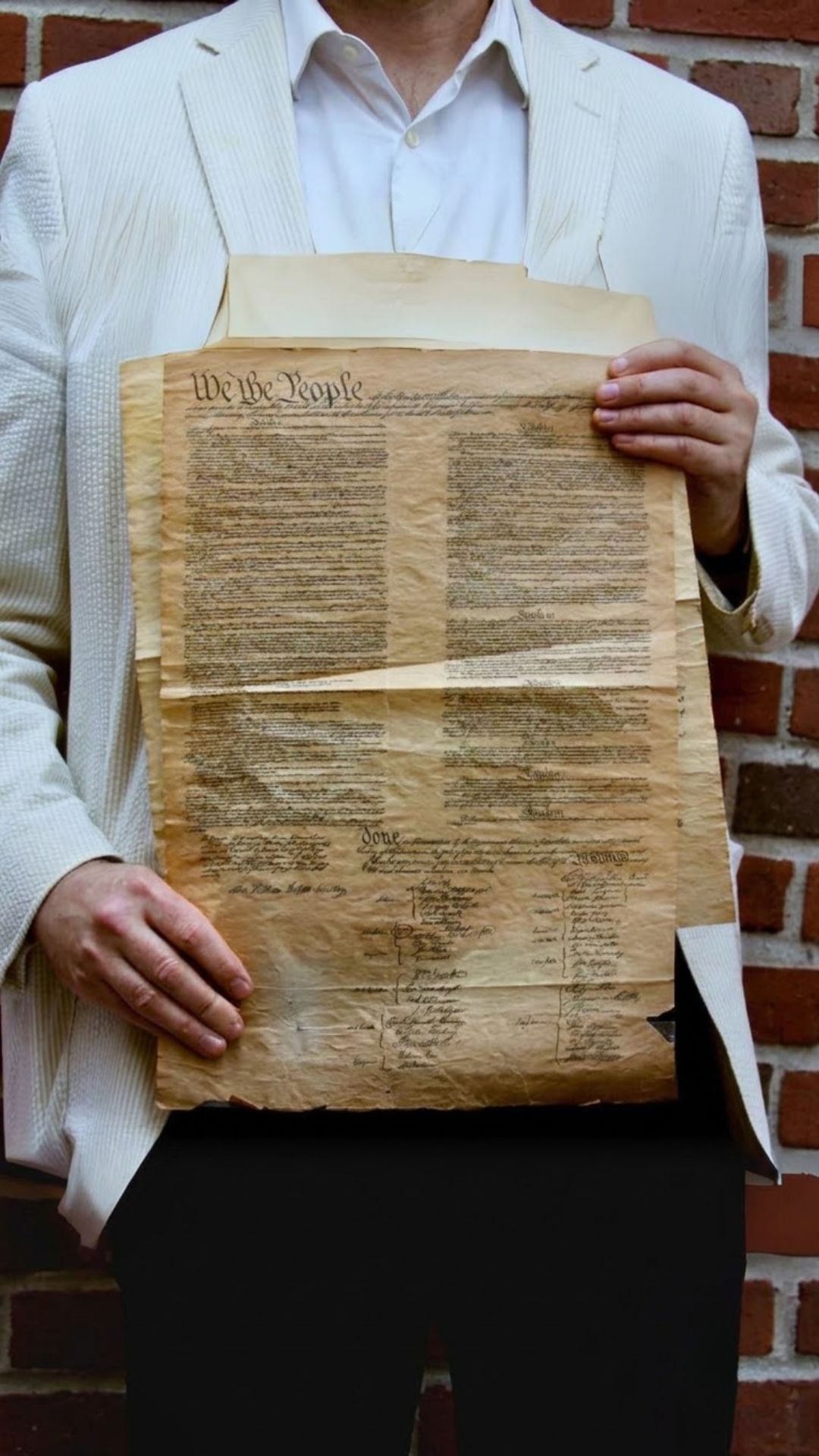
It was an original Dunlap broadside, one of the earliest printed copies of the Declaration of Independence.
The Declaration had been approved by the Continental Congress in July 1776. Once the text was adopted, it needed to be printed quickly and distributed throughout the American colonies.
Printer John Dunlap was given the task of producing these early copies.
The resulting documents became known as the Dunlap broadsides.
More than two centuries later, one of those original printings had somehow ended up folded behind an old painting at a Pennsylvania flea market.
Watch the video below to see another fascinating story brought to life. Sometimes, the most unbelievable discoveries are hidden in ordinary places—and this one proves that a single unexpected moment can change everything.
Why a Dunlap Broadside Is So Rare
The Dunlap broadsides were created for communication, not preservation. They were printed so that news of American independence could spread quickly.
People could read them.
Local officials could display them.
They could be sent to military officers and communities.
At the time, nobody could have known that these printed sheets would later become among the most valuable historical documents in the United States.
It is believed that approximately 200 Dunlap broadsides were originally printed. But over the following centuries, many disappeared.
Some were damaged.
Others were destroyed.
Many were simply thrown away after serving their original purpose.
By the time this particular copy was rediscovered, only a small number of surviving examples were known to exist. Its rarity, combined with its direct connection to the founding of the United States, made the document enormously valuable.
Why a Dunlap Broadside Is So Rare
How Experts Proved the Document Was Real
An old document alone was not enough to establish a multimillion-dollar value. Experts needed to determine whether the paper was genuinely one of the original 1776 printings.
The document was therefore examined carefully.
Specialists studied the paper, the ink and the printing style. They also compared the typography and physical characteristics with known examples of authentic Dunlap broadsides.
The results were remarkable.
The document matched the characteristics of an original printing associated with John Dunlap.
Its age and printing details were consistent with the first generation of copies produced immediately after the Declaration of Independence was adopted.
The forgotten piece of paper behind the painting was authentic.
The man who had spent four dollars on a frame was now the owner of an extremely rare piece of American history.
Watch this short video to see an incredible story unfold in just a few moments. Some discoveries happen when you least expect them—and this one is definitely worth watching until the end.
The $4 Discovery Was Sent to Sotheby’s
Once the document had been authenticated, it was eventually offered for sale through Sotheby’s.
By then, the story had already attracted enormous attention. The contrast was almost unbelievable: a document purchased accidentally at a flea market for four dollars was now considered one of the rarest surviving artifacts connected to the American Revolution.
Collectors and historians understood its significance.
This was not merely an old document.
It was a surviving witness to one of the most important political declarations in modern history.
When the auction took place on June 13, 2000, the extraordinary discovery reached another level.
The Dunlap broadside sold for approximately $2.42 million.
The four-dollar purchase had become a multimillion-dollar treasure.
From a Flea Market to $2.42 Million
The numbers alone make the story difficult to believe.
The man paid $4 for an old painting.
He did not buy it as an investment.
He did not believe the artwork was a masterpiece.
He simply wanted the frame.
Then he found the document hidden behind the canvas.
Years later, that document sold for $2.42 million.
The story became famous because of this extraordinary transformation. A flea market purchase—one that could easily have been ignored by hundreds of other shoppers—turned out to contain a piece of history with enormous financial and cultural value.
And the discovery was almost completely accidental.
If the man had not liked the frame, he might never have purchased the painting.
If he had thrown the old paper away, the document might have disappeared forever.

Why These First Printings Changed American History
When many people think about the Declaration of Independence, they imagine the famous parchment associated with the Founding Fathers and their signatures.
But the Dunlap broadsides played a different and equally important role.
They helped spread the Declaration.
Once the Continental Congress approved the text, copies needed to be distributed across the colonies. The printed broadsides allowed ordinary people, government officials and military leaders to learn that the American colonies had formally declared independence from Great Britain.
These sheets were, in many ways, the news network of their time.
They carried a political message that would change the course of history.
The document hidden behind the painting was therefore more than a valuable antique. It was one of the surviving printed copies that helped communicate the birth of a new nation.
It Survived for More Than 200 Years—Hidden Behind a Painting
Perhaps the greatest mystery is how the document ended up behind the canvas in the first place.
Nobody knows exactly who placed it there or why.
It may have been deliberately hidden.
It may have been stored behind the painting for protection.
Or it may simply have been forgotten as it passed through different owners over generations.
Whatever happened, the document remained there.
It survived wars, social change and more than two centuries of American history.
Eventually, the painting containing it found its way to a flea market in Pennsylvania.
There, surrounded by ordinary secondhand objects, it was sold for four dollars.
The value of what lay behind the canvas remained completely unknown.
Until one person decided to take the painting apart.
The Four-Dollar Painting That Changed Everything
The most remarkable part of the story is not only the $2.42 million auction result.
It is how close the document came to remaining undiscovered.
The buyer was not an experienced historian.
He was not searching for a lost copy of the Declaration of Independence.
He was not trying to identify a rare collectible.
He simply saw an old frame that he thought was worth four dollars.
That small decision changed everything.
Behind a painting that appeared to have little value was a document that had survived for more than 200 years.
And when it was finally removed, examined and authenticated, it revealed an extraordinary connection between an ordinary flea market and one of the most important moments in American history.
The story of the four-dollar painting is a reminder that history does not always survive in museums or behind heavily protected glass. Sometimes, it disappears into ordinary places, waiting unnoticed for generations. The buyer never expected to find a national treasure when he purchased an old painting simply to keep its frame. Yet hidden behind the canvas was an original Dunlap broadside of the Declaration of Independence, a document that had survived for more than two centuries. Its eventual $2.42 million auction price was extraordinary, but perhaps the most incredible fact was this: one of America’s rarest historical documents had been sitting quietly behind an old painting that almost nobody wanted.