More than 700 years ago, a young man died at Stirling Castle in Scotland under circumstances that remained a mystery for centuries. When archaeologists examined his skeleton, they found something extraordinary: 167 fractures, many of them concentrated in his skull, ribs and upper body. The pattern was so unusual that a modern forensic comparison came to mind—high-velocity trauma such as that seen in serious car crashes. Now researchers believe the injuries may reveal something far more medieval: the man could have been struck by a massive projectile fired from a trebuchet during the siege of Stirling Castle.
The Skeleton Was Found Beneath Stirling Castle
The remains, known as Skeleton 150, were discovered during excavations at Stirling Castle in 1997. The skeleton was found among a group of burials beneath the castle chapel, a location that immediately made the discovery unusual. Medieval people were generally buried in parish cemeteries, so finding these individuals within the castle grounds raised questions about who they were and why they had been buried there.
Radiocarbon dating placed Skeleton 150’s death around the beginning of the 14th century, roughly around 1300. That date is particularly significant because Scotland was experiencing intense conflict with England during the First War of Scottish Independence.
Stirling Castle was one of Scotland’s most strategically important strongholds. Whoever controlled it had a major advantage in controlling movement through central Scotland.
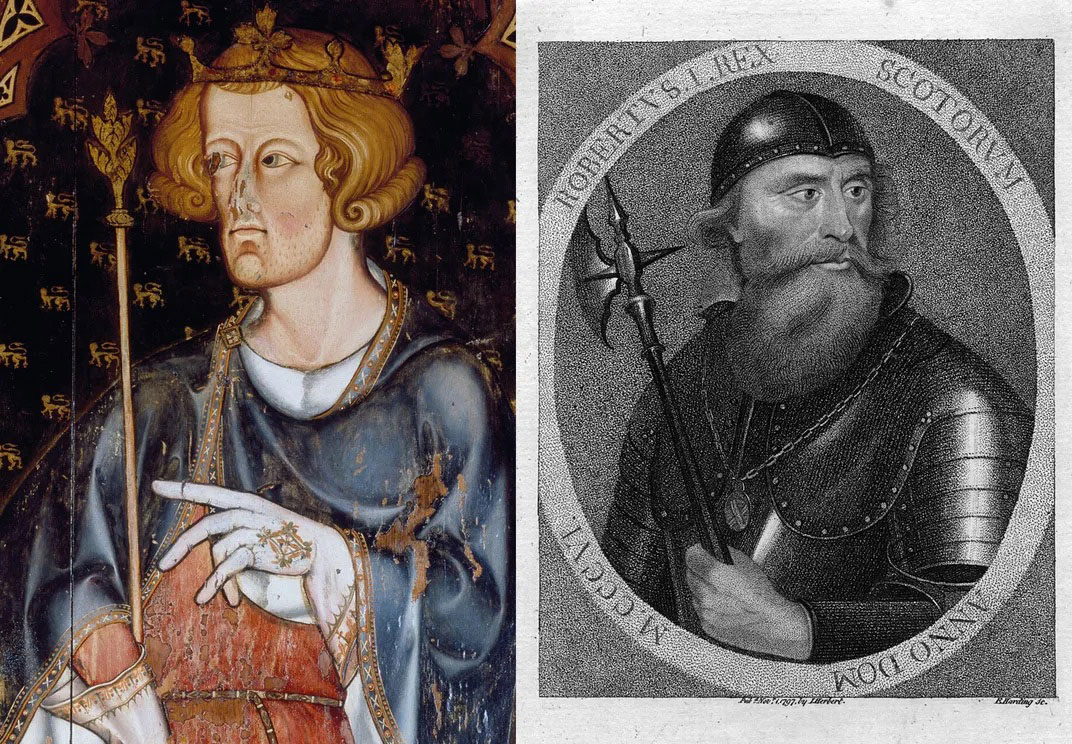
And in 1304, the castle became the target of one of Edward I of England’s most determined military campaigns.
Edward’s forces surrounded Stirling Castle and subjected it to a prolonged siege. Historical sources describe an impressive collection of siege engines being brought against the fortress, including the enormous machine later known as the War Wolf.
Skeleton 150 may therefore have died during one of the most violent episodes in the castle’s history.
But the bones themselves provided the most extraordinary clue.

His Bones Were Covered in Devastating Injuries
When researchers examined Skeleton 150 in detail, they found an astonishing 167 fractures.
The damage was not concentrated in just one part of the body. The skull alone showed about 61 fractures, while the ribs displayed approximately 57. Much of the trauma was concentrated in the upper body.
That pattern immediately raised questions.
Medieval battlefields could obviously produce terrible injuries. Swords, axes, spears, arrows and other weapons could break bones and cause fatal wounds.
But Skeleton 150 did not appear to have suffered from a collection of ordinary battlefield injuries.
The fractures had unusual zigzag patterns that researchers recognized from modern forensic cases involving extremely violent impacts. Bioarchaeologist Jo Buckberry compared the pattern with injuries associated with modern high-velocity accidents.
The comparison was striking.
A medieval skeleton was displaying damage that looked surprisingly similar to what forensic specialists might encounter after a severe modern collision.
The discovery suggested that an enormous amount of force had been applied to the man’s body in a very short period.
But researchers still had to determine what could have produced it.
Watch the video to take a closer look at the medieval skeleton, the extraordinary injuries researchers discovered, and the terrifying siege weapon that may have caused them.
Researchers Had to Look Beyond an Ordinary Battlefield Death
At first, the sheer number of fractures could have led to several possible explanations.
A fall from a great height might produce multiple broken bones. A collapse could crush a person. A violent battle could expose someone to repeated blows.
There was another possibility: some of the damage could have occurred after death as the body decomposed or the skeleton was disturbed.
That made determining when the fractures occurred essential.
Researchers used modern imaging techniques, including micro-CT scanning and 3D analysis, to examine the bones in much greater detail. The results indicated that the unusual fractures were associated with the time of death rather than being ordinary damage accumulated after burial.
The distribution of the injuries also offered clues about how the impact occurred.
The damage was particularly severe in the upper body, suggesting an extremely powerful blow rather than a series of ordinary weapon strikes.
The researchers began looking for a medieval weapon capable of generating that kind of force.
And there was an obvious candidate.
A trebuchet.
A trebuchet was a powerful medieval siege weapon designed to hurl heavy projectiles over long distances. Unlike a simple catapult, a counterweight trebuchet used a massive weighted mechanism to swing a long throwing arm and launch stones toward fortified targets.
During the 1304 siege of Stirling Castle, Edward I’s army used numerous siege engines. But the most famous was War Wolf, an enormous trebuchet constructed specifically for the assault. Historic Environment Scotland describes it as one of the largest trebuchets ever built.
The machine was so large that its construction required five master carpenters and around 50 workers. It was not merely another piece of battlefield equipment; it was intended to demonstrate the overwhelming power of Edward’s army.
Historical accounts describe War Wolf launching an enormous projectile against Stirling Castle. Modern reconstructions and historical research have attempted to estimate its capabilities, although the exact specifications of the original machine remain uncertain.
This creates a remarkable connection with Skeleton 150.
The skeleton dates to approximately the same period as the siege.
Its injuries are consistent with an extremely high-energy impact.
And it was discovered beneath the very castle that Edward’s army attacked with massive siege engines.
Researchers therefore suggest that Skeleton 150 may have been struck by a projectile launched from a trebuchet.
The idea is not that the man was loaded into the machine. Rather, he may have been standing near the castle when a massive stone projectile slammed into him.
The force would have been catastrophic.
The resulting injuries could explain why the skeleton contains such an extraordinary concentration of fractures.
It is a compelling hypothesis—but researchers still present it as a reconstruction rather than absolute proof that War Wolf itself killed him.

Skeleton 150 Offers a Rare Look at Medieval Siege Warfare
The significance of Skeleton 150 goes beyond the fate of one medieval man.
Trebuchets are well documented in medieval written records. We know they were used to attack castles, destroy walls and terrorize defenders.
But written descriptions cannot fully communicate what happened when one of these enormous projectiles actually struck a human body.
Skeleton 150 may provide an unusually direct physical record of that violence.
Instead of simply reading that a siege engine was capable of causing devastating damage, researchers can examine the consequences preserved in human bone.
The discovery also demonstrates how archaeology and modern forensic science can work together.
The researchers did not need to witness the event. They reconstructed it from clues left behind more than seven centuries ago: the location of the burial, the estimated age of the skeleton, the timing of death and, most importantly, the distinctive pattern of the fractures.
The historical context makes the theory even more intriguing.
In 1304, Edward I’s army surrounded Stirling Castle for months. The English deployed a large collection of siege weapons, bombarding the fortress before the enormous War Wolf was brought into position. Historic Environment Scotland notes that the arrival of the giant machine helped convince the defenders that resistance was futile.
The siege ultimately ended with an English victory.
Centuries later, the bones of one man buried beneath the castle may have provided evidence of just how destructive that siege could be.
Skeleton 150 effectively became a witness from the past.
His bones preserved a moment of violence that no medieval chronicler could describe in forensic detail.
And that is what makes the discovery so remarkable.
A man who died more than 700 years ago left behind a pattern of injuries that modern scientists could recognize.
The comparison to a high-speed car crash sounds strangely modern, but it points toward a very old truth: enormous amounts of kinetic energy have always had devastating consequences when transferred to the human body.

Skeleton 150 may be one of the most remarkable archaeological casualties ever linked to medieval siege warfare. His 167 fractures reveal a level of trauma so severe that researchers compared the pattern with injuries seen in modern high-speed collisions. The timing and location of his death, combined with the violence of the 1304 siege of Stirling Castle, point toward a terrifying possibility: he may have been struck by a projectile fired from a trebuchet, perhaps even the legendary War Wolf. If so, his bones offer a rare physical record of the destructive power of medieval siege weapons.