He was trapped, barely able to breathe, and the police were already looking for him. Kyle Plush used Siri to call 911 twice from inside his own van, gave them his location and warned that he was running out of time. Officers arrived at the school—but somehow, they never found him. Hours later, his father discovered his body exactly where Kyle had said he was.
A Seat Folded Back—and Kyle Was Trapped
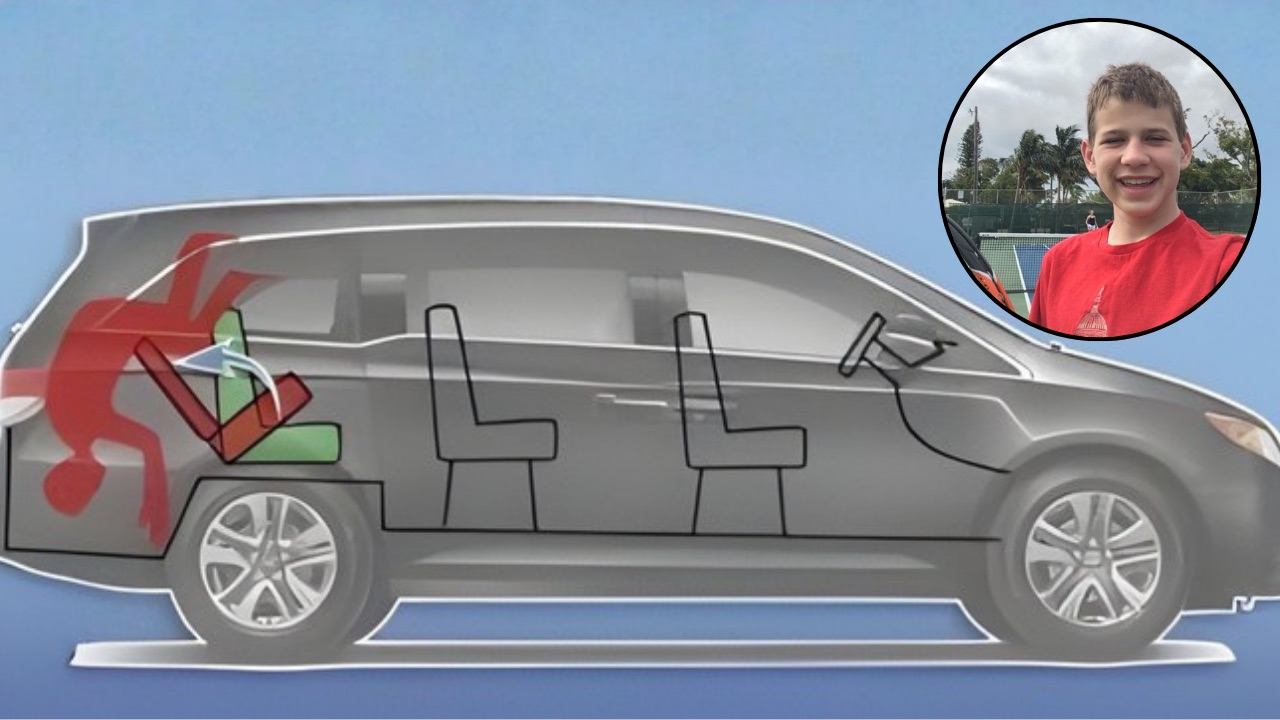
Kyle had gone to the van to collect equipment before playing tennis. According to the investigation, he reached over the third-row bench seat and it flipped backward, trapping him upside down with his chest compressed and his ability to breathe increasingly restricted.
He could not simply climb out or reach his phone normally. Instead, he relied on the voice-activation function of his iPhone to make an emergency call, turning a piece of everyday technology into his only practical way to ask for help.
The situation was already critical when his first 911 call came at about 3:14 p.m. Kyle repeatedly cried for help and said he was stuck in his van. He also mentioned Seven Hills, the school he attended, although he could not properly hear the dispatcher responding to him.

The First Call Sent Police to the School
The call lasted nearly three minutes before it disconnected. Dispatchers tried to call Kyle back but reached voicemail, and at about 3:21 p.m. the incident was broadcast as an unknown-trouble call. Officers arrived at the school at approximately 3:26 p.m.
They looked for the person who had called, but the search was unsuccessful. At 3:37 p.m., the officers closed the incident and returned to service without finding Kyle or realizing that the emergency was happening inside a nearby vehicle.
This is where the case became particularly disturbing. Later reviews established that the 911 center had received approximate wireless-location information for Kyle’s phone, and the location was ultimately found to have been within roughly 5 to 10 feet of the van. The information existed, but it was not effectively used to locate him.
Kyle Plush was trapped inside his own van, struggling to breathe, while police were already at his school looking for him. Watch the video to discover what happened during those two desperate 911 calls—and how a series of failures turned a call for help into a tragedy.
Then Kyle Called 911 Again
At about 3:35 p.m., Kyle made a second 911 call. This time, he identified himself as being trapped inside his gold Honda Odyssey in the Seven Hills parking lot and stressed that his situation was real: “This is not a joke.”
He also told the dispatcher that he was almost dead and pleaded for officers to be sent immediately. But once again, communication between Kyle and the dispatcher broke down because Kyle could not hear the call-taker. Police later confirmed that the information from that call was not relayed to the officers who were still in the area.
Kyle had done exactly what an emergency system is designed to let a person do: he called, identified the danger and asked for immediate assistance. Yet the second call did not trigger the rescue he needed, and the clock continued to run while his breathing became more difficult.

The Van Was Still There When His Father Arrived
Hours later, Kyle’s family was still trying to determine where he was. His father, Ron Plush, eventually used the Find My iPhone feature to locate his son’s phone near the school. When he reached the parking area, he found Kyle inside the van.
The coroner determined that Kyle had died from asphyxia due to chest compression and classified the manner of death as accidental. There was no evidence of foul play or drug overdose.
The fact that Kyle was found in the same general area to which emergency responders had already been sent became the central question of the case. Investigators were no longer asking only how a teenager had become trapped; they were asking how a teenager could make two emergency calls, have officers arrive nearby and still die before anyone found him.
The Investigation Exposed a System Failure
The subsequent reviews found that the failure was not reducible to a single mistake. Problems involved the handling of the 911 calls, communication of location information, training and technology at Cincinnati’s Emergency Communications Center, as well as aspects of the police response.
The findings also showed that the center had been dealing with staffing shortages, low morale, connectivity issues and other technology challenges. Those problems did not mean every employee had failed, but they revealed how multiple weaknesses could combine during one emergency and turn small mistakes into catastrophic consequences.
In November 2018, the Hamilton County prosecutor announced that no criminal charges would be filed in Kyle’s death. The conclusion was that criminal charges were not appropriate, even though the broader investigations had identified serious shortcomings in the emergency response.

His Family Took the Fight Beyond the Investigation
Kyle’s parents, Ron and Jill Plush, later filed a wrongful-death lawsuit against the City of Cincinnati and others involved in the response. Their goal was not only financial compensation; they also pushed for changes in the emergency system that they believed could prevent another family from experiencing the same tragedy.
In April 2021, the city agreed to a $6 million settlement with the Plush family. The settlement also established a long-term process involving outside experts, training, technology and operational reforms for Cincinnati’s emergency communications system.
Among the reforms were upgrades to mapping technology, changes to procedures for calls classified as “unknown trouble” and additional attention to staffing, training and quality control. The family continued monitoring the changes years later, making sure Kyle’s death produced something more permanent than a single investigation report.
Kyle Plush was 16 years old when he became trapped inside his family’s Honda Odyssey on April 10, 2018. He called 911 twice, officers arrived at the school and the emergency center had location information that was ultimately determined to be within a few feet of his van—but he was never found in time. Kyle died from chest-compression asphyxia, no criminal charges were filed, and his family later reached a $6 million settlement with Cincinnati that included years of reforms to the city’s emergency-response system. His case remains a haunting reminder that in an emergency, having the right information is not enough—the information has to reach the right person in time.