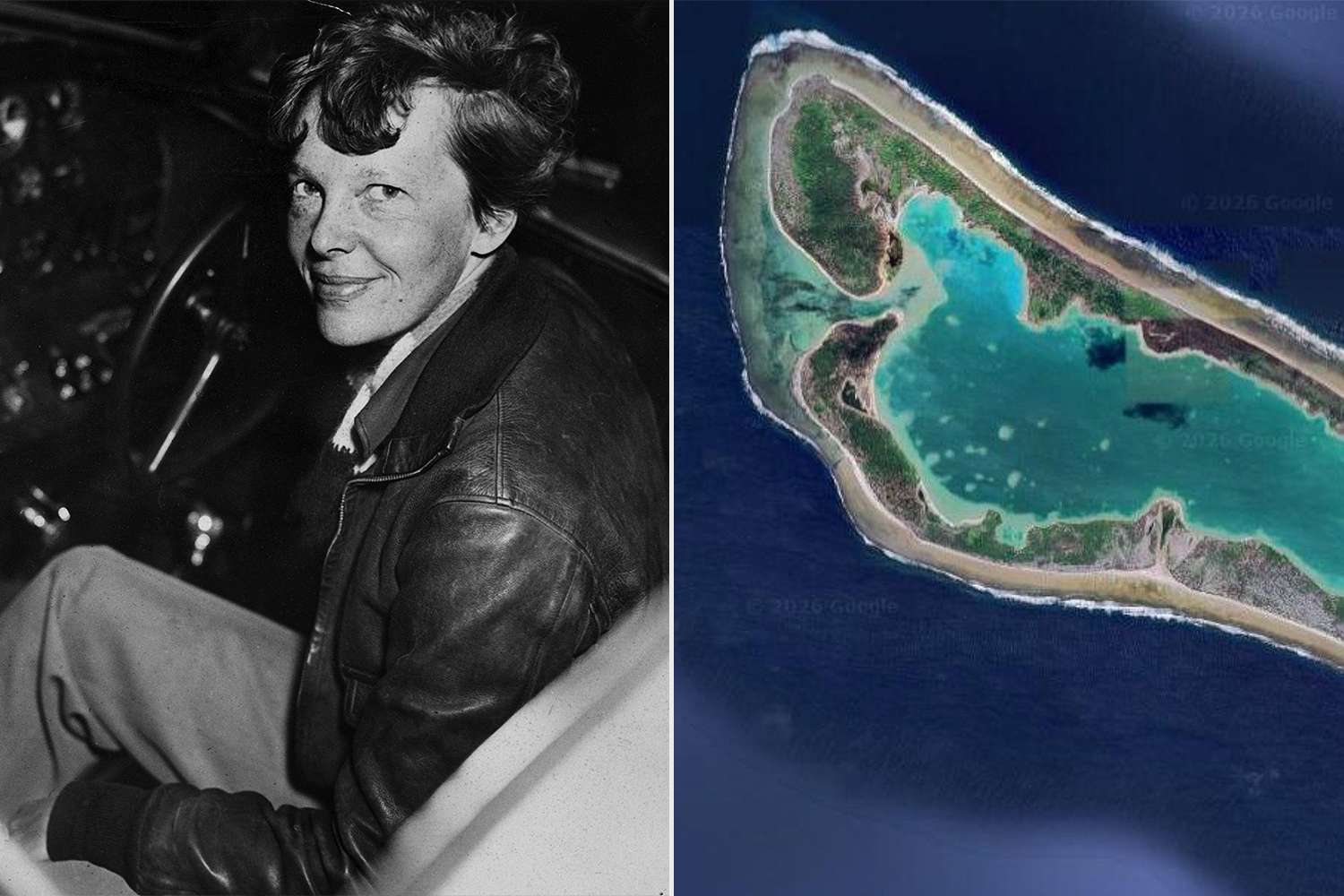
For 86 years, Amelia Earhart’s plane seemed to have disappeared into the Pacific without leaving a trace. Then a deep-sea drone picked up something that looked disturbingly like the aircraft everyone had been searching for. The image was only a blurry shape on the ocean floor, but if it really is Earhart’s Lockheed Electra, one of aviation’s greatest mysteries could finally have a physical answer. The question now is simple: did they really find it?
The Flight That Ended Without an Answer
In 1937, Earhart was attempting to become the first woman to fly around the world. She and navigator Fred Noonan were traveling from New Guinea toward Howland Island when their radio transmissions indicated they were running low on fuel. They never reached the island.
The U.S. Navy launched a search but found no trace of the aircraft, and the official position became that Earhart and Noonan went down with the plane. That conclusion never stopped the speculation. Over the decades, investigators proposed everything from a crash near Howland Island to a landing on another Pacific island.
The search became a mystery partly because there was so little to work with. There was no confirmed wreckage, no recovered aircraft and no final location that could be independently verified. Every new expedition therefore had to begin with the same basic question: where should anyone even look?
Did Amelia Earhart disappear because of one fatal mistake? This video examines the physics, radio failures and critical decisions behind her final flight—and explores the small detail that might have changed the course of aviation history.
Decades of Searches Turned Up Nothing
Researchers have tried repeatedly. David Jourdan’s company conducted three searches between 2002 and 2017, while other expeditions had already spent millions looking for evidence. One organization made six trips between 1988 and 2002 based on the theory that Earhart had crash-landed on a Pacific reef. None produced a definitive aircraft.
That history is what makes the latest expedition different. Instead of searching only around islands or relying heavily on surface evidence, Deep Sea Vision went into the deep ocean itself, using autonomous underwater technology capable of mapping huge areas of seafloor.
The person behind the expedition was Tony Romeo, whose background was not originally in deep-sea exploration. He came from commercial real estate, but had a strong connection to aviation: his father flew for Pan Am, his brother became an Air Force pilot, and Romeo himself holds a private pilot’s license.

He Sold His Real Estate Interests to Hunt for One Plane
Romeo said he sold his real-estate interests to fund the search and spent about $9 million on a HUGIN 6000 underwater drone made by a Norwegian company. The autonomous vehicle was built to operate at depths approaching 6,000 meters, far beyond the depth where Earhart’s aircraft might potentially be resting.
In September 2023, a 16-person team began an approximately 100-day expedition. Instead of searching a tiny patch at a time, they used the drone to scan more than 5,200 square miles of seafloor, concentrating on the region around Howland Island.
The scale matters. Searching the open Pacific is not like looking for a car in a field. The team was essentially trying to identify a man-made object sitting somewhere beneath thousands of feet of dark water, surrounded by a vast and uneven seafloor.
That meant the most important piece of equipment was not a diver or a ship’s crew looking through a window. It was the drone’s ability to map the bottom and record what the human eye could never see from the surface.
Then the Sonar Found Something Strange
The breakthrough came only after the team began reviewing the sonar data in December 2023. Buried among thousands of images was a fuzzy outline that appeared remarkably similar to an aircraft. Romeo became convinced it could be Earhart’s Lockheed 10-E Electra.
The image is intriguing because the object appears to have features consistent with an airplane, and its location fits the broad area the team was investigating. But the image remains just that: an image of an unidentified object. Neither the AP report nor the explorers claim that the aircraft has been conclusively identified.
The distinction is critical. Sonar can reveal shape and position, but it cannot tell investigators with certainty whether an object is a 1930s Lockheed Electra, another aircraft, wreckage or something completely unrelated.
That is why the next step is far more important than the sonar image itself.

The Real Search Is About to Begin
Deep Sea Vision plans to send a camera underwater to examine the unidentified object directly. If the image reveals unmistakable aircraft features, investigators could finally move from “possible” to “probable.” If identifying details from Earhart’s Electra are found, the mystery could take its biggest step toward a solution in 86 years.
Romeo has even said that, if the visual evidence confirms their theory, the eventual goal would be to recover the long-lost Electra. That would turn a sonar discovery into one of the most significant aviation archaeology projects ever attempted.
There is still another reason the wreck matters. An aircraft on the seafloor might preserve clues about what happened during Earhart’s final flight. Investigators have suggested that details such as the condition of the cockpit or whether a hatch was open could potentially provide evidence about the final moments of the flight—although those possibilities remain speculative until the site is actually examined.
The Ocean Still Holds the Final Answer
That is the strange position of the Earhart mystery today. After decades of failed searches, there is finally an object that appears promising enough to justify another expedition—but no one can honestly call it Amelia Earhart’s plane yet.
The story therefore remains balanced between evidence and hope. The sonar image has revived the search, but confirmation will require something much harder to fake or misunderstand: a clear view of what is actually sitting on the seafloor.
If it is the Electra, one of aviation’s oldest mysteries could finally have a physical answer. If it is not, the Pacific will have kept its secret a little longer.

Amelia Earhart vanished over the Pacific in 1937, leaving one of aviation’s greatest mysteries unsolved for decades. A deep-sea expedition has now produced a sonar image that may show her missing Lockheed Electra, but the discovery remains unconfirmed. Researchers still need direct visual evidence from the seafloor before they can identify the object. If it is Earhart’s plane, the mystery could finally be solved. For now, the ocean has revealed its most promising clue yet.