A car with wings drove through Times Square. Another was designed to reach 500 mph without using wheels. One flying car crashed during testing and ended the entire dream behind it. Yet the strangest part is this: people have been trying to build a car that could leave the road and take to the sky since 1841. Nearly two centuries later, we are still waiting. So what happened to all those flying cars?
It Started in 1841
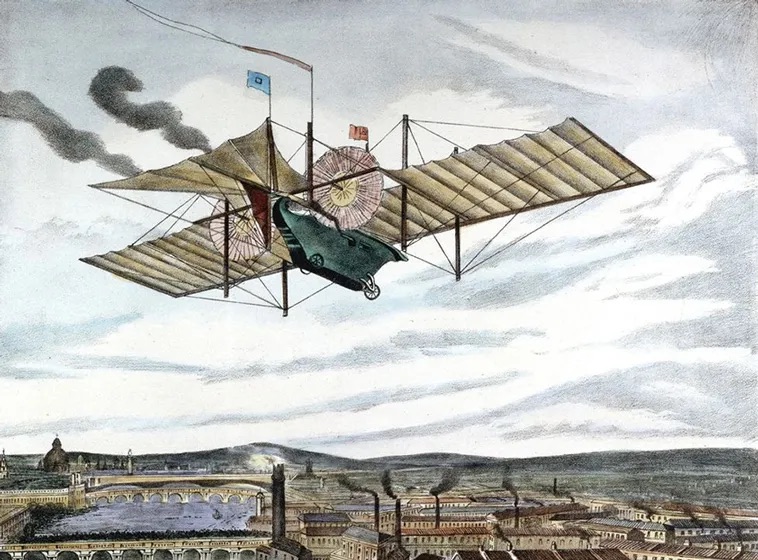
The first entry in this strange history appeared in 1841, when William Samuel Henson and John Stringfellow patented the Henson Aerial Steam Carriage.
Their design had a theoretical wingspan of 150 feet. But there was one major problem. They never succeeded in building a functional version.
The dream of the flying car had arrived before the technology needed to make it practical.
That would become a recurring theme for the next 180 years.

Then a Flying Car Reached Times Square
By 1924, the dream had become even more visually absurd.
An invention by A.H. Russell of Nutley combined a car body with wings and a propeller protruding from the front grille.
Photographs showed the machine driving through Times Square.
It looked exactly like the future people had imagined—if the future had been designed by someone who simply attached an airplane to a car.
Another flying-car concept from the same year pushed the same idea even further.
The problem was becoming obvious. Getting something to drive was difficult enough. Getting it to fly safely was another challenge entirely.
Trying to make one machine do both created a compromise that engineers would struggle with for generations.

Flying cars have been promised for nearly 200 years. So why are we still waiting? Watch the video to see the strange machines that tried to make the dream real.
Some Designs Actually Worked
Not every flying car remained a fantasy.
In 1937, Waldo Waterman modified a six-cylinder, 100-horsepower Studebaker to create the Aerobile.

A decade later came the ConVairCar Model 118, which actually flew during testing in California in 1947.

The Airphibian followed in 1948 with a different approach: instead of permanently carrying its airplane components around, the car could back into the aircraft fuselage, with the propeller attached at the front.
Then came Moulton Taylor’s Aerocar in 1957.
Its aerodynamic flying components could be detached and stored in a trailer for road travel.
This was perhaps the most logical approach yet.
Instead of forcing a car to permanently become an airplane, the vehicle transformed when necessary.

Ford Even Imagined a Flying Car Without Wheels
In 1959, Ford introduced one of the strangest concepts in the entire story.
The Ford Levacar was a single-seat concept that abandoned wheels altogether and claimed a potential top speed of 500 mph.
It was not the kind of flying car most people would recognize today.
It was closer to a radical vision of personal transportation.
But that was the entire problem with the flying-car dream.
Every generation agreed that the future should involve flying cars.
They simply could not agree on what a flying car was supposed to be.

The Dream Nearly Ended in a Crash
In 1973, the AVE Mizar attempted one of the most ambitious combinations yet.
The vehicle used both aircraft and car engines for takeoff, while its four-wheel braking system was intended to help it land safely.
At least, that was the theory.
A test flight ended in a disastrous crash.
The project was finished.
The Mizar became a brutal reminder of why flying cars were so difficult to build.
A normal car is heavy.
An aircraft must be light.
A car must survive potholes, collisions and everyday roads.
An aircraft must deal with lift, aerodynamic forces and catastrophic consequences if something fails thousands of feet above the ground.
Combining the two was never going to be as simple as adding wings.

Engineers Never Stopped Trying
The flying-car idea survived the crash of the Mizar.
Boeing engineers later developed the Sky Commuter, using a gas-turbine engine and helicopter-like drive shafts rather than simply attaching aircraft wings to a car.
Paul Moller spent much of his life pursuing the M400 Skycar, a vertical takeoff and landing vehicle.
Indian inventor A.K. Vishwanath developed the Flying Maruti.
Then came a new generation.
Terrafugia’s Transition Roadable Aircraft flew in 2009 and continued to evolve in an effort to meet aviation standards.
AeroMobil developed its own modern flying-car concept.
And NASA aerospace engineer Ilan Kroo worked on a sleek eight-prop personal flying machine.
Nearly two centuries after the first patent, the dream had not changed.
Only the technology had.

For nearly 200 years, inventors have attached wings, propellers, turbines and rotors to automobiles in an attempt to make traffic disappear beneath them. Some machines never left the ground. Some flew. Some crashed. And none became the everyday future people had imagined. That may be the strangest part of the flying-car story: the technology has changed beyond recognition, but the dream has remained exactly the same. We are still looking at the sky and asking the same question people were asking in 1841: Why are we not flying yet?