In the early 1960s, Ferruccio Lamborghini was already a wealthy industrialist with a passion for fast cars and a garage filled with some of Italy’s finest machinery. But one Ferrari repeatedly frustrated him with clutch problems, and Lamborghini believed he knew exactly what was wrong. He eventually went to Maranello to confront Enzo Ferrari himself. According to Lamborghini’s later account, Ferrari dismissed him as a tractor maker who did not know how to handle a Ferrari. Whether the famous insult happened exactly that way remains uncertain. What happened next, however, changed the history of the supercar forever.
The Tractor Maker Who Wanted Something Better
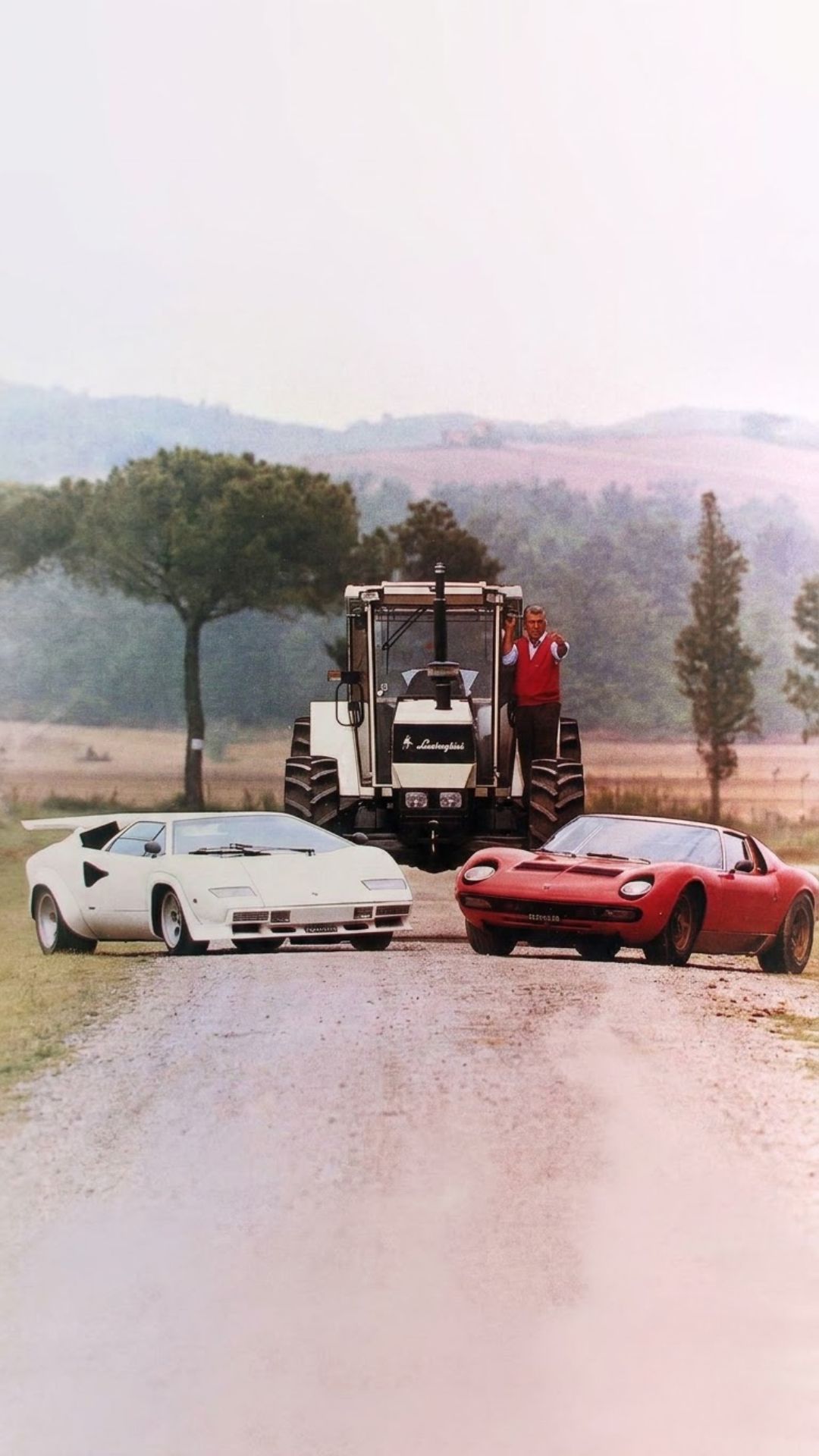
Ferruccio Lamborghini had not grown up inside the glamorous world of Italian sports cars. Born in 1916 into a farming family, he developed an early fascination with machinery and eventually trained as a mechanic. After serving as a mechanic during World War II, he returned to Italy and recognized an opportunity in the country’s struggling agricultural economy. Using surplus military equipment and his engineering skills, he began building tractors that were practical, affordable and increasingly successful.
The business grew rapidly. Lamborghini Trattori became a major source of his wealth, and Ferruccio eventually expanded into other industries, including heating and air-conditioning equipment. By the early 1960s, he was no longer simply a successful manufacturer from rural northern Italy. He was a wealthy industrialist with the freedom to indulge another passion: automobiles.
And Ferruccio did not buy ordinary automobiles. He owned expensive sports cars from several prestigious manufacturers, including Ferrari. He understood machines well enough to examine them critically, and he was not the sort of customer who was impressed simply because a famous badge sat on the hood. That distinction would become important.
Discover the incredible true story of how a heated argument with Enzo Ferrari pushed a tractor tycoon to build one of the world’s most iconic supercar brands. From his origins as a prisoner of war to his quest for automotive perfection, witness the dramatic rise of Lamborghini. Watch now!
The Ferrari That Started The Argument
Ferruccio Lamborghini later said that one of his Ferraris repeatedly suffered from clutch problems. According to the story he told years afterward, he eventually discovered that the clutch component was essentially a commercial unit also used in agricultural machinery. He was reportedly furious that a part he considered ordinary and inexpensive could be installed in an expensive Ferrari while the car itself continued to suffer problems.
The story became even more dramatic because Lamborghini claimed he eventually went to see Enzo Ferrari in person. His later account described a heated exchange in which he criticized Ferrari’s cars and suggested that he could build a better one. Ferrari, according to Lamborghini, responded by reminding him that he was a tractor manufacturer and suggesting that he did not understand how to drive a Ferrari properly.

It is one of the most famous origin stories in automotive history. But there is an important catch: nobody can prove exactly what was said that day. The precise wording comes largely from accounts given by Lamborghini himself years later, while people close to the company have disagreed over how much of the story should be taken literally. Former Lamborghini test driver Bob Wallace, for example, dismissed the idea that a single insult was the real reason Ferruccio entered the automobile business.
The truth may therefore be more interesting than the legend. Lamborghini had already become a successful businessman, he understood the economics of manufacturing, and he believed there was money to be made in high-end road cars. The Ferrari confrontation may have strengthened his determination, but it probably was not the only reason he entered the business.
Whatever happened inside Ferrari’s offices, Ferruccio Lamborghini came away with a very clear idea. He would build his own car.

He Did Not Build A Ferrari Copy
If Lamborghini had simply tried to make a cheaper Ferrari, the story would probably have ended quickly. Instead, Ferruccio approached the project like an industrialist who wanted to create something distinctly his own.
He established Automobili Lamborghini in 1963 at Sant’Agata Bolognese and began assembling a team of talented engineers. Among them was Giotto Bizzarrini, who had previously worked at Ferrari and was tasked with designing Lamborghini’s V12. Gian Paolo Dallara and Paolo Stanzani would later become central to the company’s engineering development. Lamborghini was deliberately recruiting serious technical talent rather than simply assembling a collection of expensive parts.

The first result was the 350 GTV, unveiled at the 1963 Turin Motor Show. It was followed by the 350 GT, Lamborghini’s first production car, which debuted in 1964. The car was not yet the dramatic supercar the world would eventually associate with the raging bull. It was a refined grand tourer with a V12, a five-speed gearbox and independent suspension, designed to be fast but also comfortable enough for everyday road use.
That philosophy was important because it revealed something about Ferruccio Lamborghini. He was not primarily interested in racing victories. He wanted to build a road car that combined performance with comfort, refinement and usability. In his mind, the perfect grand tourer did not need to sacrifice one quality to achieve another. And then his young engineers came to him with an idea that was far more radical.

The Car That Changed Everything
By the middle of the 1960s, Lamborghini was still a young company trying to establish itself. Then engineers Gian Paolo Dallara, Paolo Stanzani and test driver Bob Wallace began developing an entirely different kind of road car. Instead of placing the engine in the traditional front-engine configuration, they wanted to put a powerful V12 behind the driver and ahead of the rear wheels.
It was a bold idea for a production road car. The engine would be mounted transversely, helping keep the car compact and concentrating weight near the center. The young engineering team drew inspiration from racing technology, even though Ferruccio himself was not trying to turn Lamborghini into a racing constructor. The company built a bare chassis and displayed it at the 1965 Turin Motor Show, where the radical engineering attracted enormous attention.
Ferruccio saw the potential immediately. He gave the project the green light, and Lamborghini turned to Carrozzeria Bertone for the bodywork. A young Marcello Gandini created the shape that would eventually become one of the most recognizable automobile designs in history.
In March 1966, the finished car appeared at the Geneva Motor Show. Its name was Miura. And suddenly, Lamborghini was no longer merely the ambitious new company founded by a wealthy tractor manufacturer. It was a serious threat.

Then Lamborghini Unveiled The Miura
The Miura looked unlike almost anything else on the road. It was extraordinarily low, with a sleek body wrapped around a transversely mounted V12. The engine sat behind the cockpit, while the bodywork by Bertone gave the car a shape that was elegant, aggressive and almost impossibly exotic. Lamborghini itself describes the Miura as the first Lamborghini with a mid-engine layout and notes that journalists began using the term “supercar” to describe it.
The numbers were extraordinary for the period. The original P400 Miura used a 4.0-liter V12 producing around 350 horsepower, and later versions became even more powerful. The most developed SV version reached 385 horsepower. Lamborghini says the Miura ultimately reached speeds around 290 km/h in its most powerful form, making it one of the fastest production cars of its era.
But performance alone does not explain why the Miura became legendary. The car looked like a machine from another world. It was low enough to make ordinary sports cars appear tall, and its proportions suggested speed even when it was standing still.
Orders began arriving almost immediately. Between 1966 and 1973, Lamborghini produced 763 Miuras across the different versions, a remarkable achievement for such an expensive and technically ambitious automobile. The car attracted actors, musicians and other celebrities, while its appearance in films helped transform it from an exotic machine into a cultural icon.
The young company had done something extraordinary. It had created a completely new kind of road car. And it had done so only a few years after being founded.

Ferrari Had Created A Rival
This is where the famous rivalry becomes more interesting than the simple revenge story.
Ferrari and Lamborghini were not identical companies trying to sell identical cars. Their founders had very different backgrounds and priorities. Enzo Ferrari had built his identity around motor racing, competition and the prestige that came from winning. Lamborghini approached automobiles from the perspective of a successful industrialist who wanted to build exceptional road cars that were powerful, comfortable and luxurious.
The Miura represented that difference perfectly.
Ferrari’s road cars were deeply connected to the company’s racing heritage. Lamborghini’s new creation did not need a racing pedigree to make an impression. It needed to make people want one. And people did.
The Miura became so influential that its mid-engine layout helped establish a formula that would define the modern supercar: enormous power, a low body, exotic proportions and the engine positioned behind the driver. Lamborghini’s own history now describes the Miura as a car that created an entirely new vehicle segment and helped give birth to the modern mid-engine super sports car. The irony was hard to miss. The man who had supposedly been told to stick to tractors had built a machine that changed the way the world imagined an exotic sports car.

The Rivalry Outlived The Men Who Started It
Ferruccio Lamborghini did not remain at the center of the company forever. The economic difficulties of the 1970s eventually put enormous pressure on his businesses. In 1972, he sold a majority stake in Automobili Lamborghini, and he later sold his remaining interest before retiring from the automobile company.
The Lamborghini brand, however, continued.
The Countach followed the Miura and became another defining image of the supercar era. Later came the Diablo, Murciélago, Gallardo, Aventador and other models that kept the raging bull firmly positioned among the world’s most recognizable performance brands. Lamborghini eventually passed through several owners before becoming part of the Volkswagen Group in 1998.
Ferrari followed its own path, surviving the death of Enzo Ferrari in 1988 and continuing to build some of the world’s most desirable performance cars. The rivalry no longer depended on a personal argument between two Italian industrialists. It had become something much larger: a competition between two philosophies of automotive greatness. And that competition still exists today.

The Insult Was Never The Whole Story
It is tempting to tell the story as a perfect act of revenge. Enzo Ferrari insults Ferruccio Lamborghini, Lamborghini becomes furious, builds a better car and spends the rest of his life proving Ferrari wrong.
It is a wonderful story. But history is rarely that neat.
Ferruccio was already wealthy. He had already built successful companies. He understood manufacturing, had a sophisticated interest in automobiles and believed there was an opportunity in the growing market for expensive grand tourers. Automotive historians and people who knew Lamborghini have therefore questioned whether the Ferrari confrontation was really the single event that created the company.
What seems much harder to dispute is what Lamborghini did afterward. He did not simply complain about Ferrari. He assembled an engineering team, built a factory, developed a V12, produced the 350 GT and then approved one of the most radical road-car projects of its era.
The Miura was the answer. Not an angry letter. Not another argument. A car. And perhaps that is why the story has survived for so long.

The Tractor Maker Got His Answer
The famous Ferrari-Lamborghini confrontation may never be reconstructed with complete certainty. We do not have a recording of the conversation, and the most dramatic version of the exchange comes from memories and stories told years afterward. Even the people closest to Lamborghini have disagreed over whether the insult was the true reason he entered the automobile business.
But there is something undeniable about what happened after the alleged argument.
Ferruccio Lamborghini took the skills that had made him successful in tractors and industrial machinery and applied them to one of the most demanding forms of manufacturing in the world. He hired engineers who understood high-performance engines, built a new factory and created cars that quickly established Lamborghini as a major name in the automotive world. Then came the Miura.
In 1966, only three years after Automobili Lamborghini was founded, the company unveiled a car that helped create the modern supercar. Its mid-engine V12 layout, radical proportions and Bertone styling were so influential that six decades later the Miura remains one of the most celebrated automobiles ever built. Lamborghini is marking its 60th anniversary in 2026, a reminder of how long the shadow of that first revolutionary car has lasted.
Ferruccio Lamborghini did not need to defeat Enzo Ferrari personally. He had already made his point. The tractor maker had built the car.

The rivalry between Ferrari and Lamborghini is often remembered as the result of one famous insult, but the real story is more complicated—and perhaps more impressive. Ferruccio Lamborghini was already a successful industrialist when problems with his Ferrari and a legendary confrontation with Enzo Ferrari pushed him toward building cars of his own. In 1963, he founded Automobili Lamborghini. Three years later, the Miura arrived and helped create the modern supercar. Whether Ferrari actually told Lamborghini to stick to tractors may never be known for certain. But one thing is clear: the man who made his fortune building tractors eventually built one of the most important sports cars in automotive history.
This story draws on Lamborghini’s official historical records, contemporary automotive history and reporting about the famous Ferrari-Lamborghini confrontation. The sources also help separate the enduring legend of the alleged insult from the documented development of Lamborghini as a car manufacturer and the revolutionary Miura. Source: https://www.granturismoevents.com/story-the-epic-story-behind-the-ferrari-and-lamborghini-rivalry/