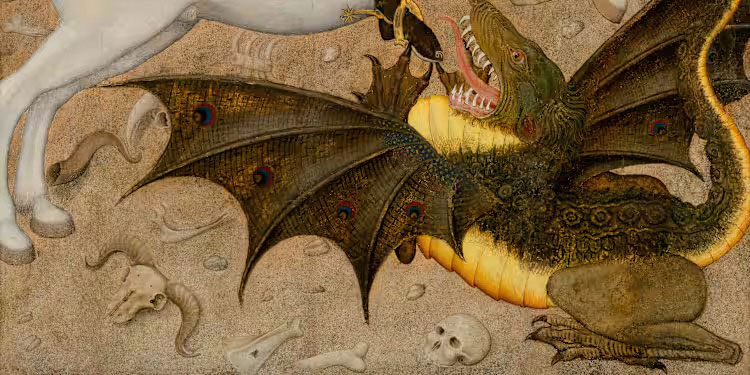
Thousands of years before Game of Thrones, people in China, Babylon, Europe and the Americas were already telling stories about enormous serpent-like creatures with claws, scales, wings and terrifying powers. The strange part is that these civilizations were separated by oceans. They had no internet. No shared movies. No global fantasy culture. Yet they all imagined something remarkably similar. So where did dragons come from—and why did humans all seem to fear the same creature?
In One Part of the World, Dragons Were Monsters. In Another, They Were Gods
Western mythology gave us the dragon most Americans immediately recognize.
- It was dangerous.
- It guarded treasure.
- It terrorized villages.
- And eventually, someone had to kill it.
From Beowulf to the legend of St. George, European dragons often represented a threat that had to be defeated. The Germanic hero Siegfried killed a gold-hoarding dragon and, according to the legend, bathed in its blood to become invincible.
But travel east and the dragon becomes something completely different.
In China, dragons were associated with rain, water, vitality, wealth and imperial power. Long, serpent-like dragon imagery dates back more than 4,000 years. Instead of being creatures people simply wanted to destroy, Chinese dragons could be powerful and beneficial beings connected to the natural forces that made life possible.
That is the first major surprise in the history of dragons.
Humanity did not simply invent one universal monster.
Different cultures took a similar creature and gave it completely different meanings.
So why did they keep returning to the same basic idea?
Dragons appeared in civilizations separated by oceans. Coincidence—or did humanity see the same thing and give it different names? Watch the video to explore the strange mystery behind one of humanity’s oldest and most universal creatures.
Maybe Ancient People Were Looking at Something They Could Not Explain
The fossil theory is irresistible.
Imagine ancient people finding enormous bones embedded in the earth. Without modern science, those remains would have demanded an explanation.
Could they have belonged to monsters?
In China, historical texts refer to “dragon bones,” a term associated with natural substances used in medicine. Modern scholars have suggested that at least some of these “dragon bones” may have been fossils. The connection became especially intriguing when excavations at a famous dragon-bone collection site near Beijing uncovered the remains of Peking Man, a type of Homo erectus.
In Europe, there is an even stranger example.
A giant skull was once associated with the dragon of Klagenfurt, Austria. According to local legend, the creature had terrorized the region before being killed. The skull later helped inspire the city’s famous dragon imagery.
But when researchers examined it centuries later, they reached a far less mythical conclusion.
It belonged to an extinct woolly rhinoceros.
The discovery raises a fascinating possibility.
Perhaps some dragon legends began when humans encountered evidence of creatures they had never seen alive.
But fossils cannot explain everything. And that is where the mystery becomes even more interesting.
What If the Dragon Was Built From Real Animals?
A dragon is rarely a completely imaginary creature. It often looks like a combination of things humans already know.
- A snake.
- A crocodile.
- A lion.
- A bird.
- A wolf.
- A giant lizard.
Dragons in myths frequently combine these familiar animals into something larger and more powerful than any one of them.
Perhaps humans did not discover dragons.
Perhaps we assembled them. Take the shape of a snake—an animal that already moves in a way humans find unsettling.
- Add claws.
- Add teeth.
- Add wings.
Make it enormous. Then give it the power to fly or control fire. You have created something that concentrates several ancient fears into one creature. And yet, this explanation still leaves one enormous question: Why did so many cultures create some version of it?

The Dragon May Be One of Humanity’s Oldest Shared Fears
Perhaps dragons survived because they were perfect mythological enemies.
They could live anywhere.
- In deep caves.
- At the bottom of the sea.
- Above the clouds.
Beyond the edge of civilization.
They could represent chaos, nature, death or an unknown world.
In ancient Mesopotamia, the dragon-like mušḫuššu could be both a terrifying creature and a powerful protector associated with Babylonian religious imagery. Persian myths described enormous dragon-like creatures that could live on land, at sea or in the air. In Mesoamerica, the feathered serpent Quetzalcoatl was associated with creation, wind, rain and agriculture.
The same basic creature could therefore become either the enemy of humanity or the force that helped create the world.
Maybe that is why dragons never disappeared.
They were flexible enough to become whatever a civilization needed them to be.
- A monster.
- A god.
- A warning.
- A symbol of power.
Or something whose meaning had been lost long before the first written version of its story appeared.

And the Mystery May Never Be Solved
There is no single proven explanation for why dragons appear across so many cultures.
Fossils may have contributed to some legends.Real animals may have inspired others.
Natural disasters, religious symbolism and storytelling may all have played a role.
The most likely answer may also be the least satisfying:
There was never just one origin story. Perhaps dragons emerged again and again because humans everywhere encountered the same basic mysteries.
- Strange bones.
- Dangerous animals.
- Thunderstorms.
- Floods.
The terrifying darkness beyond the places where people felt safe.
And each civilization gave those fears a body.
- Sometimes it had wings.
- Sometimes it had scales.
- Sometimes it brought rain.
- Sometimes it breathed fire.
But almost everywhere, it became a dragon.
That may be why dragons remain more powerful than almost any other mythical creature. We know they never existed.
At least, we think we do.
Yet thousands of years ago, people who had never met each other looked at the world and imagined something remarkably similar waiting in the darkness.

Dragons may never have existed, but the question of why humans invented them remains far more mysterious. Civilizations separated by oceans and centuries imagined giant serpent-like creatures that could fly, destroy, protect or control the forces of nature. Some legends may have begun with strange fossils. Others may have grown from encounters with snakes, crocodiles and predators. But perhaps the dragon’s greatest secret is this: humanity did not need to discover one. Again and again, we looked into the unknown—and imagined that something enormous was looking back.