In 2017, a woman searching for old picture frames at a New Hampshire thrift store spotted a dusty painting and bought it for just $4. She took it home, hung it in her bedroom and later stored it away in a closet. For years, it appeared to be nothing more than an ordinary secondhand find. Then a Facebook post, a curious conservator and a few overlooked clues transformed the forgotten painting into a remarkable discovery: a long-lost work by American illustrator N.C. Wyeth.
She Was Looking for a Frame—Not a $4 Masterpiece
The story began at a Savers thrift store in Manchester, New Hampshire. The woman, later identified in subsequent reports as Tracy Donahue, had not gone there in search of valuable art. She was looking for old frames that could potentially be reused.
Instead, she noticed a painting among other secondhand items and decided to buy it. The price was only $4.
At first, there was no reason to believe the purchase was extraordinary. Donahue took the painting home and hung it on her bedroom wall. She tried searching for information about it online but found nothing conclusive. Eventually, the painting was moved into a closet, where it remained largely forgotten.
That detail is what makes the story so fascinating. The artwork did not disappear into a private collection, museum basement or long-lost estate. A potentially important American painting spent years living an entirely ordinary life inside an ordinary home.
The real discovery would not begin until years later, when the painting finally received another look.
Watch the video to see how a forgotten $4 thrift-store purchase turned into an extraordinary art-world discovery. The journey from an ordinary secondhand shop to a lost N.C. Wyeth masterpiece is almost unbelievable.
Six Years Later, a Facebook Post Changed Everything
In 2023, Donahue came across the painting again while cleaning and decided to ask for help online. She posted photographs in a Facebook group dedicated to unusual discoveries and hidden objects.
The response was different from what she might have expected. People began suggesting that the work deserved closer examination. The images were eventually shared with a community interested specifically in the work of the Wyeth family of artists.
That was when Lauren Lewis saw the painting.
Lewis was not simply an enthusiastic internet user. She was a professional art conservator with previous experience working with the Wyeth Study Center at the Farnsworth Art Museum. She had seen countless paintings attributed to the Wyeth family and knew that most supposed discoveries turned out to be reproductions or misattributions.
But this one made her stop scrolling.
Lewis contacted the owner, and what began as an ordinary Facebook post turned into a serious investigation involving professional examination and consultation with specialists familiar with N.C. Wyeth’s work.
The $4 painting was suddenly being treated as a possible lost original.
The Most Important Clue Was Hidden on the Back
The front of the painting had attracted attention, but one of the most significant clues was on the reverse side.
Lewis noticed evidence connected to the type of artist’s board and materials used by N.C. Wyeth. The back of the work contained details that matched products known to have been used by the American illustrator, including characteristics associated with Weber art boards.
That did not prove authenticity by itself. Art authentication rarely depends on one dramatic clue. Instead, specialists compare multiple pieces of evidence: materials, style, condition, technique, historical records and the physical characteristics of the object.
In this case, the clues began pointing in the same direction.
Lewis later examined the painting in person and said she was “99% sure” that it was authentic. Further research connected the work to a missing group of illustrations created by Wyeth decades earlier. Christine Podmaniczky, a leading Wyeth scholar and curator emerita associated with the N.C. Wyeth catalogue raisonné, also agreed that the work was genuine.
The painting that had spent years hanging on a bedroom wall was no longer just an interesting thrift-store find.
It had become part of American art history.

The Painting Was One of N.C. Wyeth’s Lost Ramona Illustrations
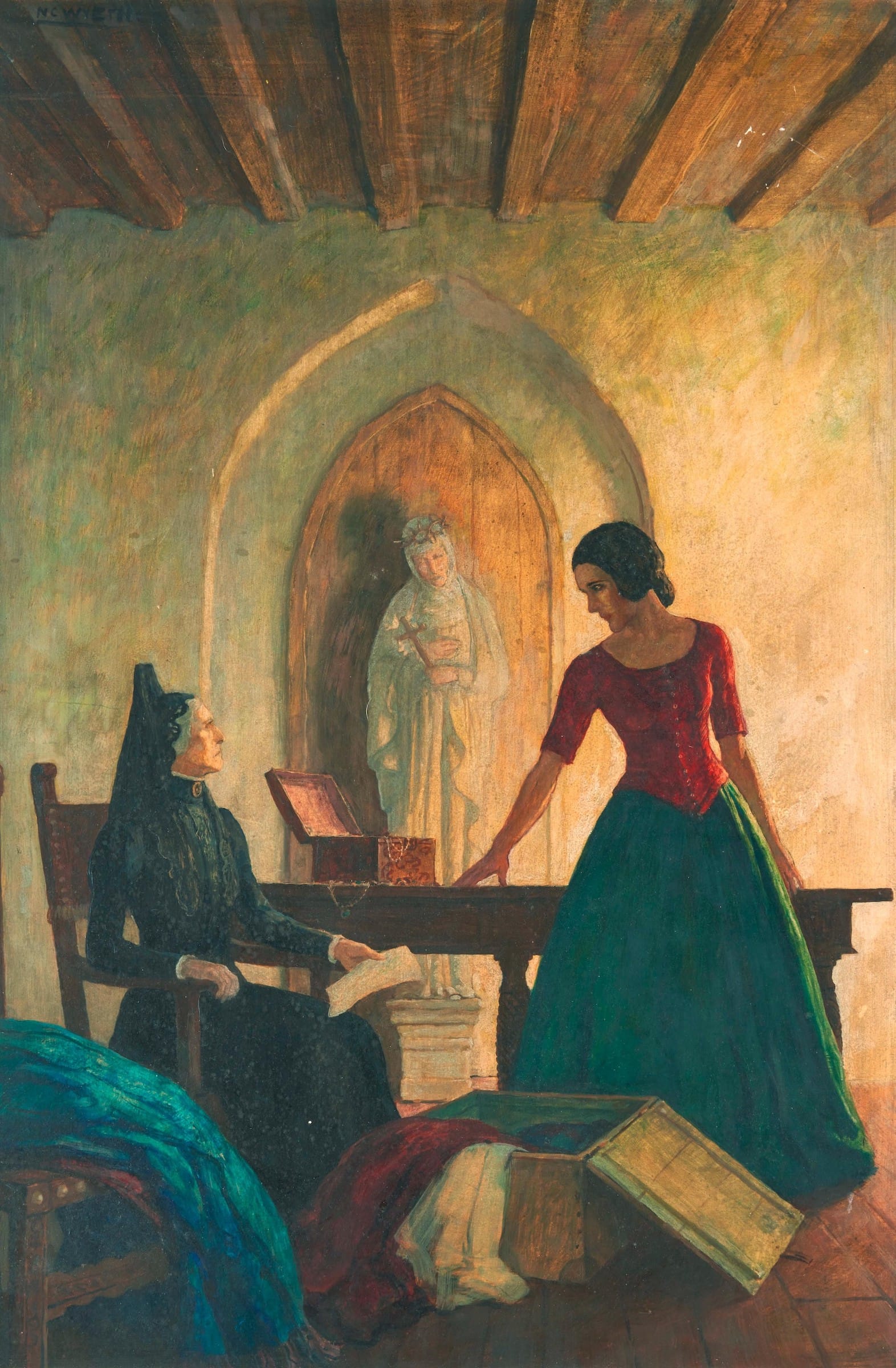
The work was identified as an illustration created by Newell Convers Wyeth, better known as N.C. Wyeth, for the 1939 edition of Helen Hunt Jackson’s novel Ramona.
Wyeth was one of America’s most celebrated illustrators. During his career, he created memorable images for novels, magazines and advertising, becoming particularly famous for his dramatic illustrations for classic adventure stories. He was also the father of artist Andrew Wyeth, one of the best-known American painters of the 20th century.
The rediscovered painting depicted Ramona and her adoptive mother, Señora Gonzaga Moreno. It was one of four illustrations Wyeth created for the 1939 edition of Jackson’s 1884 novel.
The discovery was especially significant because the locations of several works from the series had long been unknown. The painting found in the thrift store had effectively vanished from the documented art world before unexpectedly resurfacing in New Hampshire decades later.
How did it get there?
That remains one of the story’s biggest mysteries.
Auction specialists believed the work may originally have been given to an editor, publisher or someone connected to the novel’s author or estate. But the complete chain of ownership was unknown. At some point, a painting that had once been created by one of America’s best-known illustrators ended up in the anonymous donation system of a thrift store.
Then someone bought it for $4.
From a $4 Purchase to a $191,000 Auction Result
Once the painting’s identity had been established, it was consigned to Bonhams Skinner for an American Art auction in September 2023.
Before the sale, specialists estimated that the rediscovered Wyeth could fetch between $150,000 and $250,000.
The auction attracted enormous attention because the story seemed almost too perfect. A woman looking for old frames accidentally buys a painting for $4. Six years later, experts identify it as a lost work by a major American artist.
When bidding began, the work received a bid of $150,000. After the buyer’s premium and fees were added, the reported total auction price reached $191,000. The difference between the original thrift-store price and the auction result instantly turned the painting into one of the most famous secondhand art discoveries of the year.
But the story was not over.
In fact, its most frustrating twist was still waiting.
The $191,000 Buyer Never Paid
For a brief period, the discovery appeared to have received the perfect ending.
The $4 painting had been sold.
The family was expecting an extraordinary financial windfall.
Then the payment failed to arrive.
According to Hyperallergic, the auction buyer had a limited period to complete the transaction after the sale. Weeks passed, and the purchaser ultimately refused to pay. The painting was returned to the Donahues, turning what had looked like a spectacular payday into what they described as an enormous disappointment.
The story therefore became stranger than the original thrift-store discovery.
The painting had technically achieved a $191,000 auction result.
But the family did not actually receive $191,000.
Later reports indicated that the work was eventually sold privately to a collector for more than $100,000, finally allowing the owners to benefit financially from their remarkable discovery. The exact amount was not publicly disclosed.
The final lesson was almost as surprising as the discovery itself: an auction hammer falling does not necessarily mean the money has reached the seller.

Why This Story Feels Like a Real-Life Treasure Hunt
The appeal of this story goes far beyond the numbers.
Yes, the difference between $4 and more than $100,000 is extraordinary. But people are fascinated because the discovery followed the structure of a real-life treasure hunt.
First, there was an overlooked object.
Then there was a mystery.
Next came an unexpected clue hidden in a detail most people would never notice. A Facebook post brought the right person into the investigation. Experts began comparing evidence. Historical records were examined. Slowly, an ordinary object became connected to a forgotten piece of art history.
The story also challenges the assumption that valuable things always look valuable.
The painting did not come with a certificate announcing its importance. It was dusty, sitting among secondhand goods and apparently anonymous. Its real value was hidden behind a lack of information.
That is the essential difference between an old object and an important historical object.
Sometimes, the object itself is not hiding.
The knowledge needed to understand it is.
Of course, stories like this should not convince people that every dusty painting in a thrift store is a lost masterpiece. Almost all of them are not. But the Ramona discovery shows why experts pay attention to details that others might ignore.
A label.
A material.
A frame.
A signature.
The reverse side of a painting.
History can survive in surprisingly small pieces of evidence.
A woman entered a thrift store looking for old frames and walked out with a painting that had cost her only $4. For years, the work hung in her home and later collected dust in a closet before a Facebook post set an extraordinary investigation in motion. Experts eventually identified it as a long-lost N.C. Wyeth illustration, transforming an ordinary secondhand purchase into a valuable piece of American art. The journey even included a failed $191,000 auction sale before the painting ultimately found a private buyer. More than a lucky thrift-store story, Ramona is a reminder that history can disappear into ordinary places—and sometimes wait years for someone to recognize what has been sitting in plain sight.