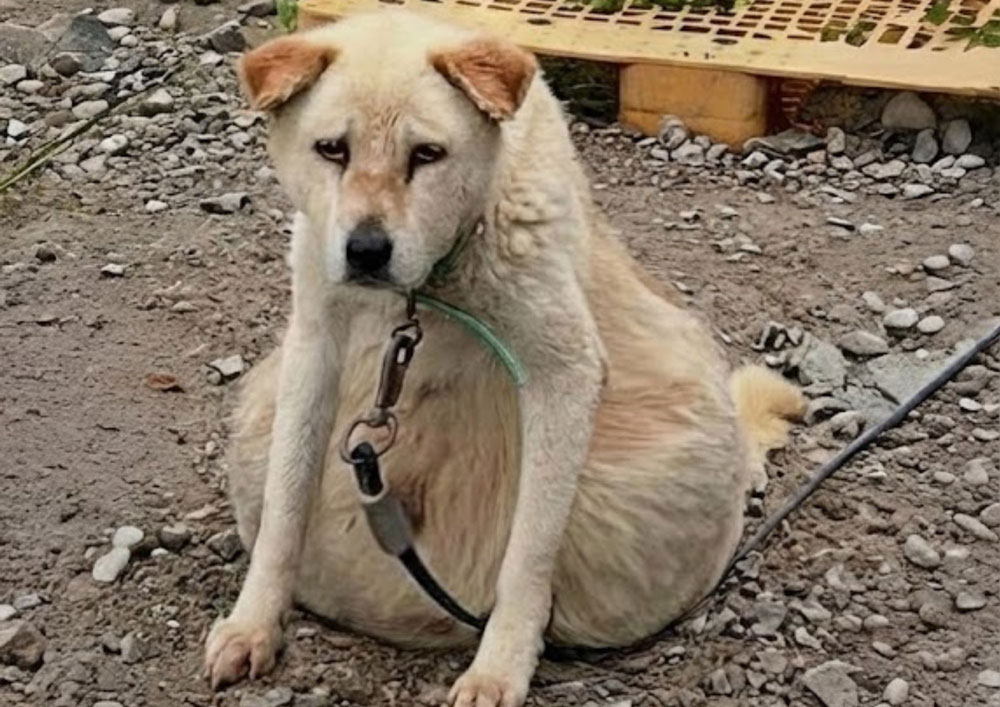
For 16 years, Youngji lived at the end of a short chain, with almost no chance to run, explore or experience the life of an ordinary dog. When rescuers finally found her, the elderly dog was severely ill and barely able to stand. Yet after everything she had endured, Youngji still wagged her tail when the people who came to save her approached. Her story is a powerful reminder of the extraordinary trust and loyalty that make dogs man’s best friend.
She Spent 16 Years on a Short Chain. Then Youngji Was Finally Free
For sixteen years, Youngji knew almost nothing beyond the length of a short chain. The elderly dog spent her life in a rural yard, exposed to the weather and largely deprived of the care and companionship that should have been part of her life. When rescuers finally arrived, her body was failing: her abdomen was severely swollen, she struggled to breathe, and she could barely stand. Yet when the people who came to save her approached, Youngji still wagged her tail.
That small movement became the detail that made her story so difficult to forget. After years of neglect, she had every reason to fear people or retreat from them. Instead, she responded to the rescuers with the same instinctive trust that has made dogs such extraordinary companions to humans.
Her rescue would not immediately erase sixteen years of suffering. But it gave Youngji something she had never truly known before: a chance to discover what life could be when there was no chain holding her back.

The Life She Knew Was Only as Long as Her Chain
Youngji had spent virtually her entire life tethered outside, her movements restricted by the short chain attached to her. She endured seasons of cold and heat in the same confined environment, with little of the interaction, exercise or comfort that most dogs experience as ordinary parts of life. By the time rescuers received an urgent call about her condition, she was an elderly dog whose body showed the consequences of years of neglect.
The most difficult part of Youngji’s story is perhaps how ordinary that existence had become to her. A dog normally experiences the world through movement and exploration: following a scent across a yard, walking beside a person, investigating a new place or simply choosing where to lie down. Youngji had spent sixteen years with almost none of those choices. Her world was defined by the distance her chain allowed her to travel.
For most dogs, a leash is something that comes off at the end of a walk. For Youngji, the restraint was effectively her entire world.
And yet, when someone finally came to change that world, she did not greet them with anger.
She greeted them with a wagging tail.
Watch the video to see Youngji’s heartbreaking rescue after 16 years on a chain, from her fragile condition to the moment she finally receives the kindness and care she had been waiting for.
When Rescue Finally Came, She Still Trusted People
When the rescuers arrived, Youngji was in critical condition. Her abdomen had become enormously swollen from accumulated fluid, her body was frail and exhausted, and she was struggling to breathe. According to the rescue account, her previous owners had essentially dismissed her condition because of her age, after which the rescuers intervened and took responsibility for her care.
The journey away from the yard marked the end of a life she had known for sixteen years. As the rescuers carefully lifted her weakened body into their vehicle, Youngji managed to move her tail against the seat in a faint greeting.
It is an incredibly simple gesture, but it changes the way the entire story feels.
She did not know these people. She had no reason to understand what a rescue organization was or where the vehicle was taking her. She could not have known that she was being transported toward veterinary treatment, food, warmth and a life without the chain.
All she knew was that someone was finally giving her attention.
And she responded with trust. After sixteen years of neglect, Youngji still wagged her tail when someone finally came for her.
Her Body Was Failing. Her Will to Live Wasn’t.
At the veterinary clinic, the rescuers discovered how serious Youngji’s condition had become. She was suffering from advanced heartworm, chronic heart disease and severe organ problems, all of which had left her struggling to breathe. More than eight liters of accumulated fluid were drained from her abdomen in an effort to relieve the enormous pressure on her body.
The treatment could not undo sixteen years of neglect. It could only give her body an opportunity to recover from what could still be treated.
And Youngji cooperated.
She accepted examinations, treatment and unfamiliar hands without the kind of resistance that might have been expected from a frightened, elderly dog. Even while her body was extremely weak, she continued to respond to the people caring for her.
Then came another small but remarkable change.
After being moved into recovery, Youngji was given soft blankets and a warm place to rest. At first, however, she preferred the hard floor. It was the environment she understood. For most of her life, cold and unforgiving ground had been the closest thing she had known to a bed.
Over time, as she received regular meals, medical care and affection, she began adapting to her new surroundings. Her legs remained unsteady and her body remained fragile, but she eventually started taking voluntary steps around the recovery area.
Those steps were tiny.
For Youngji, they represented an entirely different kind of life.
Freedom Finally Meant Something Different to Youngji
What Does Freedom Look Like for a Dog?
For most people, freedom is an enormous concept. For Youngji, it could be something much simpler: walking without a chain pulling against her neck, choosing where to lie down, feeling a soft blanket beneath her body or being able to approach a person because she wanted to.
After sixteen years, even ordinary experiences could become new ones.
A dog that has spent its life outdoors does not necessarily understand what it has been missing until someone gives it something different. Youngji’s recovery was therefore not only about treating her physical illnesses. It was about giving her the opportunity to experience comfort and choice during whatever time she had left.
That is what makes her story more than a rescue story.
It is a story about how much of a dog’s life can be changed simply by giving it the things that should have been there all along: food, medical care, warmth, affection and the freedom to move.

More Than Rescue
Youngji’s story also says something powerful about the relationship between humans and dogs.
Dogs have spent thousands of years adapting themselves to life alongside us. They work with us, protect us, follow us, wait for us and often greet us with enthusiasm regardless of how long the day has been. Their loyalty is one of the reasons humans call them man’s best friend.
But Youngji’s story adds another dimension to that phrase.
Even after sixteen years of being treated as though her life had little value, she still had the capacity to trust the people who reached out to her. Her first response to rescue was not resentment. It was a wagging tail.
That does not mean dogs simply forget suffering. It means that their ability to form bonds with humans can survive experiences that should have destroyed their trust.
And perhaps that is what makes Youngji’s first steps so meaningful. They were not simply steps away from an old yard. They were steps into a world she had never been allowed to experience.
For sixteen years, her world ended where her chain ended.
Now, for the first time, there was no chain telling her where she could go.
Youngji’s story is ultimately a reminder that rescuing a dog is not only about extending its life. Sometimes, it is about giving an animal the dignity, comfort and freedom it should have had from the beginning.
And after spending nearly her entire life waiting, Youngji finally had someone coming toward her—not to put her back on a chain, but to take it away.
Youngji spent 16 years knowing only the limits of a short chain, yet when someone finally came to rescue her, she still responded with a wagging tail. Her story is a quiet reminder of why dogs have earned the title of man’s best friend: even after years of neglect, they can still trust, still seek affection and still welcome a helping hand. For Youngji, freedom did not mean something grand. It simply meant finally being able to walk wherever she wanted.