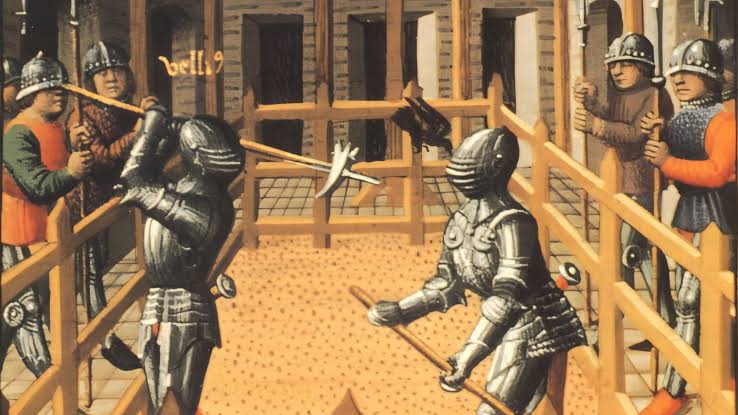
By the late Middle Ages, the sword had a problem: plate armor was getting very good at stopping it. From the second half of the 14th century, the war hammer became one of the answers—a weapon designed to concentrate force rather than depend on a cutting edge, then expanded with picks, spikes and reinforced shafts as armored combat became more demanding.
A Weapon Designed for a New Kind of Armor
The war hammer was, in simple terms, a response to a late-medieval arms race between offense and defense. As steel plate armor spread among the warrior classes from the 14th century onward, its hardened and angled surfaces became increasingly resistant to swords and axes.
Instead of trying to penetrate the plate with a thin edge, the war hammer relied on concussion. A forceful strike to the head, limbs or body could deliver enough blunt-force trauma to stun, disable or kill an armored opponent, even when the armor itself remained intact.

Then the Hammer Started Carrying a Second Weapon
The basic design was straightforward: a long haft, available in one- or two-handed versions, ending in a metal hammer head. But between the 14th and 15th centuries, weaponsmiths began modifying the design to make it more versatile and more lethal.
The most important addition was the sharpened pick placed on the opposite side of the hammer. Depending on the design, the pick could be straight, hooked, thick, thin, short or long; swung with enough force, it could puncture plate armor, while hooked versions could pull warriors from horses or catch reins and shield rims.
Some war hammers also gained a thin spike on top for stabbing attacks. The result was a weapon with several options: hammer an opponent to stun him, then use the pick or spike to finish the attack.
A sword might struggle against plate armor, but what happens when a war hammer hits it? Watch the video below to see the kind of damage this medieval weapon was designed to inflict.
The Swiss Made It Bigger Then Reinforced the Shaft
The design continued to evolve, and the Swiss developed one of the most imposing versions: the Lucerne war hammer. Its head could have three or four prongs and was combined with a long spike, a pick and a haft measuring about 6½ feet.
War hammers came in a wide range of sizes, with hafts measuring anywhere from about 2 feet to 6½ feet. Short versions were suited to close-quarters fighting, while longer versions allowed deeper swings, including attacks delivered from horseback. Although mainly associated with cavalry, war hammers also saw widespread use among infantry.
There was one obvious weakness to a weapon built around a wooden haft: an enemy sword could attack the shaft itself. To prevent the hammer from being shattered before it could be used, weaponsmiths reinforced many examples with all-metal langets running along the sides of the haft.
It was a small but important detail. The war hammer was being designed not only to defeat armor, but also to survive attacks from other weapons.

Why the War Hammer Eventually Disappeared
In Western Europe, war hammers remained in use into the 16th century. Their decline came as firearms became increasingly effective and eventually made plate armor obsolete as the dominant form of battlefield protection.
The story was different in Eastern Europe. Polish hussars continued to use war hammers through the 17th century and into the early 18th century, showing that the weapon remained useful where heavily armored cavalry still played an important role.

The war hammer became important for a simple reason: medieval armor had changed the rules of combat. A weapon that depended on a thin cutting edge was no longer always enough, so warriors adopted a design built around concentrated impact, then added picks, spikes, longer hafts and metal reinforcement as the weapon evolved. For several centuries, the war hammer was a practical answer to one battlefield question: how do you bring down a man whose armor is designed to stop your sword?