In 1978, a Princeton student asked a simple question about a brand-new New York skyscraper: what happens if the wind hits it from the wrong direction? The question sounded technical, but it exposed a weakness in the structural assumptions behind the 59-story Citicorp Center. The building had already opened the year before, and thousands of people were working inside it. Its structural engineer, William LeMessurier, now faced an agonizing choice: conceal a potentially catastrophic problem, or admit that his own design needed to be fixed. He chose the second option—and launched a secret repair operation that continued for months while New York remained unaware of how serious the problem could have been.
The Skyscraper Was Built Around A Compromise
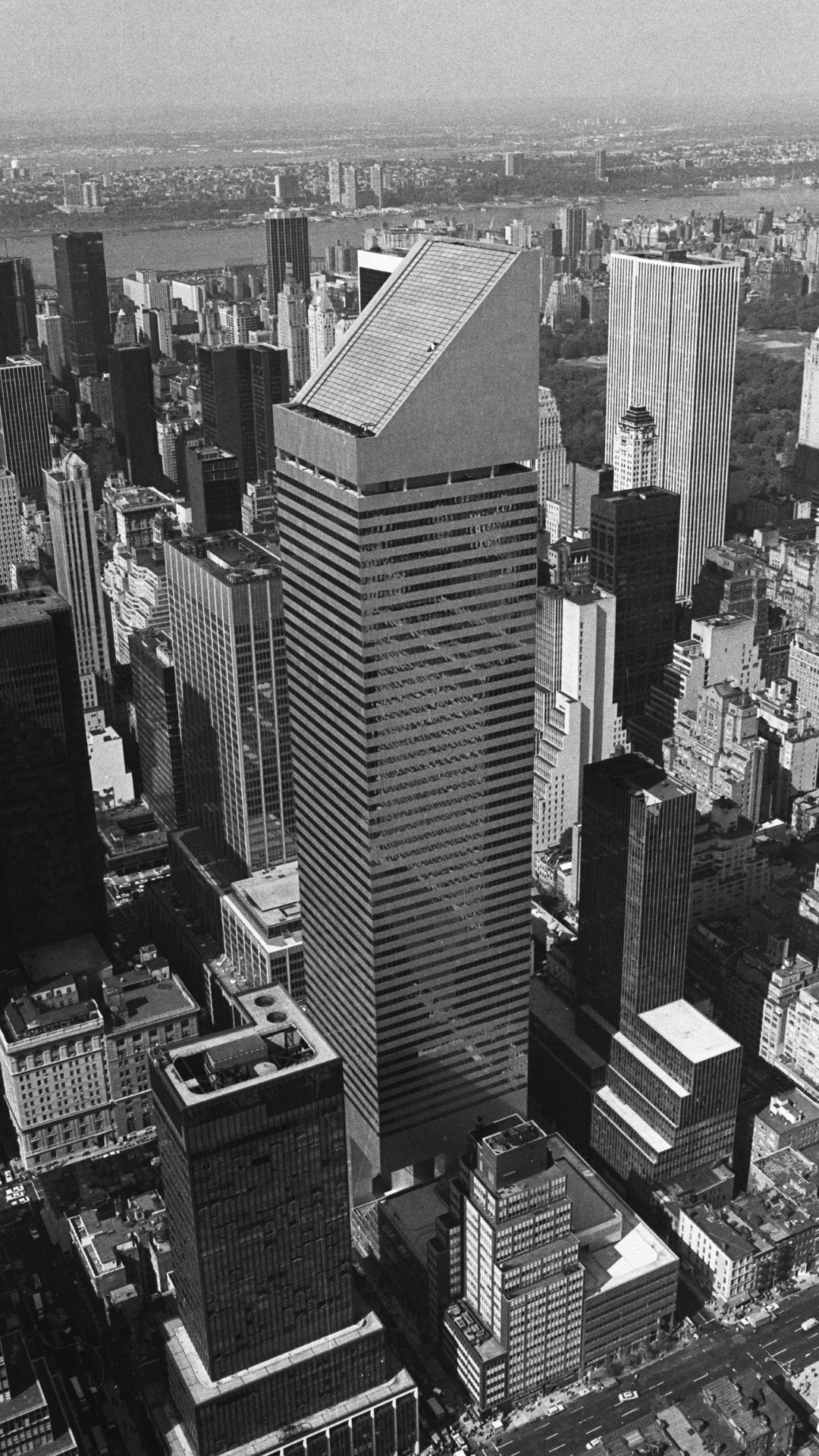
Citicorp Center was designed by architect Hugh Stubbins and structural engineer William LeMessurier for Citibank and completed in 1977. Rising about 279 meters with 59 stories, it was one of the world’s tallest buildings at the time and quickly became a distinctive part of the Manhattan skyline.
But the building’s unusual appearance came from an unusual structural problem before construction even started. The planned site included St. Peter’s Lutheran Church, whose existing position meant the skyscraper could not simply be supported by columns at its four corners.
Instead, the architects and engineers placed the major supporting columns toward the center of the building, allowing the tower to stand above the church.
That decision produced a striking design, but it also changed the way the building would respond to wind.
For a conventional tower with columns positioned at the corners, the structure naturally distributes some of the forces differently. Citicorp Center’s arrangement required engineers to think carefully about forces acting along the building’s edges and from different directions. The building had passed its design checks. Then a student asked a question that had not received enough attention.

The Question Came From A Student
In 1978, Princeton undergraduate Diane Hartley was working on her senior thesis under Professor David Billington. Her research involved structural behavior, and she became interested in the wind forces acting on Citicorp Center.
Hartley’s question focused on something the original analysis had not fully considered: quartering winds, or winds striking the building at an angle rather than directly against one of its four faces.
The question was simple, but the implications were not.
LeMessurier’s original calculations had examined the building’s behavior under wind loads acting against its faces. When he was asked to investigate the diagonal case, he recalculated the structure using the additional loading scenario. The results revealed a serious vulnerability.
The building could withstand the design assumptions that had been used. But under the diagonal winds Hartley had raised, the forces on some of the building’s connections were significantly greater than expected. A skyscraper that looked solid from the outside had a weakness hidden inside its structural system.
What happens when an engineering marvel hides a fatal flaw? Discover the incredible true story of how a student’s question saved a NYC skyscraper from collapse. Watch now!
The Problem Was In The Connections
The most important part of the discovery was not that the tower would simply “fall over” in ordinary weather. The issue involved the way the building transferred wind forces through its steel connections.
LeMessurier discovered that the structure had been designed using welded connections in the original calculations, but the construction had ultimately used bolted connections. The change had been made to reduce costs, but the difference mattered because the bolts did not provide the same resistance to the particular wind forces LeMessurier was now examining.
When he recalculated the diagonal wind case, the safety margin was far smaller than he had believed.
The problem became particularly serious because the Citicorp Center had a distinctive structural system. Its columns were concentrated beneath the center of the tower, and its enormous upper structure extended outward toward the corners, making the building especially sensitive to certain wind directions.
The weakness was not visible from the street. It existed in connections hidden inside the steel skeleton. And a sufficiently powerful storm could expose it.
LeMessurier Faced A Terrible Choice
LeMessurier quickly realized that the consequences could be enormous.
According to accounts of the incident, he understood that acknowledging the mistake could expose him and others to lawsuits, financial ruin and professional disgrace. The building was already occupied, which meant admitting the problem could trigger panic and potentially force a major evacuation.
There was another option: say nothing. LeMessurier ultimately decided that was unacceptable.
He informed Citicorp, his professional colleagues, lawyers and insurers and began organizing a repair. The decision was extraordinary because he was not merely reporting someone else’s mistake. He was accepting responsibility for a weakness in a building for which he had served as structural engineer.
The repair had to be done without causing widespread public alarm. That meant workers had to operate largely at night while the building continued functioning during the day.
The Secret Repair Operation
The solution involved strengthening the vulnerable connections by welding steel plates over the existing bolted joints. Hundreds of connections had to be reinforced across the building.
The work was carried out over roughly three months, mostly at night, while the tower remained occupied during the day. Skilled welders were brought in, and the repair progressed floor by floor.
The operation became known as Project Serene.
The secrecy was partly practical. Engineers wanted to avoid unnecessary panic while ensuring the building was made safe as quickly as possible. But the decision to keep the operation quiet has also made the story controversial, especially because of how serious the discovered vulnerability was.
According to the account published by MIDAS, the repaired structure was ultimately brought to a much higher wind-resistance standard, moving from a condition considered vulnerable under a roughly once-in-16-years hurricane scenario to one capable of withstanding a storm expected only once in about 700 years.
The exact probabilities attached to those scenarios come from the specific engineering analysis of the incident, rather than predictions that New York would literally experience such a storm on those schedules.
What mattered was the enormous increase in the building’s safety margin.

The Timing Was More Frightening Than Anyone Knew
The repair became even more urgent because of the weather.
While Project Serene was underway, Hurricane Ella was moving along the Atlantic coast in September 1978. The storm ultimately turned away from New York, but the possibility that it could have approached the city created a frightening deadline for the engineers working on the repairs.
If a major storm had struck the building before the reinforcement was finished, LeMessurier feared the consequences could have been catastrophic.
The danger was not that the tower was certain to collapse. It was that the existing safety margin was much smaller than anyone had realized, and an unusually severe combination of wind conditions could potentially push the structure beyond what its connections could safely handle.
For months, people inside the building went about their daily lives without knowing that welders were quietly working overhead.
Outside, the skyscraper looked completely normal. Inside, engineers were racing against the weather.
The Student’s Question Changed More Than One Building
Diane Hartley’s question did not lead to the discovery of a completely defective skyscraper. It exposed a weakness in an otherwise sophisticated structural design that had been overlooked because engineers had not fully considered one particular wind direction.
That distinction matters.
The building was not saved by a student magically spotting a visible crack or structural failure. It was saved by someone asking whether the assumptions behind the calculations covered every important possibility.
The question then prompted LeMessurier to recalculate the structure, discover the vulnerability and take responsibility for correcting it.
The episode became a powerful example of why engineering depends not only on mathematical skill, but also on the willingness to question assumptions.
A design can pass its original checks and still contain an overlooked condition.
The most valuable question may be the one that forces everyone to check again.
What Happened To Citicorp Center?
Citicorp Center was never evacuated or demolished. The repairs remained in place, and the building continued to serve New York for decades.
The complex was later renamed 601 Lexington Avenue, but its unusual structural history remained one of the most studied episodes in modern skyscraper engineering.
The story also changed how engineers and educators talk about professional responsibility.
LeMessurier’s response is often held up as an example of engineering ethics because he chose to disclose a problem that could have destroyed his reputation. His own later reflections emphasized that engineers have obligations not only to clients but also to society.
The incident also demonstrated why independent review matters. A question from someone outside the original design team revealed an issue that had escaped the project’s initial analysis.
The tower was strong enough to stand. But it became safer because someone asked whether the original calculations were enough.
The Real Hero Was A Question
The most remarkable part of the Citicorp story is that nobody needed to see the building moving dangerously before action was taken.
There was no crack running down the facade. No column suddenly buckled. No storm had to arrive and prove the engineers wrong.
Instead, the warning began with a question from an undergraduate student who wondered whether the building had been analyzed correctly for winds coming from the corners.
That question traveled from a Princeton classroom to one of New York’s most important skyscrapers. It forced a senior engineer to reconsider his own work, acknowledge a serious design vulnerability and organize an expensive repair before disaster occurred.
The public eventually learned what had happened.
But for years, the skyscraper remained standing as a reminder of something engineers know all too well: the most dangerous problems are not always the ones you can see.
Sometimes the most important warning is simply a question that no one thought to ask.
The Citicorp Center story began with a question from Princeton student Diane Hartley in 1978, one year after the 59-story New York skyscraper opened. Hartley wondered how the building would respond to diagonal winds, prompting structural engineer William LeMessurier to recalculate forces that had not been fully considered in the original design. His analysis revealed a significant vulnerability involving the tower’s wind-resistant system and its bolted connections. Rather than hide the problem, LeMessurier informed Citicorp, insurers and other parties and organized a secret nighttime reinforcement project. Workers strengthened hundreds of connections over approximately three months while the building remained occupied. No disaster occurred, and Citicorp Center continued standing for decades. The episode became an enduring lesson in engineering: sometimes a massive structure is protected not by a dramatic discovery, but by one person asking a question that everyone else had overlooked.
P.S. This story draws on the MIDAS account of the Citicorp Center episode and its references to Diane Hartley’s thesis, William LeMessurier and the engineering ethics case study. Sources: MIDAS; Online Ethics Center; The New York Times – https://resource.midasuser.com/en/blog/get-motivated/student-question-saved-nyc-skyscraper