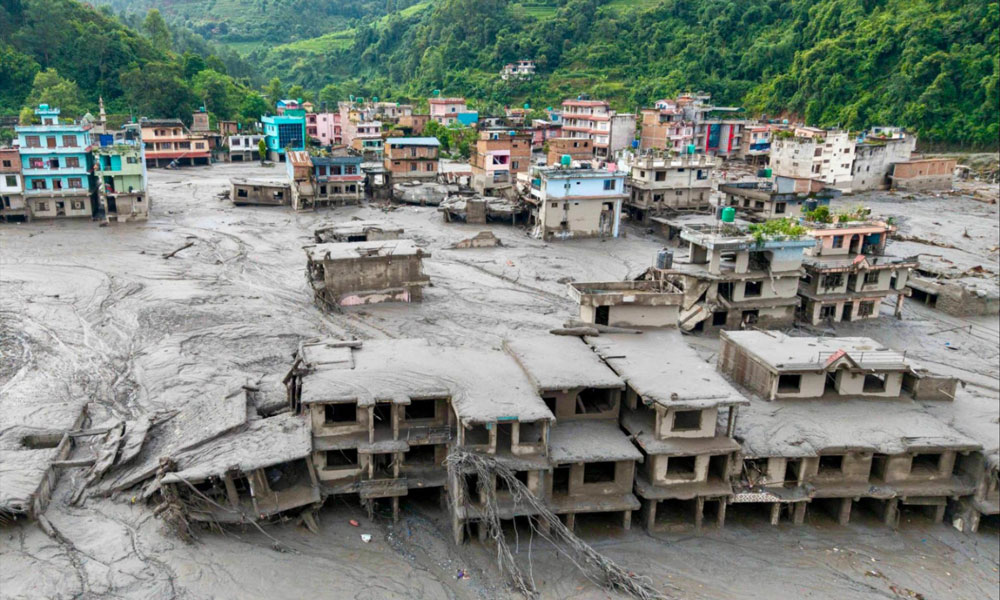
More than 350 people are dead. Nearly 1,400 others are still missing. And the disaster began with a collapse almost 17,000 feet above the Himalayas. A massive section of glacier broke away and plunged roughly 3,900 feet into the valley below, unleashing a violent cascade of ice, rock and debris that sent floodwaters racing downstream. In one area, water levels surged nearly 30 feet in just 30 minutes. So what exactly happened high in the mountains before the catastrophe reached Nepal and Tibet?
It Started 17,000 Feet Above the Valley
The disaster appears to have begun at an elevation of about 5,200 metres, or 17,000 feet.
Satellite imagery showed that a large section of a Himalayan glacier’s lower end broke away and plunged roughly 1,200 metres, or 3,900 feet, onto the valley floor.
As the collapsing mass fell, it gathered rock and sediment.
The resulting ice-and-rock avalanche struck the Lhende River in Tibet, about 20 kilometres, or 12 miles, northeast of the Nepal-China border crossing.
For a brief moment, the debris blocked the river. Then the natural barrier gave way. That was when the flood began.

The Water Rose 30 Feet in Just 30 Minutes
The surge entered the Lhende Khola and moved into the Bhote Koshi before continuing into the Trishuli River system.
The floodwaters then raced south through Nepal.
According to reports cited by Al Jazeera, water levels in the Trishuli River rose by as much as 9 metres, or nearly 30 feet, in just 30 minutes.
The speed of the disaster helps explain why the destruction was so severe.
This was not a river gradually overflowing its banks.
It was a sudden, violent surge moving through steep Himalayan valleys.
More than 350 people were killed, nearly 1,400 remain missing—and it all began with a collapse high above the Himalayas. Watch the video below to see the terrifying scale of the flood and destruction that followed.
No Rain Had Fallen
One detail made the disaster even more shocking.
Officials were reportedly caught off guard because it was not raining when the floods struck.
The destruction had begun high above the populated areas.
A collapse in the mountains triggered a chain reaction that carried ice, water, mud and debris downstream.
By the time communities below understood what was happening, the flood was already moving through the valleys.
Roads, Bridges and Entire Communities Were Cut Off
The damage stretched far beyond individual villages.
At least 19 bridges and approximately 40 kilometres, or 25 miles, of roads were washed away.
That created a second crisis.
The disaster had destroyed not only homes and infrastructure but also many of the routes rescuers needed to reach survivors.
Nepalese soldiers and rescue teams were deployed with helicopters, drones and search dogs. But high river levels, mud and damaged roads continued to complicate access to some of the hardest-hit areas.
Across the border, deep sediment also slowed Chinese rescue operations.

Nearly 1,500 People Are Still Missing
The number of missing people has turned the disaster into an international search operation.
In Nepal, 826 people were reported missing, including almost 600 foreign tourists, according to police and tourism officials.
In Tibet’s Gyirong County, authorities reported 558 people missing, including 260 foreign nationals.
Many of the missing were believed to be tourists and pilgrims traveling through the Himalayan region near Mount Kailash.
That means families in multiple countries are now waiting for information from an area where roads, communications and access have been badly disrupted.
The Flood May Not Be the Last Danger
The immediate disaster may be over.
The danger is not.
Authorities have warned about the possibility of another major flood after the disaster created a new lake behind debris in the mountain region. Communities downstream have been urged to remain highly alert as officials assess the risk.
The disaster has therefore created a frightening second problem.
The same collapse that unleashed one catastrophic flood may have changed the landscape enough to create conditions for another.

A disaster that began with a glacier collapse 5,200 metres above the Himalayas became, within hours, one of the region’s deadliest recent catastrophes. A mass of ice and rock plunged 1,200 metres into the valley below, blocked a river and then unleashed a torrent powerful enough to destroy 19 bridges and 40 kilometres of roads. With at least 359 dead and nearly 1,500 missing, the story is still unfolding—and rescuers are now racing against both time and a landscape that remains dangerously unstable.