High in Nepal’s Himalayas, a massive section of glacier suddenly broke away and crashed down the mountainside. Just 30 minutes later, water levels in the river system below had surged by as much as 9 meters, sending a destructive torrent through the valleys.
What happened between the collapse high above the mountains and the sudden flood below was a rapid chain reaction involving ice, rock, debris and water—one that initially left scientists questioning whether an earthquake had triggered the disaster.
It Started High Above the River
On the morning of August 26, 2026, an enormous section of glacier in Nepal’s Langtang region suddenly sheared away from the mountain. Satellite imagery showed the collapse occurring at roughly 5,200 meters above sea level, with ice and rock plunging about 1,200 meters toward the valley floor.
The falling mass did not remain on the mountainside. It slammed into the terrain below, gathering rock, ice, mud and debris as it moved toward the Lhende Khola, a tributary feeding the Bhote Koshi River and ultimately the Trishuli.
That transformed a mountain collapse into a river disaster. Instead of one isolated avalanche, the event became a rapidly moving chain reaction capable of carrying enormous quantities of material downstream.
A glacier collapsed high in the Himalayas. Just 30 minutes later, a river below had risen by up to 9 meters. Watch the video to see how falling ice and rock turned into a devastating flash flood—and how scientists are piecing together what happened in the mountains above.
The River Rose 9 Meters in Half an Hour
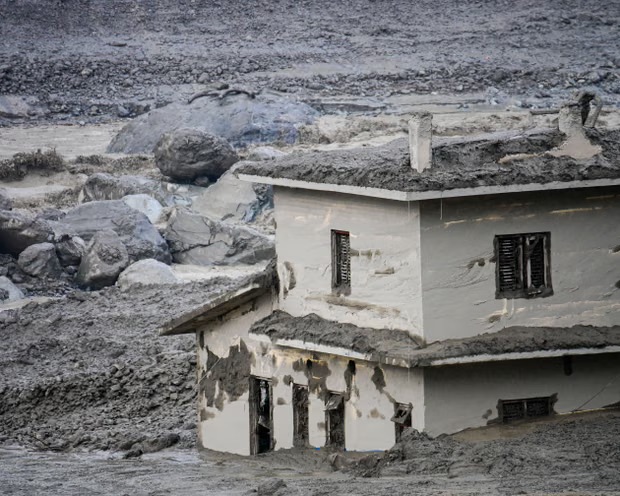
The most dramatic part of the sequence happened after the collapse reached the river. Scientists at the International Centre for Integrated Mountain Development reported that water levels downstream increased by roughly 7 to 9 meters within 30 minutes.
That helps explain why people had so little time to react. The flood was not simply a normal rise in river level caused by hours of rainfall; enormous amounts of ice, rock, mud and water were suddenly injected into an already steep mountain drainage system.
The debris also made the flow far more destructive. Roads, bridges, homes and power infrastructure along the valleys were swept away as the torrent moved downstream through Nepal and toward Tibet.
Scientists First Thought an Earthquake Had Started It
The disaster initially created another mystery. Because seismic instruments detected strong movement during the event, early reports suggested that an earthquake might have triggered a landslide, which then caused the flood.
But further analysis changed that picture. The US Geological Survey concluded from the character of the seismic waves that the energy was more consistent with a glacial collapse and debris flow, meaning the avalanche itself generated a seismic signal equivalent to roughly a magnitude 5.2 event.
That reversal is important because it changes the direction of the entire chain. The earthquake was apparently not the beginning of the disaster—it may have been one of the consequences of the glacier breaking apart and crashing down the mountain.

So How Does a Glacier Collapse?
A glacier is far more than a block of frozen water sitting motionless on a mountain. It is a huge mass of ice that can contain cracks, meltwater and unstable connections with the rock beneath it, while the surrounding mountain itself can also become less stable.
Scientists say unusually warm conditions may play a role by accelerating snow and ice melt and weakening the bonds that help keep high-altitude ice and rock masses in place. Researchers are also examining whether water had accumulated beneath the glacier or whether the falling ice temporarily blocked part of the river before the trapped water was released.
In this case, however, scientists are still working through the exact mechanism. What is increasingly clear is the sequence: a massive ice collapse produced an avalanche, the avalanche struck the river system, and the river rapidly transformed that impact into a catastrophic flood.
A massive glacier collapse high in the Himalayas triggered a chain reaction that sent a river surging by meters in minutes. Watch the video to see how falling ice and rock transformed into a devastating flash flood—and the science behind the disaster.
The Himalayas May Be Becoming Less Predictable
The event has also raised a much larger question about the changing stability of Himalayan mountains. Scientists have warned that warming temperatures can contribute to faster glacier loss, thawing ground and greater instability in high mountain environments.
That does not mean every glacier collapse is directly caused by climate change. But warming can alter the conditions that keep ice, rock and frozen ground locked together, potentially increasing the number of situations in which a mountain slope can suddenly fail.
The danger is especially difficult to manage because people living downstream may not see the event that starts the disaster. A collapse can happen kilometers away and high above the valley, while the first visible warning comes only when the river itself suddenly changes.

Then a Second Threat Appeared
The flood did not necessarily end all the danger. A new lake formed around the area affected by the collapse, raising concerns that additional water could create another flood if the lake expanded or suddenly breached. Authorities and scientists have been monitoring that threat as rescue operations continue.
This is what makes the disaster so difficult to understand as a single event. The first collapse triggered an avalanche, the avalanche transformed a river into a flash flood, and the resulting landscape created the possibility of another water hazard.
The deeper lesson is that mountain disasters rarely follow a single cause-and-effect step. Ice can become rockfall, rockfall can become debris, debris can become a flood, and a flood can reshape the landscape enough to create the next threat.
The Nepal-Tibet flood began with a glacier collapse high in the Himalayas, but the devastation unfolded through a chain of physical events. Ice and rock crashed into the river, sending water levels soaring by up to 9 meters in just 30 minutes. Scientists initially suspected an earthquake, yet later analysis suggested the collapse itself produced the seismic signal. The exact trigger remains under study, but the disaster shows how rapidly unstable mountain systems can turn hidden changes into catastrophic floods downstream.