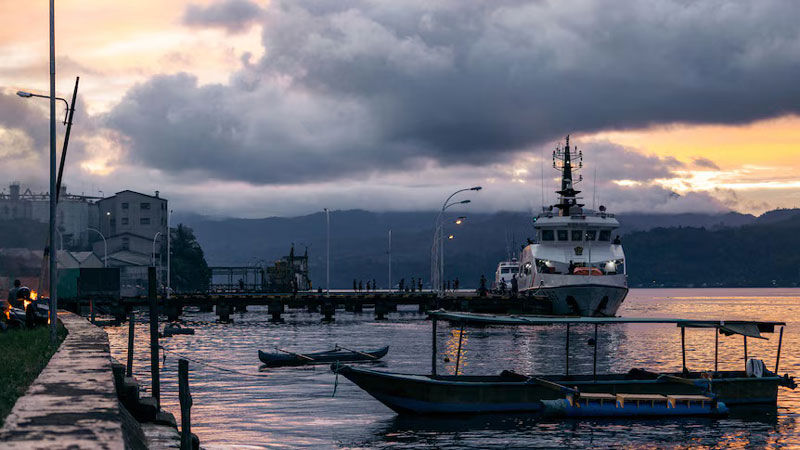
The ferry was somewhere in the Java Sea when the weather turned dangerous. Then, in the early hours of Sunday, communication with the vessel suddenly disappeared. The Virgo Transport 8 had been carrying 243 people from Surabaya toward Banjarmasin, with roughly 150 kilometres still separating it from its destination. At first, authorities did not know whether anyone was alive. Then other ships began finding people in the water. By midday, 103 people had been evacuated, one of them dead. But about 140 people were still missing, and the ferry itself had not yet been located.
The Journey Was Supposed To End In Banjarmasin
The Virgo Transport 8 had left Surabaya, Indonesia’s second-largest city, on Saturday morning, beginning a roughly 500-kilometre journey across the Java Sea toward Banjarmasin in South Kalimantan, on the island of Borneo. According to the vessel’s operator, the ship departed at about 10:13 a.m. local time. It was a routine inter-island voyage of the kind that millions of Indonesians rely on because the country’s thousands of islands make maritime transport an essential part of everyday life.
The ship was expected to continue through the Java Sea before approaching Banjarmasin. Instead, something changed during the final part of the journey. The vessel encountered bad weather, and authorities later learned that its condition had become serious enough for the crew to report the situation before communication was lost. The last known position was about 148 kilometres from Banjarmasin, leaving rescuers with a large stretch of open water to search.
That distance mattered. A ship in trouble can drift, especially when wind and waves are strong, and a rescue operation becomes much harder when crews do not know exactly where the vessel is. By the time authorities received the report, the sea had already become part of the mystery.
Breaking News: A passenger ferry carrying 243 people has gone silent in the Java Sea after encountering severe weather. Rescue teams are currently racing against time to locate survivors. Watch this urgent update to stay informed on the ongoing search and rescue efforts for the missing Virgo Transport 8.
Then The Ship Went Silent
Contact with the Virgo Transport 8 was lost at about 2 a.m. Sunday, according to Indonesian search-and-rescue officials. The vessel’s operator reported the incident after receiving information that the ship had encountered bad weather. Authorities were notified roughly two hours after communication was lost and immediately began organizing a search.
At first, there was very little information to work with. There were no immediate reports of casualties, and officials did not know whether the ship was still afloat, had suffered serious damage or had been forced into some other situation. The last known position in the Java Sea became the starting point for the search.
Rescuers mobilized a search vessel from Banjarmasin and coordinated with maritime authorities, naval and police units and other agencies. Equipment including rescue gear, diving equipment and communications systems was prepared as crews headed toward the estimated location. Authorities also warned that weather conditions in the search area could complicate the operation.
For the families waiting on shore, however, those first hours must have felt very different. A vessel carrying hundreds of people had stopped communicating, and nobody could yet tell them what had happened.

The Sea Was Already Making The Search Dangerous
The weather was not simply a background detail. It became one of the central problems facing the rescuers.
Later reports said waves in the area reached about 2.5 metres, creating dangerous conditions even for the rescue vessels sent to find the ferry. I Putu Sudayana, who was coordinating the search in Banjarmasin, warned that the conditions posed serious risks to vessels operating in the area.
That created a difficult calculation. Rescuers needed to reach the last known position as quickly as possible, but sending vessels into rough seas could put the rescuers themselves in danger. Every hour also mattered because people who had entered the water could be carried farther away from the ship’s last known location.
The operation therefore became a race against both distance and time. The rescue teams were searching for a vessel whose exact position was unknown, while the sea itself was constantly changing the area they needed to search. And then, the first survivors began to appear.
Other Ships Started Finding People
The breakthrough did not initially come from locating the Virgo Transport 8 itself. It came from other vessels operating in the area.
Three ships helped evacuate 103 people by around midday, according to an update from Indonesian rescue authorities. The tugboat TB Mauhaw IX recovered 16 people, including one person who had died. Another tugboat, TB TCP, rescued 38 people, while MV Haida brought 49 people to safety.
Suddenly, the search had a new dimension. Rescuers were no longer looking only for a missing ship; they were also trying to locate people who had been separated from it and were potentially drifting in the sea.
The fact that more than 100 people had been found alive was a major development, but it also made the remaining numbers more painful. If 243 people had been aboard and 103 had been evacuated, about 140 people were still unaccounted for. One of those already recovered had died. The operation was therefore continuing not only as a search for survivors, but also as an effort to account for everyone who had been aboard. The ferry itself still had not been located.
One Ferry Had Become A Search Area
This is what makes the incident so difficult to understand from shore. A passenger ferry carrying hundreds of people had disappeared from communication, yet the rescue effort was finding people without immediately finding the vessel itself.
Reports from the rescue operation indicated that the ship had encountered severe weather and that its captain had reported the vessel was tilting before communication was lost. Later reports said the ship had capsized, although the full circumstances remained under investigation as the rescue continued.
For the people in the water, the situation would have changed rapidly. A large passenger vessel can provide shelter, equipment and a concentrated location for rescuers to search. Once people are separated from the vessel, they become much harder to find, particularly in rough water.
That is why nearby commercial ships can become crucial during a maritime emergency. They may be closer to survivors than official rescue vessels and can begin pulling people from the water before a larger coordinated operation reaches the area. In this case, those ships became an unexpected lifeline.
The Search Was Still Far From Over
By the latest reported update, the rescue operation involved multiple vessels, including the KN SAR Laksmana, KRI Nala and KM Kunyit, along with the commercial vessels already involved in evacuating survivors. Indonesian authorities were also coordinating with maritime, naval and police agencies while monitoring the conditions in the search area.
The remaining search was complicated by the same conditions that had made the original incident so dangerous. Rough seas can make visual searches difficult, while wind and currents can move people away from the area where they were last seen. Darkness, distance and uncertainty about the vessel’s exact position add another layer of difficulty.
For families waiting in Banjarmasin and elsewhere, the numbers therefore meant something very different from what they might mean in a news report. One hundred and three people had been found, but approximately 140 families were still waiting for confirmation about loved ones.
The rescue operation was continuing, and authorities had not yet established the full fate of everyone who had been aboard.
Why The First Hours Matter So Much
Maritime rescues often depend on finding people before the search area becomes too large. The longer survivors remain in the water, the farther they can be carried by currents and wind, making each subsequent search more complicated.
That is why the discovery of more than 100 people was so significant. It showed that survivors were still being found and that vessels in the area were able to reach them. At the same time, the number of people still missing meant the operation could not slow down.
The search also demonstrated the importance of cooperation between different kinds of vessels. Official rescue ships, naval assets, police vessels and commercial ships were all involved in the response. In an emergency covering a large section of ocean, no single vessel can realistically search every possible location alone.
The sea does not provide roads, landmarks or obvious boundaries. Once a ship loses contact, rescuers are often forced to reconstruct the last known movements and work outward from there. That was now happening in the Java Sea.

Indonesia Depends On Ships Like This
The Virgo Transport 8 incident is also a reminder of how important ferries are to Indonesia. The country is made up of thousands of islands, and sea transport connects communities that cannot always be reached easily by road or air.
For many passengers, a ferry journey is not an adventure. It is simply how they get from one part of the country to another.
That dependence also means that maritime accidents can have consequences far beyond the vessel itself. When a ferry carrying hundreds of people encounters serious trouble, entire families can suddenly find themselves waiting for news from the sea.
The Virgo Transport 8 was supposed to be one more link in that enormous network of inter-island transportation. Instead, its journey became a large-scale search-and-rescue operation involving vessels spread across the Java Sea. And as the search continued, the most important question remained unanswered.
What Happened To The Virgo Transport 8?
The early information provides a sequence, but not yet a complete explanation. The ship departed Surabaya on Saturday morning. It encountered bad weather during the voyage. Its condition was reportedly serious enough for the operator to receive information about the situation. Communication was then lost around 2 a.m. Sunday, and the last known position was roughly 148 kilometres from Banjarmasin.
After that, the story becomes a search.
People were found by other vessels. More than 100 were evacuated, one had died, and many others remained missing. But the ferry itself had not yet been located in the latest available reports.
Until rescuers find the vessel and gather more information from survivors, investigators may not be able to reconstruct exactly what happened aboard it. The cause of the emergency, the sequence of events and the circumstances that led so many people into the water will all depend on evidence that has yet to emerge. For now, the Java Sea is holding the answers.
The Search That Began With Silence
When the first reports emerged, the story was simple and terrifying: a passenger ship carrying more than 240 people had stopped communicating somewhere in the Java Sea.
Hours later, it became a story of survival. Other ships began finding people, and more than 100 were brought to safety. But it was also a story of loss, because one person had died and roughly 140 people remained unaccounted for.
The rescue operation was still underway, and the full story of the Virgo Transport 8 had not yet been written. There were survivors who could eventually describe what happened, rescuers still searching the sea and families still waiting for answers.
The most haunting detail may be that the ferry was nearing the end of its journey. It had already crossed a large part of the distance between Java and Borneo when the weather turned dangerous and communication disappeared. A normal journey home had suddenly become a race against the sea.
The Virgo Transport 8 was carrying 243 people from Surabaya toward Banjarmasin when bad weather struck the Java Sea and communication was lost. Rescue teams were dispatched to the vessel’s last known position, while other ships began finding people in the water. By the latest update, 103 people had been evacuated, one had died and about 140 remained missing. The ferry itself had not yet been located. As rescuers continued searching through difficult conditions, families waited for the answers that only the sea could provide.
This story is based primarily on ABC News’ report of the initial search for the Virgo Transport 8, supplemented by updates from Indonesian rescue authorities and local reporting as the operation developed. Because the rescue was still underway, casualty and survivor figures changed during the day; the article reflects the latest available figures found at the time of writing. The latest rescue update reported that 103 people had been evacuated, including one person who died, while the search for those still missing continued. Source: https://www.abc.net.au/news/2026-09-13/search-underway-for-indonesian-passenger-ship/107148298