On a cold January night in 1952, six men jumped from a 16-ton military aircraft into the darkness above Death Valley. Their plane had lost an engine and was rapidly losing altitude, leaving the crew little choice but to bail out over one of the most remote landscapes in the United States. The men survived, but the unmanned SA-16 Albatross continued flying before crashing into a mountain. More than 70 years later, the metallic wreck still rests on that mountainside, preserving a remarkable piece of America’s early Cold War history.
The Flight Was Part Of A Secret Cold War Operation
The aircraft was an SA-16 Albatross operated by the U.S. Air Force’s 580th Air Resupply and Communications Wing. The unit was part of a joint effort involving the Air Force and CIA during the early Cold War, when the United States was developing ways to move personnel and equipment into countries controlled by Communist governments.
The crew’s flight was not an attack mission over Death Valley. The aircraft was conducting a nighttime training flight between Mountain Home Air Force Base in Idaho and San Diego, following a route that passed directly over the young national monument. According to Death Valley historian Kimberly Selinske, the crews practiced navigation and other skills they would need for much more secretive operations.
At the time, very few people outside the program would have understood what these units were designed to do. Their existence was closely connected to the covert side of America’s Cold War strategy, making the aircraft’s eventual crash more significant than an ordinary military accident. The wreck would later provide an unusual physical reminder of a part of Cold War history that was rarely visible to the public.
Discover the haunting history of a secret Cold War mission. Join me on an epic, rugged hike into the heart of Death Valley to locate the wreckage of a long-forgotten CIA plane. Explore this abandoned aviation relic and uncover the gripping true story that has been hidden for 73 years!
Then One Engine Failed In The Darkness
The first major problem came around 6:30 p.m. when one of the Albatross’s two engines suffered a violent failure. The aircraft was flying at about 11,000 feet, but the remaining engine could not maintain altitude. The plane began descending at roughly 500 feet per minute, while the surrounding Panamint Range included mountains rising even higher.
It was already dark, and the crew had a serious problem. Continuing toward the mountains risked a direct collision, while keeping the damaged aircraft airborne was becoming increasingly difficult. The decision was eventually made to abandon the plane.
At approximately 9,700 feet, the six men went out through the aircraft’s rear door using parachutes. Two were injured when they landed, while the others began making their way toward Furnace Creek. They had landed roughly 14 miles north of Furnace Creek, meaning survival was only the beginning of their ordeal.

The Men Had To Walk Across Death Valley At Night
The four men who could continue were suddenly on foot in the middle of Death Valley. It was January rather than the famously scorching summer season, but the desert was still cold after dark, and the terrain was far from easy to cross.
They followed the visible light toward Furnace Creek, crossing a landscape that included steep terrain, alluvial surfaces and areas around the salt pan where apparently solid ground could give way to mud. Exhausted and cold, the group eventually reached Furnace Creek around midnight. Rangers were then sent to locate the two injured crew members who had remained behind after their parachute landings.
The men had survived the part of the story that sounded most dangerous: jumping from an aircraft at night. But their survival also depended on something they could not control—the fate of the aircraft they had just abandoned. The Albatross was still somewhere in the darkness.
The Wreck Disappeared For Two Days
After the crew was rescued, investigators still had to find the missing aircraft. The Albatross had continued flying without anyone aboard, skimming a summit at Towne Pass before striking a ridge and coming to rest mostly intact on Hunter Mountain.
Finding it proved surprisingly difficult. At least two searches using a local sheriff’s aircraft failed to locate the wreckage. For two days, investigators knew that a large military aircraft had crashed somewhere in the vast mountain landscape but could not pinpoint its location.
On January 26, 1952, a telescope finally revealed the wreck from the ground. An Air Force investigation team was sent into the mountains, but reaching the crash site was itself difficult enough that only one member of the three-person team ultimately had the stamina to climb Hunter Mountain and inspect the aircraft.
The plane was a relatively new aircraft, but the crash had left little worth salvaging. Instead of being removed, the wreck was left on the mountain.
The Albatross Became Part Of The Landscape
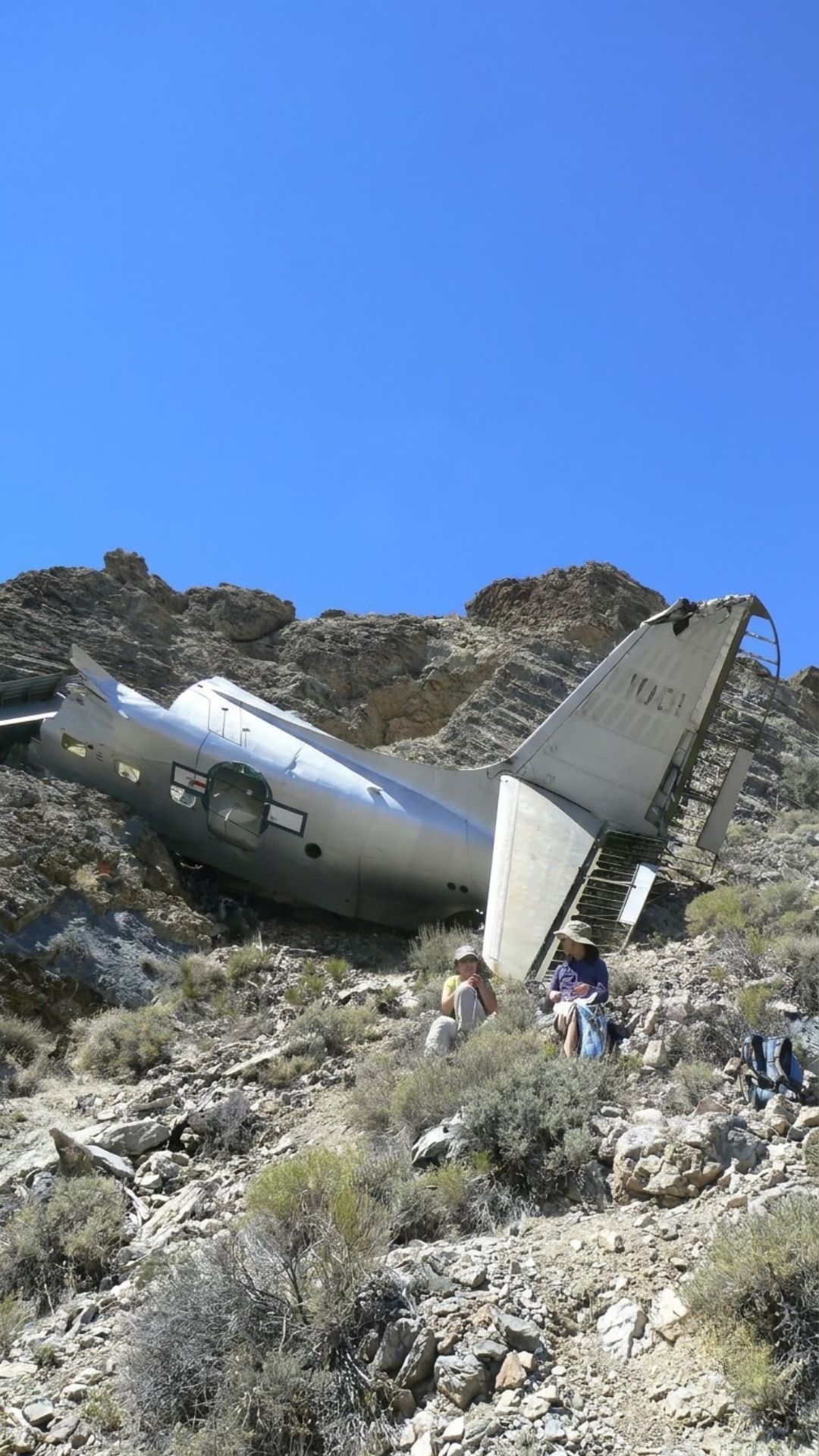
The aircraft now sits at roughly 6,500 feet on a steep section of Hunter Mountain. It is only about 2.5 miles from California Highway 190 and can reportedly be seen from the road under the right conditions, although its exact position is difficult to identify from below.
There is no official trail to the wreck. Death Valley National Park spokesperson Abby Wines, who has personally hiked to the site, described it as a destination for experienced desert hikers. The route involves steep ridges, loose and difficult terrain, and significant elevation changes. Even getting there and back can take an entire day.
The harsh desert environment has slowly transformed the aircraft. Its metal body is weathered and heavily aged by decades of exposure, but much of the recognizable structure remains. The result is an unusual sight: a Cold War military aircraft sitting on an isolated mountain slope, surrounded by the vast emptiness of Death Valley.

More Than 70 Years Later, The Crash Still Tells Its Story
The Albatross is more than an old aircraft wreck. It is one of the few physical remnants of a secretive period when the United States and the Soviet Union were building entirely new systems for conducting operations during the Cold War. The crash exposed a small part of that hidden world because a routine training flight ended with six men parachuting into Death Valley and an aircraft disappearing onto a mountain.
Today, the wreck remains where it came to rest in 1952. There is no museum around it, no restored aircraft and no formal trail leading visitors to its location. Instead, the Albatross has become part of the landscape itself—a rusting reminder of a dangerous era when some of America’s most secret military work took place far from the public eye.
More than seven decades later, the Albatross remains on the mountainside where its final flight ended. The men who abandoned it survived that January night, but the aircraft became an unexpected time capsule of America’s early Cold War years. Its weathered frame now sits among the rugged terrain of Death Valley, far from any museum or paved path. What began as a secret military training flight ultimately left behind something more tangible: a piece of history that can still be seen on the same mountain where it crashed in 1952.
The story is preserved in the landscape as much as in the archives. More than seven decades after six men stepped out of that aircraft into the darkness, the Albatross is still sitting on Hunter Mountain, quietly marking the night when a secret Cold War flight came to an unexpected end. Source: https://www.sfgate.com/california-parks/article/cia-spy-plane-crash-death-valley-19974450.php