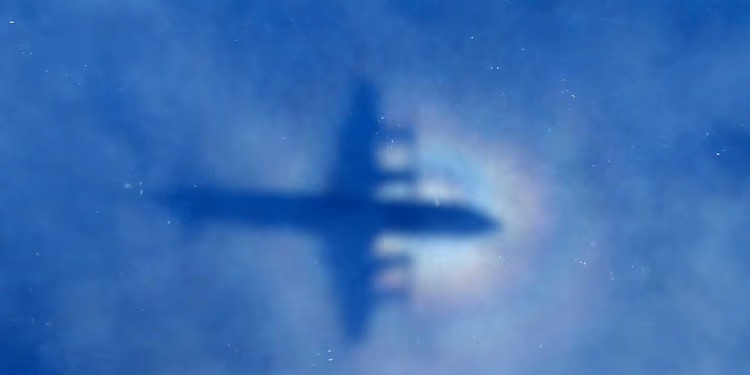
When Malaysia Airlines Flight 370 disappeared in 2014, the world struggled to understand how a modern Boeing 777 carrying 239 people could seemingly vanish. Satellites, radar, aircraft tracking systems and one of the largest searches in aviation history all failed to produce a complete answer. But MH370 was not the first passenger flight to disappear. Decades before its disappearance, other commercial aircraft had vanished over oceans, crashed into vast lakes or disappeared after sending no meaningful distress call. Some wreckage was found. Some evidence surfaced years later. Others simply became aviation mysteries that investigators never fully solved.
Malaysia Airlines Flight 370
MH370 remains the modern benchmark for an impossible aviation mystery. On March 8, 2014, the Boeing 777 departed Kuala Lumpur for Beijing with 239 people on board. Less than an hour after takeoff, it disappeared from civilian radar. Investigators later determined that the aircraft had changed course and continued flying for hours, most likely toward the southern Indian Ocean.
What followed was an international search of extraordinary scale. Satellite data was analyzed, ships and aircraft searched remote waters and investigators studied every plausible explanation, from mechanical failure to deliberate human intervention. Pieces of debris later found on islands and coastlines were linked to the aircraft, confirming that it ended in the Indian Ocean. Yet the main wreckage—and the full explanation for what happened aboard the flight—remains missing. MH370 proved that even in the age of satellites and digital communication, a passenger aircraft can still disappear into a part of the planet that is almost impossible to search.
239 people boarded Malaysia Airlines Flight 370 in 2014. The plane disappeared—and more than a decade later, the full truth remains unknown. Watch the video to revisit one of aviation’s greatest mysteries.
EgyptAir Flight 804
On May 19, 2016, EgyptAir Flight 804 was flying from Paris to Cairo when it suddenly disappeared over the Mediterranean Sea. The Airbus A320 had 66 people on board. There was no conventional distress call warning of an emergency. Then the aircraft vanished from radar.
Wreckage was eventually found, and investigators recovered the flight recorders. But the cause remained controversial for years. French investigators examined the possibility of an onboard fire, while Egyptian authorities focused on other possibilities. The case became a reminder that finding the wreckage of a missing aircraft does not necessarily mean investigators will agree on what caused it to fall from the sky.
Unlike MH370, Flight 804 was eventually located. The mystery was what happened during its final minutes.
66 people were on board when EgyptAir Flight 804 vanished over the Mediterranean in 2016. The wreckage was eventually found—but the final moments of the flight remain one of aviation’s most haunting mysteries. Watch the video:
Flying Tiger Line Flight 739
On March 16, 1962, Flying Tiger Line Flight 739 disappeared over the western Pacific during a military charter flight. The aircraft was carrying 107 people, including 93 U.S. Army Rangers traveling toward Vietnam.
The Lockheed Super Constellation vanished somewhere between Guam and the Philippines without sending a distress signal. A massive search involving ships and aircraft followed, but no confirmed wreckage was ever recovered.
Witnesses on a passing tanker reportedly saw a bright object in the sky around the time of the disappearance, leading to speculation that the aircraft may have exploded. But investigators never established what actually happened.
More than six decades later, Flight 739 remains one of the largest disappearances in the history of aviation by number of people lost aboard an aircraft whose wreckage was never conclusively identified.
107 people were flying across the Pacific in 1962 when Flying Tiger Line Flight 739 suddenly vanished. No distress call. No wreckage. No survivors. A witness reported seeing what looked like an explosion in the night sky—but the mystery was never solved. Watch the video.
Pan Am Flight 7
In 1957, Pan Am Flight 7 was crossing the Pacific from San Francisco toward Honolulu when the Douglas DC-7C disappeared with 44 people on board.
Radio communication from the aircraft gave no clear indication of a catastrophic emergency. The crew reported routine conditions before the flight vanished somewhere over the vast Pacific.
Searchers eventually found an oil slick and other evidence, but the aircraft itself was never recovered. Investigators could not determine why it crashed.
Theories included structural failure, pilot incapacitation, engine trouble and other mechanical problems. But none could be proven. The Pacific is large enough to erase almost any trace of an aircraft, and Flight 7 became an early example of how an ordinary flight can disappear into an ocean without leaving investigators enough evidence to reconstruct its final moments.
44 people were flying from San Francisco to Honolulu aboard Pan Am Flight 7 when the aircraft suddenly disappeared over the Pacific in 1957. Searchers later found debris and 19 bodies—but the Boeing 377 itself, along with 25 of those on board, was never recovered, and investigators could not determine what caused the crash. Watch the video.
Canadian Pacific Air Lines Flight 402
This was not Canadian Pacific Air Lines Flight 402, despite the name that appeared in the earlier draft. The case listed in the original HISTORY article was an earlier Canadian Pacific Air Lines disappearance in 1951. A Douglas DC-4 departed Vancouver for Tokyo as part of the Korean Airlift, carrying 31 passengers and six crew members. The aircraft was scheduled to stop in Anchorage, Alaska, for refueling before continuing across the Pacific.
As it approached Alaska, the flight encountered increasingly difficult conditions. Rain, low visibility and icing were reported in the region, yet the crew gave no indication that the aircraft was in immediate trouble. Around 90 minutes before its expected arrival in Anchorage, the DC-4 checked in near the Alaskan panhandle. It was the last time anyone heard from the plane.
Then it disappeared.
American and Canadian rescue teams launched an extensive search that continued for months, scouring the rugged terrain and waters along the aircraft’s likely route. They found no confirmed wreckage, no survivors and no definitive explanation for what had happened to the 37 people aboard. Unlike many famous aviation mysteries, there was no final radio transmission, no dramatic distress call and no clear clue pointing investigators toward a mechanical failure or crash site.
That is what makes the disappearance so unsettling. The aircraft vanished during a period of difficult weather, but weather alone does not explain where the DC-4 went. Somewhere between Vancouver and Anchorage, a fully operational commercial aircraft carrying nearly 40 people simply disappeared from history. More than seven decades later, the final fate of the Canadian Pacific airliner remains unknown.
In 1951, a Canadian Pacific Air Lines DC-4 vanished during a flight from Vancouver to Alaska with 37 people on board. The aircraft never arrived, never sent another message—and despite an extensive search, no trace of the plane was ever found. Watch the video.
Northwest Orient Flight 2501
On June 23, 1950, Northwest Orient Flight 2501 disappeared over Lake Michigan during a severe storm. The Douglas DC-4 was carrying 58 people from New York to Minneapolis.
The crew requested permission to descend to a lower altitude because of worsening weather. Soon afterward, the aircraft disappeared.
Despite searches over the lake, the main wreckage was never found. Over the decades, human remains and small pieces of debris associated with the flight were recovered, but the aircraft itself has remained elusive.
Flight 2501 is particularly unsettling because it did not vanish over the middle of an ocean. It disappeared over one of America’s Great Lakes, within reach of a major search effort.
Yet more than 70 years later, investigators still do not have a complete explanation for what happened during the final moments of the flight.
A violent storm. A desperate request to descend. Then silence. In 1950, Northwest Orient Flight 2501 disappeared over Lake Michigan with 58 people on board. More than 70 years later, the main wreckage has still never been found. Watch the video.
Star Tiger and Star Ariel
Two British South American Airways aircraft disappeared in the late 1940s while flying routes through the Atlantic.
Star Tiger vanished in January 1948 during a flight from the Azores toward Bermuda with 31 people aboard. Less than a year later, Star Ariel disappeared on another route near Bermuda with 20 people on board.
Neither aircraft sent a convincing distress signal before vanishing, and no confirmed wreckage was ever recovered.
Their disappearance later became part of the mythology surrounding the Bermuda Triangle, even though the cases occurred before the modern concept of the Bermuda Triangle became popular.
Investigators examined weather, mechanical problems, navigation and operational decisions. But the lack of physical evidence meant neither case was conclusively solved.
Together, Star Tiger and Star Ariel became two of aviation history’s most famous examples of aircraft that simply disappeared between radio transmissions.
Two British airliners vanished near Bermuda less than a year apart. Star Tiger disappeared with 31 people aboard. Then Star Ariel vanished with another 20. Neither aircraft sent a distress call, and neither was ever found. Watch the video.
Why Can a Passenger Plane Still Disappear?
The story of these aircraft reveals an uncomfortable truth about aviation.
Modern airplanes are extraordinarily safe. But the world below them is still enormous.
Oceans cover more than two-thirds of the planet. Aircraft can crash thousands of miles from land. Deep water can hide wreckage beneath terrain that is more difficult to map than the surface of the Moon. Storms, strong currents and the passage of time can scatter debris across enormous distances.
And aviation accidents can unfold quickly.
A fire, structural failure, sudden loss of control or deliberate action can turn a functioning aircraft into a wreck within minutes. If communications fail at the same time, investigators may be left with almost nothing.
MH370 demonstrated that modern technology does not eliminate that possibility.It only makes the mystery harder to accept.
MH370 was supposed to belong to a different era from the vanished flights of the 1940s, 1950s and 1960s. Its Boeing 777 was equipped with technology those earlier pilots could never have imagined. Yet its disappearance produced a mystery with an eerily familiar ending: an enormous search, scattered clues and no complete explanation. These flights reveal one of aviation’s most unsettling realities. Planes may have become safer than ever—but under the right conditions, the sky and the sea can still keep their secrets.