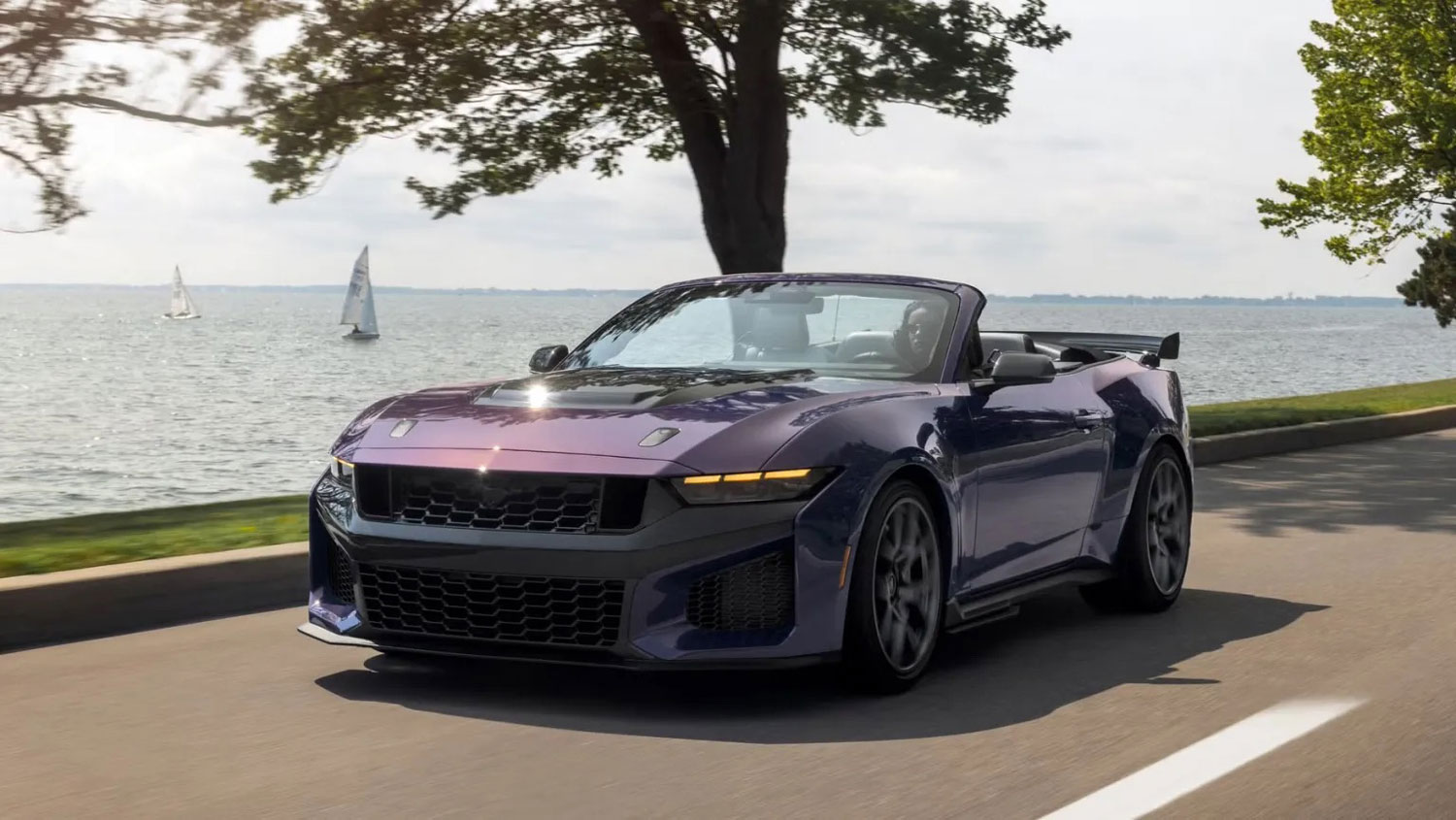
Ford just took a nearly 800-hp Mustang and cut the roof off. That sounds like a terrible idea for a car built around serious performance—but the engineering gets interesting once you ask what happens to the chassis when all that structural metal disappears. The result is not simply a roofless Dark Horse SC. Ford rebuilt the car around a different purpose: what if 795 horsepower were meant for the open road, with nothing between the driver and the sound of a supercharged V8?
The Coupe Was Already a Monster
The Dark Horse SC coupe was developed with performance and lap times in mind. Its supercharged 5.2-liter V8 produces 795 horsepower and 660 lb-ft of torque, sending that power through a seven-speed dual-clutch transmission.
That created an obvious problem for the convertible version. A fixed roof contributes to a vehicle’s structural stiffness, so removing it can change how the body responds to acceleration, braking and cornering. Ford therefore had to make sure the open car could handle the output without turning into a compromised version of the coupe.
The result was not simply a Dark Horse SC with the roof removed. Ford Racing developed the convertible as its own version, with a different objective from the beginning: keep the enormous performance, but make the car better suited to public roads and long drives.
Ford took a nearly 800-hp Mustang and turned it into a convertible. Watch the clip to see the Dark Horse SC Convertible in action—and hear what happens when a supercharged V8 with 795 horsepower is unleashed with the roof down.
What Happens When You Remove the Roof?
Ford builds the convertible around the Mustang GT convertible architecture and adds a magnesium tower-to-tower brace to increase structural rigidity. The brace helps give the open chassis the support it needs while keeping additional mass under control.
But stiffness is only part of the equation. Ford Racing also gave the convertible its own springs, stabilizer bars and calibration for the next-generation MagneRide adaptive suspension rather than simply carrying over the coupe’s setup.
That distinction explains why the convertible is not intended to chase the exact same goal as the coupe. Ford describes the Dark Horse SC Convertible as an ultimate top-down grand touring machine—a car designed to remain comfortable while cruising but still feel planted when the driver gets serious with the throttle.

Nearly 800 HP, But the Goal Isn’t the Track
This is where the car becomes more interesting than its horsepower figure. The convertible keeps the same 795 hp and 660 lb-ft powertrain, but Ford deliberately calibrates the chassis around street driving rather than maximum lap performance.
In practical terms, that means the driver gets enormous reserves of power without having to live with a chassis tuned exclusively for racing. The suspension is meant to deliver a smoother ride during ordinary driving while remaining composed when the driver accelerates hard or attacks a winding road.
Ford is essentially separating two kinds of performance. The coupe is the sharper instrument for someone chasing lap times, while the convertible is about what happens when the destination matters less than the road getting there. That makes the 795-hp engine less about proving a number and more about changing the entire character of the drive.

The Roof Comes Down—and the Engine Gets Louder
There is another reason to put this much power in a convertible: you can hear it.
With the roof folded away at the touch of a button, there is little between the occupants and the sound of the supercharged V8. Ford specifically emphasizes the combination of deep V8 exhaust note, supercharger whine and rapid gear changes from the seven-speed dual-clutch transmission.
That experience is fundamentally different from the coupe. The convertible is not merely removing metal from above the driver’s head; it removes part of the barrier between the driver and the machine’s mechanical character.
And that is why the huge power figure starts to make more sense. A convertible does not need to be the fastest Mustang around a circuit to justify nearly 800 horsepower. It can instead use that power to make every open-road acceleration, highway pass and winding-road run feel like an event.

Ford Changed the Mission, Not the Muscle
The new convertible is the first new high-performance Mustang convertible since 2013, and Ford is positioning it as the most powerful open-air Mustang it has ever offered. Orders are scheduled to open in fall 2026, with cars arriving at dealerships in spring 2027.
It also gets its own visual personality, including Precision Purple Metallic and distinctive interior treatments in Black Onyx and Space Gray. But the most important differences are underneath the bodywork, where Ford adjusted the structure and chassis around the very different demands of an open-roof car.
So the real engineering story is not that Ford somehow found a way to put 795 horsepower into a convertible. Ford already knew how to make the engine. The challenge was making the rest of the car work with it—and choosing what that power should actually be used for.

So Why Does a Convertible Need 795 HP?
The answer is not practicality. It is experience.
Ford could have softened the powertrain and created a more sensible open-top Mustang. Instead, it kept the full supercharged V8 output and changed the surrounding hardware and tuning so the car could deliver that performance in a completely different environment.
That makes the Dark Horse SC Convertible an unusual machine. It is not trying to be a coupe with the roof removed, nor is it trying to become a track car without a roof. It is a high-performance grand tourer built around one simple idea: what happens when you combine almost 800 horsepower with open sky?
The answer will be heard before it is seen—the V8 rumble, the supercharger whine and the rapid shifts arriving without a roof to contain them.
Ford’s 2027 Mustang Dark Horse SC Convertible puts 795 horsepower beneath an open roof, but the real story is how Ford reworked the chassis to handle it. With structural bracing, revised suspension and the supercharged 5.2-liter V8, it trades lap-time focus for a high-performance grand-touring experience. The result is a Mustang built not simply to go fast, but to make every acceleration, exhaust note and open-road drive feel dramatic.