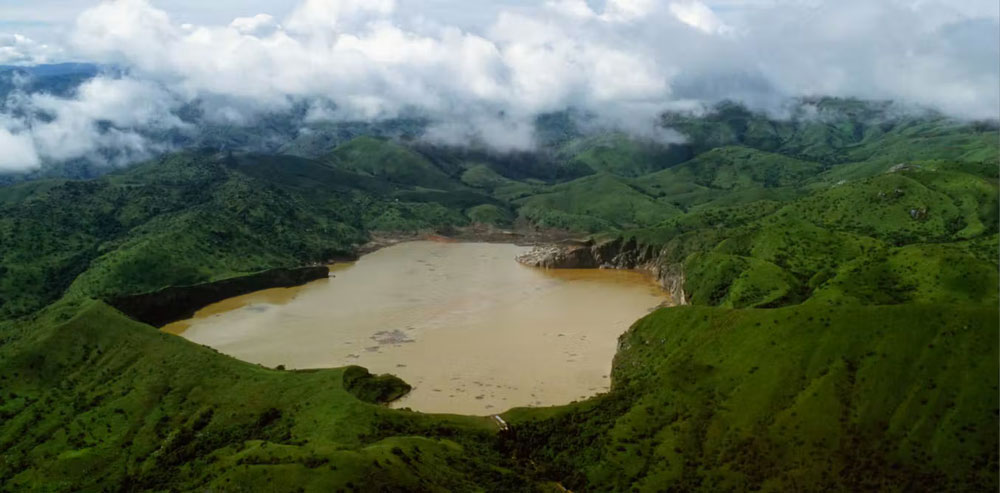
Lake Nyos looked like an ordinary volcanic lake. Then, on the night of August 21, 1986, something happened beneath its surface that turned it into a silent disaster. Carbon dioxide that had been building up for years suddenly burst from the deep water, displaced the oxygen in the air and flowed downhill through surrounding valleys. By the time people understood anything was wrong, about 1,700 had died and roughly 3,500 cattle were gone.
The Night the Lake Became a Killer
Lake Nyos sits inside an ancient volcanic crater in Cameroon’s Northwest Region. Before the disaster, more than 3,000 people lived around the area, many depending on farming and livestock, and there was no warning system suggesting that the lake itself could become dangerous.
On the night of August 21, something disturbed the lake and triggered a sudden release of gas-rich deep water. Researchers believe a landslide may have set off the chain reaction, although the precise trigger has never been established with absolute certainty.
The released gas was carbon dioxide, which normally exists harmlessly in the atmosphere. But in a massive concentrated cloud, it can displace oxygen, and because CO₂ is heavier than air, it flowed down into the surrounding valleys instead of immediately dispersing upward. Many people died in their sleep before they realized what was happening.
Nothing exploded. No fire spread. Yet about 1,700 people died overnight when an invisible cloud emerged from beneath Lake Nyos. Watch the video to see how a seemingly ordinary lake became one of the world’s strangest natural disasters—and how scientists eventually figured out what happened.
The Gas Had Been Hiding Under More Than 200 Meters of Water
The mystery became clearer when scientists studied what was happening beneath the surface. Carbon dioxide from deep underground had been dissolving into the lake for years and accumulating at depths greater than 200 meters, trapped under the enormous pressure of the water above it.
Scientists often compare the lake to a gigantic bottle of carbonated water. As long as the gas-rich deep water remains stable, the CO₂ stays dissolved; disturb that balance, and the gas can suddenly escape in a rapid chain reaction known as a limnic eruption.
That explanation also solved one of the strangest clues from the disaster. There had been no conventional explosion and no spreading fire, yet people and animals across the surrounding area died almost simultaneously. The invisible cloud had simply removed the oxygen from the air they were breathing.

Lake Monoun Had Already Given a Warning
Lake Nyos was not the first place in Cameroon to experience such a phenomenon. On August 15, 1984, about two years before the Nyos disaster, a sudden release of carbon dioxide from nearby Lake Monoun killed 37 people.
Scientists were still investigating the Monoun deaths when the much larger Nyos disaster struck. The second event made it clear that this was not simply a mysterious poisoning or an isolated accident, but a rare geological hazard associated with gas-rich volcanic lakes.
The discovery raised an even more unsettling question: if the gas could accumulate again, could Lake Nyos do the same thing twice? The answer led scientists and engineers to focus not on predicting the next eruption, but on preventing the gas from building up in the first place.
Engineers Turned the Lake Into a Pressure-Release System
In the years after the disaster, engineers installed degassing pipes in Lake Nyos. The idea was remarkably simple: bring the carbon-dioxide-rich deep water upward in a controlled way so the gas could escape gradually instead of remaining trapped until another sudden release occurred.
The system works by exploiting the pressure difference between deep water and the surface. Once gas begins escaping through the pipe, the process can continue, steadily reducing the concentration of dissolved CO₂ in the deeper layers of the lake.
Four decades later, Cameroonian geologist Isaac Konfor Njilah told DW that the lake no longer contains enough dissolved carbon dioxide to trigger a disaster of the same scale and is considered safe enough for people to return. That assessment reflects the current scientific view, although many survivors remain deeply afraid of the lake.

The Lake Is Safer. The Memory Isn’t.
For survivors, the danger was never just geological. Tsang Emelda Njah was five years old when the disaster happened, and she remembers a violent vibration in her home before the family ran outside. Others returned to villages where parents, relatives and livestock were lying dead.
Ndong Frederick Bah recalled that nine members of his family went to bed that night and that he alone survived. Entire communities were later relocated, leaving people separated from homes and ancestral land as they tried to rebuild their lives.
And even though scientists now consider Lake Nyos much safer, fear has remained. The lake once appeared harmless precisely because the danger was invisible, and that memory is difficult to erase. Meanwhile, ongoing insecurity in Cameroon’s English-speaking Northwest region has made reconstruction, scientific work and efforts to encourage people to return even more difficult.

Lake Nyos did not need fire, an earthquake or a giant wave to become deadly. For years, carbon dioxide accumulated beneath more than 200 meters of water, until a sudden disturbance released the gas in a rare limnic eruption and sent an invisible cloud through nearby valleys. The disaster killed about 1,700 people and 3,500 cattle, while the earlier Lake Monoun event showed that Cameroon faced a broader geological hazard. Engineers later installed degassing pipes to release the trapped gas gradually, and scientists now consider Lake Nyos much safer. But the real mystery of Nyos is also its warning: sometimes the most dangerous thing in nature is the thing you cannot see.