In 1845, Sir John Franklin sailed into the Arctic with 128 other men aboard two of Britain’s most advanced ships, HMS Erebus and HMS Terror. They were searching for the legendary Northwest Passage, a route that could connect the Atlantic and Pacific through the Arctic. Instead, both ships became trapped in the ice, Franklin died, and eventually every member of the expedition disappeared. For more than 150 years, explorers searched for evidence of what happened. Then, in 2014 and 2016, the two lost ships were finally found beneath Arctic waters. The discoveries answered some questions—but created others that remain unsolved.
They Sailed Into The Arctic With Everything They Thought They Needed
Franklin’s expedition was not a desperate gamble by inexperienced explorers. When the two ships left Britain in 1845, they represented the best of Victorian naval technology and preparation. Erebus and Terror were reinforced for polar conditions, had heated cabins and carried enough provisions to sustain the expedition for years. The 129 men aboard were expected to chart the Northwest Passage and return as heroes.
Franklin himself was already a famous Arctic explorer. He had survived an earlier expedition in which members of his party nearly starved, earning him the grim nickname “the man who ate his boots.” By the time he set out again at nearly 60 years old, he was hoping to complete the achievement that had eluded generations of explorers: finding a navigable route through the Arctic between the Atlantic and Pacific.
The expedition initially appeared to be progressing normally. The ships entered Lancaster Sound and continued westward into the Canadian Arctic. Then the ice closed around them.
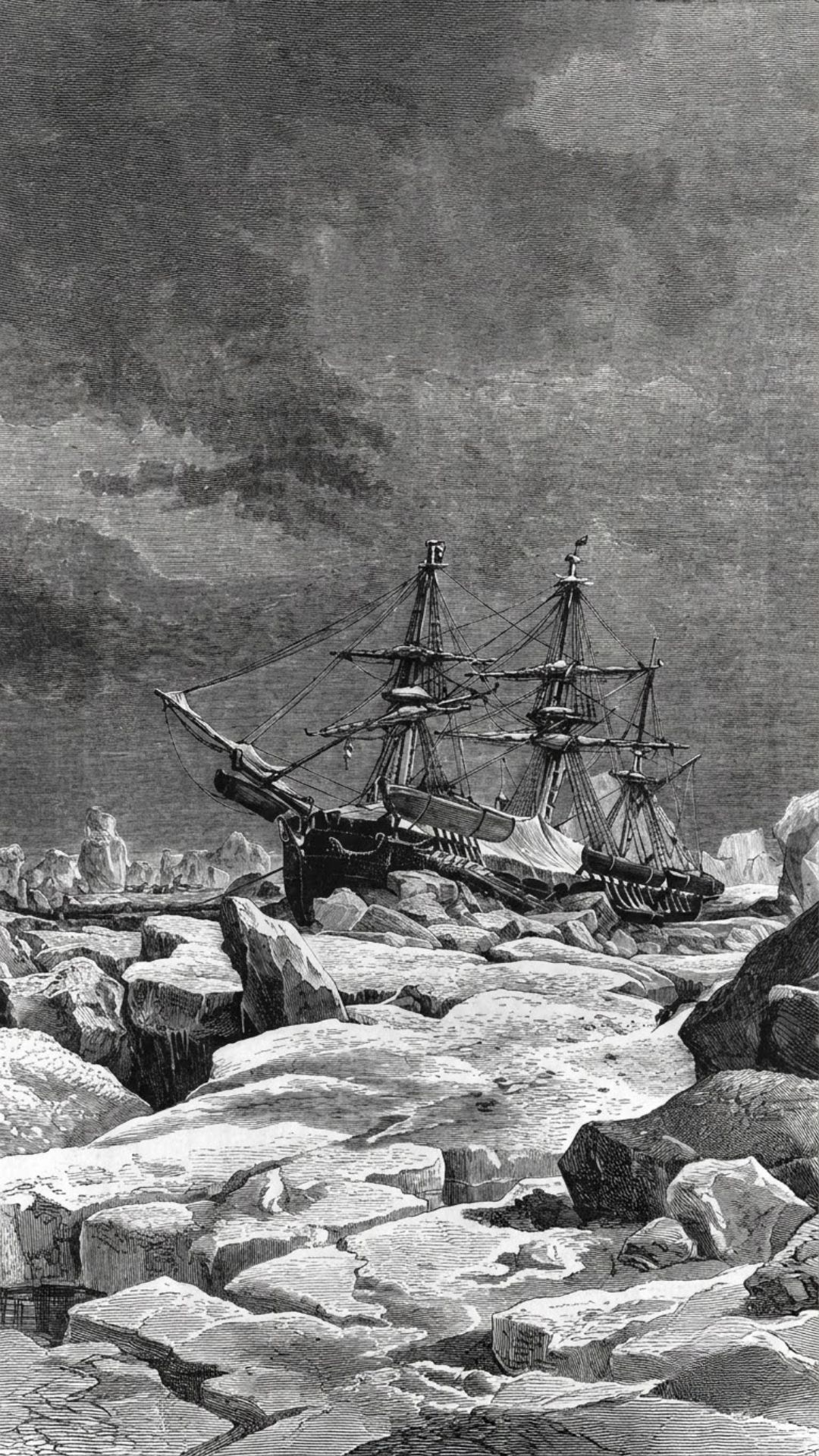
In September 1846, Erebus and Terror became trapped near King William Island. They would remain there for more than a year and a half. What began as a difficult winter became a catastrophe that would eventually consume every person on board.
Dive into the haunting mystery of the Franklin Expedition! Discover the tragic fate of the HMS Erebus and HMS Terror as they vanished into the Arctic ice. This gripping journey of exploration, survival, and discovery is a must-watch. Click the link to uncover the full, fascinating story today!
Then The Ships Stopped Moving
By June 1847, the situation had already become serious. Franklin had died, along with other members of the expedition, but the ships remained locked in the ice.
A note later found beneath a cairn provides one of the most chilling records of what happened. The original message had reported that all was well, but a later addition revealed that Franklin had died on June 11, 1847, and that 24 men had died by April 1848. The ships were then abandoned on April 22, 1848, and the remaining men planned to travel overland toward the Back River.
That decision marked the beginning of the expedition’s final journey.
More than 100 men were now attempting to cross one of the most unforgiving environments on Earth on foot. They dragged heavy boats and equipment across the ice, hoping eventually to reach areas where they could find food or make contact with other people. But the men were weakened by disease, hunger and the brutal Arctic environment.
They never reached safety.
Later expeditions found graves, scattered bones and abandoned equipment along the route. Inuit accounts described starving European sailors moving across the region, and forensic examinations of some remains eventually confirmed evidence consistent with cannibalism. The revelation was shocking to Victorian Britain, which had initially struggled to accept the Inuit testimony. The men had not simply vanished. They had died slowly, far from home, while trying to escape the frozen ships.

For More Than A Century, Nobody Could Find The Ships
The disappearance became one of the great mysteries of the age of exploration.
Search parties began looking for Franklin’s expedition while there was still some hope that survivors might be found. Over the following decades, explorers recovered fragments of clothing, equipment, bones and other objects. But the two most important pieces of evidence remained missing: Erebus and Terror.
The search eventually became enormous. Lady Jane Franklin, the explorer’s determined wife, pressured the British government to continue looking for her husband and even helped finance expeditions herself. Her campaign became one of the most extraordinary missing-person searches of the nineteenth century. She even turned to spiritualists and clairvoyants in the hope of somehow communicating with Franklin.
But the Arctic kept its secret.
One reason the search was so difficult was the sheer scale of the environment. The region around King William Island is vast, remote and frequently covered by ice. A wooden ship could disappear beneath the surface and leave almost no obvious trace.
There was another problem: researchers had often overlooked one of the most valuable sources of information available to them.
For generations, Inuit communities had preserved oral accounts describing encounters with Franklin’s men and the abandoned ships. In the modern search, Inuit knowledge became increasingly important. Louie Kamookak, an Inuit researcher from Gjoa Haven, spent years collecting and studying these oral histories, helping researchers connect stories passed down through generations with locations on the Arctic landscape. That collaboration would eventually change the search.
Then They Saw A Ship Beneath The Water
In 2014, Canadian researchers began another major effort to locate the missing vessels. They combined modern sonar and marine archaeology with historical research and Inuit knowledge.
On September 2, the search team was scanning the seafloor when an image suddenly appeared on the sonar screen. It was a ship.
Not a few scattered timbers. Not a fragment of wreckage. An intact vessel was sitting on the bottom of the Arctic sea.It was HMS Erebus.
The discovery was astonishing. The ship had been missing for approximately 168 years, yet it remained remarkably well preserved in the cold water. Archaeologists could still identify major features of the vessel, turning what had been a historical mystery into a physical archaeological site. But one ship was still missing.
Then, in 2016, a remarkable tip from an Inuk hunter helped direct researchers toward an area they had not expected to search successfully. The research vessel Martin Bergmann passed over a wreck while traveling to meet the main search team. Archaeologists investigated and confirmed what they were looking at. It was HMS Terror. After 170 years, both ships had been found.

Finding The Ships Solved One Mystery—And Created Another
The discovery of Erebus and Terror transformed the Franklin story, but it did not provide a simple ending.
Instead, the wrecks became time capsules.
The ships could potentially contain documents, personal objects and other evidence that might reveal what happened during the final months of the expedition. The cold Arctic water had preserved parts of the vessels remarkably well, raising the possibility that archaeologists might eventually recover clues that had been lost for more than a century and a half.
Even the location of the wrecks raised questions.
Why was Terror found so far from where researchers had expected it to be? What happened to the ships after they were abandoned? Why did some Inuit accounts describe encounters with the vessels that seemed impossible to reconcile with the assumptions of nineteenth-century British investigators?
And perhaps most hauntingly: where was Franklin himself?
Some Inuit oral histories describe a possible grave or cairn on King William Island. Louie Kamookak believed finding Franklin’s final resting place could provide another opportunity to understand what happened to the expedition. A grave might potentially contain documents or other clues that could illuminate the missing chapters of the story.
Modern science is also slowly bringing individual members of the expedition back into the historical record.
In 2026, researchers announced DNA identifications of four additional sailors, bringing the number of expedition members conclusively identified through DNA analysis to six. The newly identified men included William Orren, David Young and John Bridgens from Erebus, along with Harry Peglar from Terror. That may sound like a small number compared with 129 men. But each identification gives researchers another name, another life and another piece of the final story.
The Lost Expedition Still Has No Final Ending
Today, we know far more about Franklin’s expedition than the Victorians did.
We know that Erebus and Terror became trapped in Arctic ice. We know that Franklin died before the ships were abandoned. We know that the remaining men attempted to escape overland and that none survived. We know that some of the remains show evidence consistent with cannibalism. We know where both ships came to rest, and modern DNA research is beginning to identify individual members of the expedition.
Yet the central mystery has never completely disappeared.
We still do not have a complete account of those final months. Franklin’s personal records have never been recovered, and many of the expedition’s dead remain unidentified. The exact sequence of events after the ships were abandoned remains incomplete.
That is what makes the Franklin expedition so compelling more than 180 years later.
It began as a story about exploration and ambition. It became a story about survival, starvation and death. Then it became one of the greatest archaeological mysteries in history.
And even after the two lost ships were finally found, the Arctic still had one last secret to keep. We found Erebus. We found Terror. But we still do not have the full story of what happened to the 129 men who sailed north with them.
In 1845, 129 men sailed into the Arctic aboard HMS Erebus and HMS Terror, hoping to complete one of the greatest challenges of the age of exploration. Instead, the ships became trapped in ice, Franklin died, the vessels were abandoned and every member of the expedition eventually perished. For more than 150 years, searchers found only fragments of the story. Then Erebus was discovered in 2014 and Terror in 2016. Modern archaeology and DNA have answered some questions, but not all. The ships have returned from the darkness. The final story of their crews has not.
This story draws primarily on National Geographic’s reporting about the Franklin expedition and the extraordinary search for HMS Erebus and HMS Terror. Additional information from Parks Canada and recent 2026 DNA research helps bring the story up to date, showing how Inuit knowledge, underwater archaeology and modern genetics are still revealing new details about one of history’s most famous lost expeditions. Source: https://www.nationalgeographic.com/adventure/article/franklin-expedition-ship-watson-ice-ghosts