Walk into an American supermarket and you may find vegetables labeled “yams” that are actually sweet potatoes. The confusion goes far beyond a simple grocery-store mistake, tracing a fascinating path through botany, African food traditions, migration, American agriculture and marketing. From Thanksgiving tables to international markets, the story of these two very different roots reveals how a familiar food name can travel across cultures, change meaning and eventually become part of everyday American life.
The Vegetable Many Americans Call by the Wrong Name
Walk into an American supermarket and you may see a familiar sight: bins filled with sweet, earthy-looking vegetables labeled “yams.” Perhaps you have bought them for a Thanksgiving casserole without giving the name a second thought. But there is a surprising detail hiding in that label. What many Americans call yams are often actually sweet potatoes.
That raises a more interesting question: If they aren’t the same vegetable, why have Americans been calling sweet potatoes “yams” for so long?
Botanically, the two are very different. Sweet potatoes, scientifically known as Ipomoea batatas, belong to the morning glory family. True yams belong to the genus Dioscorea and the Dioscoreaceae family. They are not closely related plants, despite the names often being used interchangeably in American grocery stores.
Even the parts of the plants that store their energy are different. A sweet potato is an enlarged storage root, while a true yam is an underground tuber—a thickened underground stem.
So this is not simply a case of supermarkets getting their labels wrong. The confusion has a much deeper story involving migration, African food traditions and the way sweet potatoes were marketed in the United States.
Which raises an even more intriguing question the next time you see a bin labeled “yams”: what exactly is sitting there?

Two Roots, Two Very Different Plants
They Look Similar — But They Grow Differently
Despite being treated as interchangeable in American grocery stores, sweet potatoes and true yams are very different plants. Sweet potatoes belong to the morning-glory family, Convolvulaceae, and are dicots. The part we eat is an enlarged storage root. True yams, by contrast, belong to the Dioscoreaceae family and are monocots. What we eat is an underground tuber—a thickened underground stem.
Their growing habits are different, too. A sweet potato plant can typically produce around four to 10 storage roots, while a yam plant may produce roughly one to five tubers. Sweet potatoes can mature in about three to five months, whereas some yams may take six months to a year to reach maturity.

The Easiest Way to Tell Them Apart
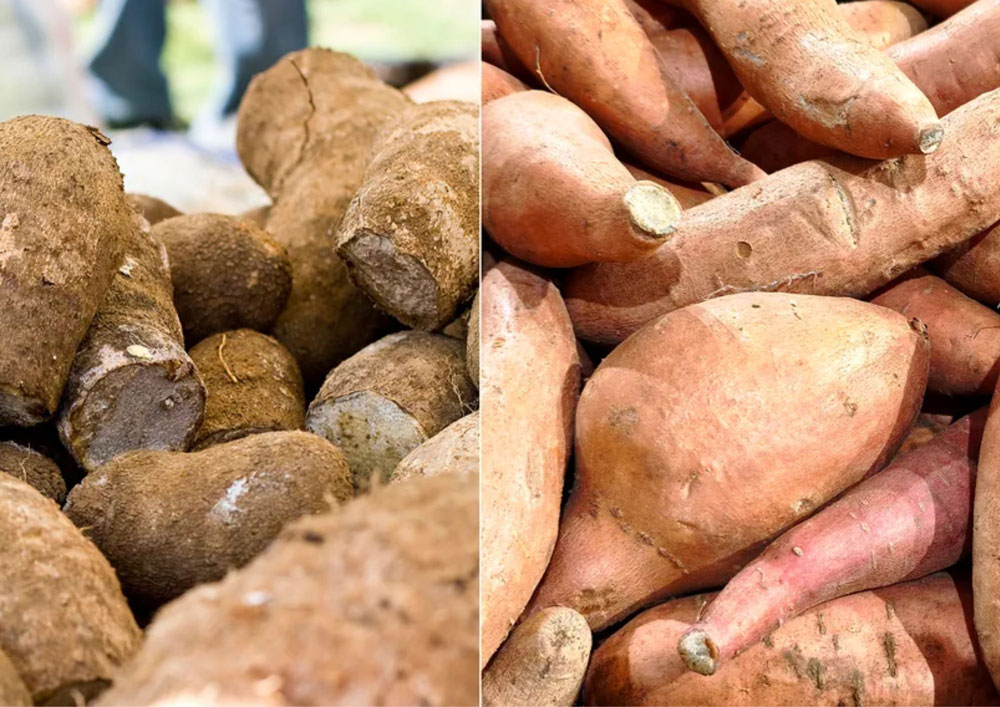
Once you know what to look for, the physical differences become much easier to spot. Sweet potatoes are generally shorter and more compact, with relatively smooth, thin skin and tapered ends. Their flesh can range from orange and yellow to white or purple, depending on the variety.
True yams are usually longer and more cylindrical, with thick, rough skin that can resemble tree bark. Some varieties even have small protrusions that look almost like toes. Their flesh may be white, purple or reddish, depending on the species.
In other words, these are not simply two names for the same vegetable. They belong to different plant families, grow differently and have noticeably different appearances.
And yet, the labels at an American supermarket can make these two completely different plants look like the same food. That curious naming confusion has a history of its own.
Think you know the difference between a yam and a sweet potato? Watch the video below to see how these two very different roots compare—and why Americans so often confuse them.
Why Americans Started Calling Sweet Potatoes “Yams”
An African Word Crossed the Atlantic
The confusing name has a history that reaches far beyond the produce aisle. True yams were an important food in West Africa, and yams were among the familiar foods used to feed enslaved people during voyages from West Africa to the Americas. Once in mainland North America, however, African yams were difficult to grow in many plantation regions. Sweet potatoes could serve as a substitute staple, and the similarities between the two eventually blurred the language used to describe them.
This does not mean enslaved Africans simply “renamed” sweet potatoes. The story was more gradual. As people carried food traditions and vocabulary across the Atlantic, the word yam came to be used colloquially for both crops in parts of mainland America. Food, language and agricultural circumstances gradually turned two different plants into two names that could refer to the same thing in everyday conversation.
Then Marketing Made the Confusion Permanent
American sweet potato producers later gave the confusing terminology another push. Orange-fleshed, moist varieties were often marketed as “yams” to distinguish them from drier, white-fleshed sweet potatoes. The name became familiar enough that varieties such as “Garnet yams” and “Jewel yams” are still commonly sold under those labels—even though both are actually sweet potatoes.
That helps explain why the confusion remains so persistent. A shopper can encounter a vegetable labeled “yam” that is botanically a sweet potato, while true yams are generally found in international and specialty markets.
The confusion wasn’t created by botany. It was created by history, language and eventually marketing.

What You’re Actually Buying at Thanksgiving
The “Yams” in Your Supermarket
Thanksgiving is perhaps the perfect time to notice America’s long-running yam confusion. Dishes such as candied yams are a familiar part of holiday tables, yet the vegetables used in many of these recipes are actually sweet potatoes. In a typical American supermarket, a bin labeled “yams” is also very likely to contain a variety of sweet potato rather than a true yam.
You could walk into a grocery store, pick up something labeled “yam,” take it home, cook it for Thanksgiving dinner and never realize that, botanically speaking, you never bought a yam at all.
True yams are generally easier to find in international markets, African grocery stores, Caribbean markets and specialty produce shops. For shoppers who know the difference, the label can therefore be an important clue—but not necessarily a reliable botanical identification.
Does the Difference Matter in the Kitchen?
It can, because the two vegetables behave differently when cooked. Sweet potatoes tend to be sweeter, moister and creamier, making them well suited to baking, mashing and the rich casseroles commonly associated with American holiday meals.
True yams are generally starchier, drier and earthier, with a texture that can be closer to a potato. They are not necessarily better or worse; they simply bring different characteristics to the kitchen.
There is also an important safety distinction. Some true yam varieties contain naturally occurring compounds that can be harmful when the tubers are eaten raw, which is why appropriate cooking is important.
So while the names may be interchangeable in everyday American conversation, the ingredients themselves are not. Knowing which one you have can change both the way you cook it and what you should expect when it reaches the plate.

The Bigger Story Behind a Simple Grocery Label
A simple question—“Are yams and sweet potatoes the same thing?”—turns out to lead much further than the produce aisle.
The answer begins with botany, but the story does not end there. It moves through migration, African food traditions, American agriculture, marketing and eventually one of the country’s most familiar food traditions: Thanksgiving.
The most fascinating part is not simply that yams and sweet potatoes are different plants. It is how a word can change meaning as it travels across an ocean, enters another culture and becomes part of a new food system.
For generations, Americans have used “yam” as a familiar name for certain sweet potato varieties, particularly those with orange flesh and a softer, sweeter texture. The terminology became so common that many shoppers can encounter a vegetable labeled “yam” without realizing that, botanically, it is a sweet potato.
That makes the grocery-store label more than just a description of what’s inside the bin. It is a small reminder of how food traditions evolve. Ingredients travel, languages adapt, markets reshape terminology and eventually, those changes can become so familiar that we forget there was ever another story behind them.
The next time you see a “yam” at an American grocery store, you may want to look twice. The label might say yam—but the story underneath it is much more complicated.
The difference between a yam and a sweet potato may seem like a small detail, but the story behind their names reveals something much bigger about American food culture. Plants travel, words change and traditions evolve as they move between people and places. What Americans call a “yam” today is often a sweet potato shaped by generations of history, agriculture and marketing. So the next time one appears on a Thanksgiving table, remember that beneath the familiar name is a story that traveled far beyond the grocery store.