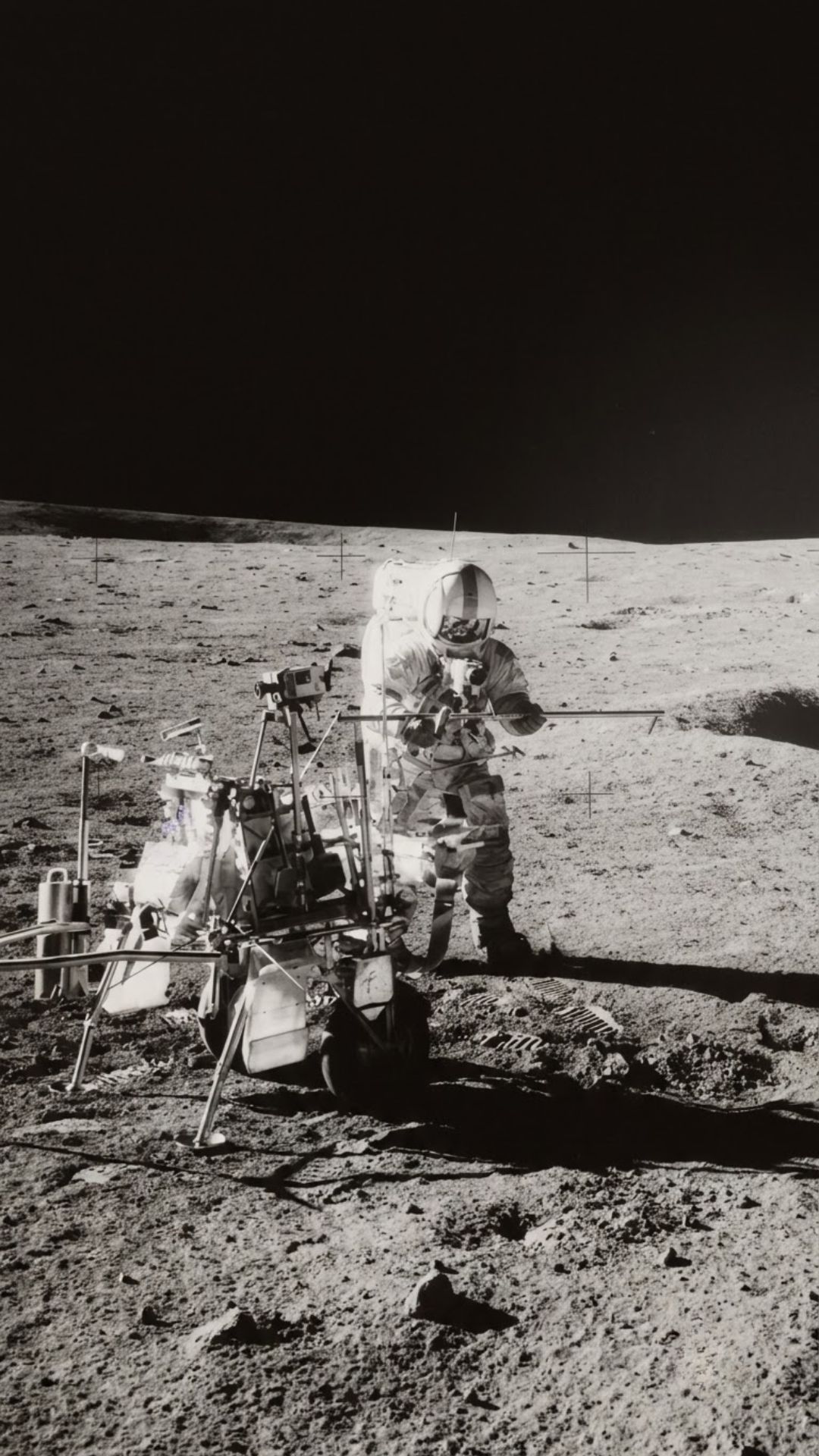
In February 1971, Apollo 14 astronaut Alan Shepard stood on the Moon in a bulky pressure suit, reached into a tube sock and pulled out something nobody expected to see there: a golf ball and a makeshift six-iron. NASA had nearly rejected the idea because the Apollo program was under intense scrutiny, but Shepard eventually received permission to try it at the very end of the mission. What followed was one of the most recognizable moments in spaceflight—a golfer attempting a swing in one-sixth gravity, using a club built from a real golf-club head and a lunar sampling tool.
Alan Shepard Had An Unusual Idea For The Moon
Shepard was not simply an astronaut who happened to play golf. He was an avid golfer, and while preparing for Apollo 14 he began thinking about what the sport might look like in an environment with radically different gravity and no atmosphere. During a visit involving comedian and golfer Bob Hope at NASA, the idea became more concrete: a golf shot could turn a familiar activity into a simple way of demonstrating how objects behave differently on the Moon.
Apollo 14 was scheduled to land at the Fra Mauro highlands, with Shepard and Edgar Mitchell conducting two lunar surface excursions. The mission was serious scientific work, including collecting lunar samples and deploying experiments. Shepard’s golf idea was therefore not intended to replace the mission’s objectives; he planned it as a brief personal experiment after the essential work was complete.
Witness history in the making! Watch legendary Apollo 14 Commander Alan Shepard perform the ultimate lunar stunt: the first-ever golf shot on the Moon. Experience this iconic moment from 1971 as he tees off in low gravity, famously declaring the ball went “miles and miles.” Click to watch this incredible footage!
NASA Almost Said No To The Golf Club
Getting the golf club to the Moon was not as easy as simply putting it in Shepard’s luggage. Manned Spaceflight Center director Robert Gilruth initially rejected the idea, concerned that Apollo was already facing criticism over its enormous cost and that an astronaut visibly playing golf could make the program appear less serious. The previous year’s Apollo 13 accident had only increased pressure on NASA to demonstrate that it could safely accomplish another lunar landing.
Shepard eventually persuaded NASA by proposing a remarkably simple solution. He would carry only a modified club head and two golf balls, with no significant cost to the program, and he promised not to attempt the shot unless the rest of the mission went according to plan. That condition explains why the golf game appeared only at the end of the second lunar excursion, just before the astronauts returned to the lunar module.
He Built A Golf Club That Worked With A Spacesuit
The club Shepard carried was not a normal golf club. He took the head of a Wilson Staff six-iron and attached it to the handle of a contingency sample-return tool that was already part of the mission’s equipment. He also carried two golf balls in a tube sock, keeping the entire setup compact enough to fit within the constraints of lunar operations.
The spacesuit itself created the biggest mechanical problem. The pressurized suit was stiff enough that Shepard could not make a conventional two-handed golf swing, so he had to swing with one hand. He had practiced the movement beforehand while wearing his pressure suit and life-support equipment, trying to develop a technique that would actually work once he was standing on the Moon.
It was a perfect example of Apollo-era improvisation: rather than designing an entirely new piece of equipment, Shepard adapted something already available and changed the way he used it.
The First Swings Were Hardly Perfect
When the moment finally arrived on February 6, 1971, Shepard stood in front of the television camera and explained to mission control that the handle in his hands was the contingency sample-return device—with a genuine six-iron on the bottom. Then he dropped a golf ball onto the lunar surface.
His first attempt was largely a swing through dust. Edgar Mitchell immediately joked that Shepard had hit more dirt than ball, and communicator Fred Haise later teased him about slicing the shot. Shepard then tried again before finally connecting properly with the first ball.
NASA’s historical account records that the successful shot with the first ball traveled about 24 yards and landed in a nearby crater. Shepard then hit the second ball, which traveled about 40 yards toward the Apollo Lunar Surface Experiments Package. So while his famous description that the second ball went “miles and miles and miles” became part of the legend, the actual measured distance was much shorter.

The Moon Changed What The Golf Ball Could Do
The short distance did not make the experiment meaningless. The Moon’s gravity is only about one-sixth as strong as Earth’s, and the lunar surface has essentially no atmosphere. That means the ball experienced much less gravitational acceleration after leaving the club and no ordinary atmospheric drag during its flight.
Shepard was interested in precisely that difference. A golf ball is something people understand intuitively, so watching it move through the lunar environment offered a surprisingly accessible demonstration of basic physics. The shot also showed how difficult it could be to perform an ordinary Earth activity while wearing a pressurized spacesuit on another world.
There was another consequence: the golf balls would not come home. They remained on the lunar surface, becoming some of the strangest pieces of sports equipment ever left outside Earth.
The Golf Club Became Part Of Apollo History
The little experiment lasted only moments, but it became one of the most memorable images from Apollo 14. Smithsonian curator Teasel Muir-Harmony has noted that the golf club is striking precisely because it is so familiar; seeing such an ordinary object on the Moon reminds people that Apollo was a human mission, carried out by people who brought their personalities, interests and curiosity with them.
The original club head eventually went to the U.S. Golf Association’s museum in New Jersey, while Shepard donated a replica to the Smithsonian in 1975. The National Air and Space Museum still holds that replica as part of its collection.
The golf balls, meanwhile, remain where Shepard left them. That gives the story an unusual ending: the club returned to Earth and became a museum artifact, while the actual balls stayed on another world.
Alan Shepard’s golf shot remains memorable because it combined something completely ordinary with one of humanity’s most extraordinary achievements. In the middle of a carefully planned lunar mission, an astronaut used a modified six-iron to hit two golf balls across the Moon, turning a familiar sport into a demonstration of life in one-sixth gravity. NASA had nearly rejected the idea, yet the brief experiment became part of Apollo’s cultural legacy. The golf club is now preserved on Earth, while the two balls remain on the Moon—a fitting reminder of how human exploration can be both highly technical and unexpectedly playful.
The original Smithsonian story offers a detailed look at how Alan Shepard brought golf to the Moon, why NASA initially resisted the idea and how the makeshift club was designed for use with his spacesuit. NASA’s historical records add the technical details of the Apollo 14 mission and the actual distances traveled by the two golf balls. Source: https://www.smithsonianmag.com/smithsonian-institution/when-astronaut-alan-shepard-hit-golf-shot-heard-round-world-180976903/