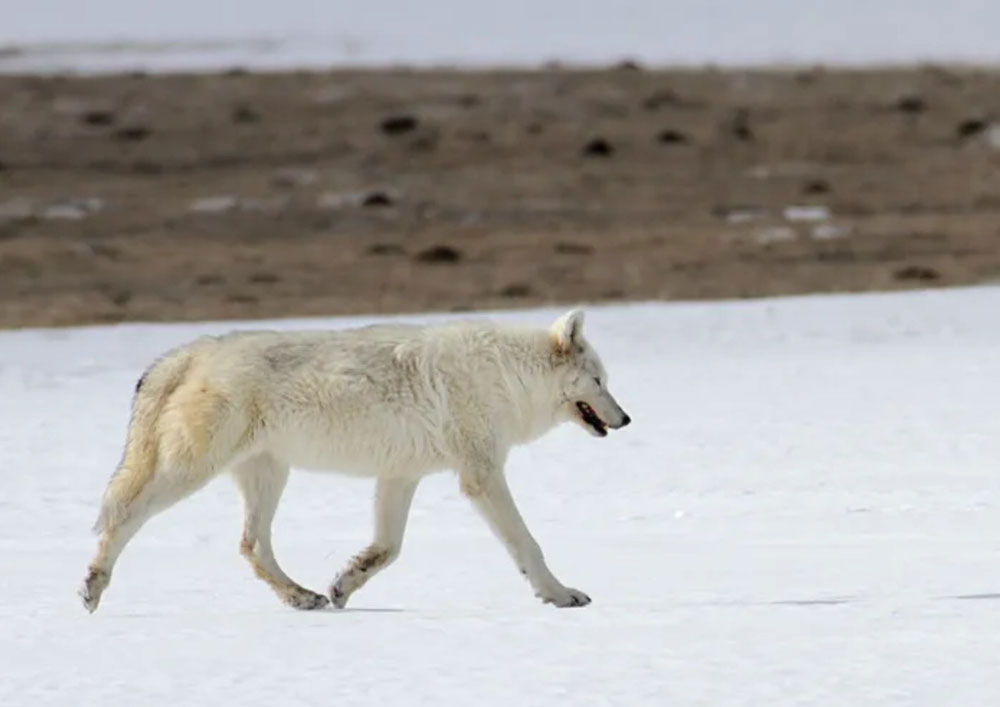
For decades, Americans saw wolves as predators that threatened livestock, wildlife and human interests. Today, people wake before sunrise in Yellowstone, setting up spotting scopes and waiting patiently for a glimpse of a wild wolf. How did an animal once hunted to near disappearance become a symbol of wilderness and one of Yellowstone’s most sought-after sights? The answer is a remarkable story of changing attitudes, conservation, controversy and America’s evolving relationship with the wild.
The Wolf That Went From Public Enemy to Yellowstone Icon
How did an animal once treated as a public enemy become one of Yellowstone’s biggest attractions?
On a cold morning in Lamar Valley, visitors may stand quietly along the roadside, binoculars and spotting scopes pointed toward the distant hills. They are not waiting for a famous landmark or a spectacular waterfall. They are hoping to catch a glimpse of a wolf.
That scene would have been difficult to imagine less than a century ago. Today, people travel to Yellowstone specifically hoping to see wolves in the wild. But for much of American history, wolves were viewed very differently—as predators that threatened livestock, competed with hunters and needed to be eliminated.
Wolves once occupied much of North America. As American agriculture and ranching expanded westward, encounters between wolves, livestock and people became increasingly common. Predator-control campaigns followed, dramatically reducing wolf populations across much of their historic range.
Yellowstone became one of the clearest examples of this shift. By the early 20th century, wolves had been systematically eliminated from the park. According to the National Park Service, the last known wolf pack in Yellowstone was killed in 1926.
For decades afterward, wolves were largely absent from the landscape. But American attitudes toward predators gradually began to change, as conservation increasingly emphasized protecting entire ecosystems rather than simply removing animals considered undesirable.
That change eventually placed Yellowstone at the center of one of America’s most remarkable wildlife conservation stories—and set the stage for the wolf’s unexpected return.

How America Tried to Get Rid of the Wolf
What happens to a national park when one of its top predators disappears? The answer is more complicated than simply having fewer wolves. When Yellowstone lost its wolves, an important part of the ecosystem—and America’s understanding of predators—began to change.
When Wolves Became the Enemy
During the 19th and early 20th centuries, America’s expansion westward brought settlers, ranchers and livestock into landscapes where wolves had long lived. As cattle and sheep became increasingly common, wolves were sometimes viewed as a direct threat to ranching. They also competed with hunters for wild game, making them an unwanted presence from several perspectives.
The response was increasingly aggressive. Hunters, ranchers and government agencies participated in predator-control efforts designed to reduce or eliminate wolves and other predators. Yellowstone was not exempt from this approach. In the early years of the national park, wolves were considered animals that needed to be controlled rather than an essential part of the ecosystem.
The effort was remarkably successful from the perspective of those who wanted fewer wolves. By the middle of the 20th century, wolves had disappeared from most of their historic range in the contiguous United States, including Yellowstone.

Yellowstone Without Wolves
By 1926, the last known wolf pack in Yellowstone had been killed. Wolves occasionally appeared afterward, but there was no longer a resident population maintaining a continuous presence in the park.
Yellowstone did not suddenly stop functioning. Elk remained, vegetation continued to grow and the park’s other wildlife survived. But removing a top predator meant removing one important relationship from an ecosystem whose parts were interconnected.
Over the following decades, American thinking about wildlife management began to change. The 1963 Leopold Report helped advance the idea of managing ecosystems rather than simply maximizing individual game species, while the Endangered Species Act of 1973 provided stronger federal protection for threatened wildlife.
Those changes eventually raised a question that earlier generations had rarely considered: instead of asking how to keep wolves out of Yellowstone, should America find a way to bring them back?
For decades, wolves were gone from Yellowstone. Then America made the controversial decision to bring them back. Watch the video below from 60 Minutes Archive to see the wolves of Yellowstone up close—and discover why their return became one of the most debated wildlife stories in American conservation:
The Return of the Wolves — And the Debate That Followed
carefully planned conservation experiment—and one that immediately raised difficult questions about who should decide what belongs in the American West.
The 1995 Experiment
In January 1995, the first 14 gray wolves were brought into Yellowstone from western Canada. They were temporarily held in acclimation pens before being released, allowing the animals to adjust to their new surroundings. A second group of 17 arrived in 1996. Each social group was kept together, and the wolves were fitted with radio collars so biologists could track their movements and study how they adapted.
The project continued in 1997, when 10 wolves from northwestern Montana were relocated. Altogether, 41 wild wolves from Canada and northwestern Montana were released in Yellowstone between 1995 and 1997.
The scale of the planning reflected how controversial the idea was. Before the first wolves arrived, the federal government had completed an Environmental Impact Statement that received more than 160,000 public comments. The wolves were also classified as a “nonessential experimental population” under the Endangered Species Act, giving managers additional flexibility in dealing with the concerns surrounding their return.
Not Everyone Wanted Them Back
For some ranchers and local interests, bringing wolves back raised practical concerns. Wolves could leave the park, encounter livestock and affect hunting interests. Those concerns did not disappear simply because the animals were inside Yellowstone.
The reintroduction also became a legal battle. In December 1997, a federal judge ordered the removal of the reintroduced wolves, concluding that the program violated certain provisions of the Endangered Species Act. The order was stayed while the government appealed. In January 2000, a federal appeals court reversed the lower court’s decision, allowing the reintroduction program to continue.
involved science, conservation goals, ranching concerns, federal law and competing ideas about what the modern American West should look like.
And that makes Yellowstone’s wolf story much more interesting than a simple conservation success story.

Why Yellowstone’s Wolves Became a Cultural Icon
Today, Yellowstone’s wolves have become something of a destination within a destination. In Lamar Valley, visitors arrive before sunrise, park along the road and set up spotting scopes, sometimes waiting quietly for hours for a distant pack to appear. The National Park Service describes the northern range as one of the best places in the world to watch wolves, while generations of “wolf watchers” have developed their own informal culture around observing the animals respectfully.
There is something remarkable about that scene. An animal that Americans once tried to eliminate has become one of the most sought-after sights in one of the country’s most famous national parks.
Yellowstone has also become an extraordinary natural laboratory. Since their reintroduction, researchers have followed individual wolves and packs for decades, studying their biology, social behavior, relationships with prey and interactions with other predators. The wolves’ kills also provide food for scavengers ranging from ravens and coyotes to bears and countless smaller organisms.
But the ecological story is more complicated than the popular version sometimes suggests. Wolves clearly influence elk and other parts of the food web, yet scientists caution against claiming that wolves alone transformed Yellowstone. Weather, human hunting, other predators and changes in vegetation all affect elk populations, and the National Park Service notes that the precise role of wolves in long-term elk dynamics remains debated.
That complexity makes the wolf’s cultural transformation even more interesting. The animal has come to represent wilderness, the American frontier and conservation.
The wolf’s greatest transformation may not have happened in the wilderness at all. It happened in the way Americans learned to see the animal.

The story of Yellowstone’s wolves is more than a conservation success story. It is a reminder that America’s relationship with nature can change dramatically over time. A predator once hunted across the country became an animal people now travel to Yellowstone hoping to see. The wolf’s return did not erase the debates surrounding ranching, wildlife management or ecology, but it changed how many Americans viewed the species. From public enemy to cultural icon, the wolf became a symbol of a wild America worth preserving.